Practise 15 exam-style questions on Energy transfers in a system for AQA GCSE Combined Science (Physics Paper 1). Write your answer as you would in the exam and get it marked in seconds against the mark scheme, point by point, with the Study Helper on hand if you get stuck.
15 questions
1–6 marks each
Instant marking
No sign-up needed
15 questions, marked as you go
Sample questions with model answers
Here are 4 of the questions in this topic, each with a model answer, an explanation of why it earns the marks and the mark scheme an examiner would use.
Question 1
2 marks
Explain what is meant by the statement 'energy is dissipated', and why dissipated energy is often described as wasted.
Model answer
Dissipated energy has spread out into the surroundings, usually into the thermal energy store of the air around the device. It is described as wasted because once it is spread out like this it is stored in a less useful way and cannot easily be used for anything useful.
Explanation
In every energy transfer some energy is dissipated. The energy still exists, but it is spread so thinly that it only warms the surroundings slightly, so it is no longer useful to us.
Mark scheme
1 mark
energy spreads out into the surroundings / is transferred to the thermal energy store of the surroundings
1 mark
it is stored in less useful ways / it cannot easily be used again for a useful purpose
allow it only raises the temperature of the surroundings by a tiny amount
Question 2
2 marks
Many saucepans have a steel or copper base and a wooden handle.
Explain why these materials are used, in terms of thermal conductivity.
Model answer
Steel and copper have high thermal conductivities, so energy is transferred quickly by conduction through the base to the food. Wood has a low thermal conductivity, so energy is transferred only slowly along the handle, and it stays cool enough to hold.
Explanation
A high thermal conductivity gives a high rate of energy transfer by conduction, which is what you want for the base. A low thermal conductivity gives a low rate, which is what you want for the handle.
Mark scheme
1 mark
the metal base has a high thermal conductivity, so energy is transferred quickly from the cooker to the food
1 mark
the wood has a low thermal conductivity, so energy is transferred slowly through the handle and it stays cool enough to hold
allow the handle does not burn the cook's hand
Question 3
3 marks
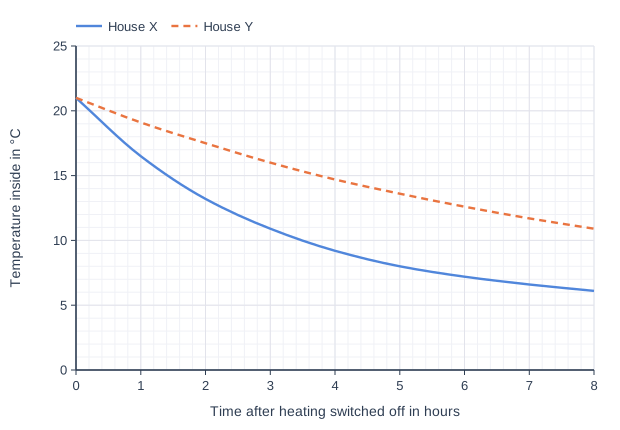
Two houses, X and Y, are identical except for their walls. On a cold night the heating in both houses is switched off at the same time. The graph shows how the temperature inside each house changes.
Which house has walls with the lower thermal conductivity? Explain your answer using the graph.
Model answer
House Y. The temperature inside house Y falls more slowly than in house X (after 8 hours Y is at about 11 °C but X is at about 6 °C), so house Y has a lower rate of cooling. This means energy is transferred through its walls at a lower rate, so its walls have a lower thermal conductivity.
Explanation
The rate of cooling of a building depends on the rate of energy transfer through its walls. A lower thermal conductivity (or thicker walls) means a lower rate of energy transfer, so the temperature inside falls more slowly.
Mark scheme
1 mark
house Y
1 mark
the temperature in Y falls more slowly / Y has a lower rate of cooling
allow after 8 hours Y is at about 11 °C and X at about 6 °C; allow Y's graph is less steep
1 mark
so the rate of energy transfer through Y's walls is lower, which means a lower thermal conductivity
Question 4
4 marks
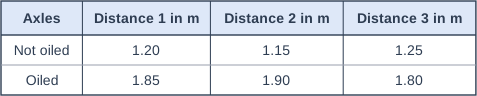
A student released a toy trolley from the same point on a ramp three times. Each time she measured the distance it rolled along the floor before stopping. She then oiled the trolley's axles and repeated the experiment. The table shows her results.
Calculate the mean distance for each set of results and explain what the results show about lubrication.
Model answer
Mean without oil = (1.20 + 1.15 + 1.25) ÷ 3 = 1.20 m Mean with oil = (1.85 + 1.90 + 1.80) ÷ 3 = 1.85 m The trolley travels further when the axles are oiled. The oil lubricates the axles and reduces friction, so less energy is dissipated to thermal energy stores for each metre the trolley travels. The trolley starts with the same kinetic energy each time, so it can travel further before all its energy has been dissipated.
Explanation
The trolley starts from the same height, so it has the same energy each time. Lubrication reduces the unwanted energy transfer caused by friction, so the energy is dissipated over a longer distance. Repeating and calculating a mean makes the comparison more reliable.
Mark scheme
1 mark
mean without oil = (1.20 + 1.15 + 1.25) ÷ 3 = 1.20 (m)
1 mark
mean with oil = (1.85 + 1.90 + 1.80) ÷ 3 = 1.85 (m)
1 mark
the trolley travels further when the axles are oiled
1 mark
because the oil reduces friction, so less energy is dissipated (as thermal energy) for each metre travelled
allow the kinetic energy at the bottom of the ramp is dissipated more slowly
Ready to try the rest? Every answer you write is marked against the mark scheme, so you can see exactly where the marks are.
Ctrl + Enter to check
Study HelperHints first, answers after you try
Stuck on this one? Ask for a hint and I’ll point you in the right direction, without giving the answer away. Once you’ve checked your answer, I’ll show you how the marks are awarded.