Practise 18 exam-style questions on The development of the model of the atom for AQA GCSE Combined Science (Physics Paper 1). Write your answer as you would in the exam and get it marked in seconds against the mark scheme, point by point, with the Study Helper on hand if you get stuck.
18 questions
1–6 marks each
Instant marking
No sign-up needed
18 questions, marked as you go
Sample questions with model answers
Here are 4 of the questions in this topic, each with a model answer, an explanation of why it earns the marks and the mark scheme an examiner would use.
Question 1
2 marks
Describe the plum pudding model of the atom.
Model answer
The plum pudding model suggested that the atom is a ball of positive charge with negatively charged electrons embedded in it.
Explanation
In the plum pudding model there is no nucleus: the positive charge and the mass are spread out through the whole atom, and the electrons are scattered through it like plums in a pudding.
Mark scheme
1 mark
the atom is a ball of positive charge
allow positive charge spread throughout the atom
1 mark
with (negative) electrons embedded in it
allow electrons scattered through it / dotted through it
Question 2
2 marks
Give the name of the particle whose existence was shown by the experimental work of James Chadwick, and state where this particle is found.
Model answer
James Chadwick's work provided the evidence for neutrons, which are found in the nucleus.
Explanation
Chadwick's evidence for the neutron came about 20 years after the nucleus became an accepted scientific idea. It explained why the mass of most nuclei is greater than the mass of their protons alone.
Mark scheme
1 mark
neutron
1 mark
in the nucleus
Question 3
3 marks
The model of the atom has changed several times since scientists first thought atoms were tiny spheres that could not be divided.
Explain why scientific models of the atom change. Use one example in your answer.
Model answer
Scientific models change when new experimental evidence is found that the existing model cannot explain. The model is then changed or replaced by one that explains all of the evidence. For example, the results of the alpha particle scattering experiment could not be explained by the plum pudding model, so it was replaced by the nuclear model.
Explanation
Models in science are always open to change. A model is kept while it explains the evidence; when new results disagree with its predictions, scientists adapt it or replace it. The history of the atom is a clear example of this process.
Mark scheme
1 mark
new experimental evidence is found
allow new discoveries / experiments
1 mark
that the existing model cannot explain, so the model is changed or replaced
allow the new model must explain all the evidence
1 mark
a correct example, e.g. the alpha particle scattering experiment led to the nuclear model replacing the plum pudding model
allow the discovery of the electron led to the plum pudding model; allow Chadwick's evidence for neutrons
Question 4
4 marks
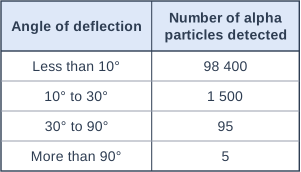
In an alpha particle scattering experiment, alpha particles were fired at a thin gold sheet. A detector counted how many alpha particles were deflected through different angles. The table shows the results.
Use the data to explain what the experiment showed about the structure of the atom.
Model answer
Almost all of the alpha particles (98 400 out of 100 000) were deflected by less than 10°, so they passed almost straight through the gold. This shows that most of the atom is empty space. Only 5 alpha particles were deflected by more than 90°, bouncing back towards the source. This shows that the mass and positive charge of the atom are concentrated in a very small nucleus at the centre, which only a very few alpha particles came close to.
Explanation
Link each pattern in the data to a conclusion: the huge number of small deflections shows that most of the atom is empty space; the tiny number of large deflections shows a small, massive, positively charged nucleus. Quoting numbers from the table makes the answer stronger.
Mark scheme
1 mark
almost all of the alpha particles were deflected through less than 10° / passed almost straight through
allow 98 400 of 100 000 / 98.4%
1 mark
so most of the atom is empty space
1 mark
only a very small number (5) were deflected by more than 90° / bounced back
1 mark
so the mass and positive charge are concentrated in a very small nucleus at the centre
allow there is a tiny, positively charged, massive nucleus
Ready to try the rest? Every answer you write is marked against the mark scheme, so you can see exactly where the marks are.
Ctrl + Enter to check
Study HelperHints first, answers after you try
Stuck on this one? Ask for a hint and I’ll point you in the right direction, without giving the answer away. Once you’ve checked your answer, I’ll show you how the marks are awarded.