Practise 14 exam-style questions on Changes of state and specific latent heat for AQA GCSE Combined Science (Physics Paper 1). Write your answer as you would in the exam and get it marked in seconds against the mark scheme, point by point, with the Study Helper on hand if you get stuck.
14 questions
1–6 marks each
Instant marking
No sign-up needed
14 questions, marked as you go
Sample questions with model answers
Here are 4 of the questions in this topic, each with a model answer, an explanation of why it earns the marks and the mark scheme an examiner would use.
Question 1
1 mark
What name is given to the specific latent heat for a change of state from liquid to vapour?
Model answer
Specific latent heat of vaporisation.
Explanation
Fusion refers to melting (solid to liquid) and vaporisation refers to boiling or evaporating (liquid to vapour). The same amount of energy is released when the reverse change (freezing or condensing) happens.
Mark scheme
1 mark
specific latent heat of vaporisation
allow latent heat of vaporisation; do not accept latent heat of fusion
Question 2
2 marks
A burn from 1 g of steam at 100 °C is usually much more severe than a burn from 1 g of boiling water at 100 °C.
Explain why.
Model answer
When steam touches the skin it condenses into water. As it condenses it releases its latent heat of vaporisation, a large amount of energy, to the skin. The condensed water at 100 °C then cools down, transferring as much energy as the boiling water would, so the steam transfers far more energy to the skin in total.
Explanation
Energy is released when a vapour condenses, equal to the energy that was needed to vaporise it. Water's specific latent heat of vaporisation is very large, so condensing steam transfers much more energy than water at the same temperature.
Mark scheme
1 mark
the steam condenses on the skin, transferring its latent heat (of vaporisation) to the skin
allow steam releases a large amount of energy when it turns into water
1 mark
the condensed water then cools like the boiling water, so the steam transfers more energy to the skin in total
allow so much more energy is transferred to the skin than from the water alone
Question 3
3 marks
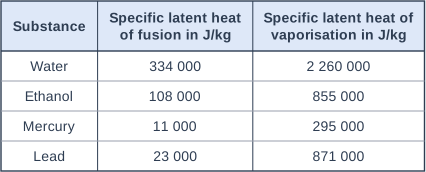
The table shows the specific latent heats of four substances.
The equation linking energy for a change of state, mass and specific latent heat is: energy for a change of state = mass × specific latent heat
Calculate the energy needed to change 0.30 kg of liquid ethanol at its boiling point into ethanol vapour.
Model answer
Liquid to vapour, so use the specific latent heat of vaporisation of ethanol = 855 000 J/kg E = m × L E = 0.30 × 855 000 E = 256 500 J
Explanation
Choose the right value from the table: changing a liquid to a vapour needs the specific latent heat of vaporisation, not fusion. For every substance in the table, vaporisation needs far more energy per kilogram than melting.
Mark scheme
1 mark
uses the specific latent heat of vaporisation of ethanol, 855 000 J/kg
an answer of 256 500 J scores 3 marks
1 mark
E = 0.30 × 855 000
allow ecf from an incorrect value taken from the table
A block of ice of mass 0.50 kg is at 0 °C. It is melted and the water is then warmed to 20 °C. Specific latent heat of fusion of ice = 334 000 J/kg Specific heat capacity of water = 4200 J/kg °C
The equations you need are: energy for a change of state = mass × specific latent heat change in thermal energy = mass × specific heat capacity × temperature change
Calculate the total energy needed.
Model answer
Melting the ice at 0 °C: E = m × L = 0.50 × 334 000 = 167 000 J Warming the water from 0 °C to 20 °C: ΔE = m × c × Δθ = 0.50 × 4200 × 20 = 42 000 J Total energy = 167 000 + 42 000 = 209 000 J
Explanation
Split the process into stages. During melting the temperature does not change, so use E = m L; once the ice has become water, its temperature rises, so use ΔE = m c Δθ. Melting needs about four times as much energy as warming the water by 20 °C.
Mark scheme
1 mark
energy to melt = 0.50 × 334 000
an answer of 209 000 J scores 4 marks
1 mark
= 167 000 (J)
1 mark
energy to warm = 0.50 × 4200 × 20 = 42 000 (J)
1 mark
total = 209 000 (J)
allow ecf from their two values added; allow 2.09 × 10⁵ J
Ready to try the rest? Every answer you write is marked against the mark scheme, so you can see exactly where the marks are.
Ctrl + Enter to check
Study HelperHints first, answers after you try
Stuck on this one? Ask for a hint and I’ll point you in the right direction, without giving the answer away. Once you’ve checked your answer, I’ll show you how the marks are awarded.