Practise 15 exam-style questions on Radioactive decay and nuclear radiation for AQA GCSE Combined Science (Physics Paper 1). Write your answer as you would in the exam and get it marked in seconds against the mark scheme, point by point, with the Study Helper on hand if you get stuck.
15 questions
1–6 marks each
Instant marking
No sign-up needed
15 questions, marked as you go
Sample questions with model answers
Here are 4 of the questions in this topic, each with a model answer, an explanation of why it earns the marks and the mark scheme an examiner would use.
Question 1
2 marks
What is meant by radioactive decay?
Model answer
Radioactive decay is when an unstable nucleus gives out radiation as it changes to become more stable. It is a random process.
Explanation
Some atomic nuclei are unstable. They give out radiation to become more stable, and nobody can predict exactly when any particular nucleus will do this - that is what random means.
Mark scheme
1 mark
an unstable nucleus gives out radiation (to become more stable)
allow emits alpha, beta, gamma or neutrons; do not accept an atom gives out radiation unless nucleus is implied
1 mark
it is a random process
allow you cannot predict when a nucleus will decay
Question 2
2 marks
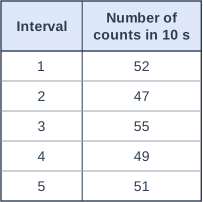
A Geiger-Muller tube was placed near a radioactive source. The table shows the number of counts recorded in five 10-second intervals.
The source and the tube were not moved. Explain why the number of counts was different in each interval.
Model answer
Radioactive decay is a random process. It is not possible to predict when any nucleus will decay, so the number of nuclei that decay - and so the number of counts recorded - varies from one 10-second interval to the next.
Explanation
Because decay is random, repeat readings of count-rate always vary a little even when nothing changes. This is why count-rates are measured over a long time or averaged over several readings.
Mark scheme
1 mark
radioactive decay is random
1 mark
so the number of nuclei decaying (and the radiation reaching the tube) varies from one interval to the next
allow you cannot predict how many nuclei will decay in a given time
Question 3
3 marks
Engineers want to find a leak in a water pipe buried 1 m underground. They add a small amount of a radioactive substance to the water, which escapes at the leak. They then use a detector at the surface above the pipe.
Explain which type of radiation the substance should emit.
Model answer
The substance should emit gamma rays. Gamma rays are very penetrating, so they can pass through 1 m of soil and be detected at the surface above the leak. Alpha and beta particles would be absorbed by the soil and water and would never reach the detector.
Explanation
When the detector is outside the material, the radiation must be penetrating enough to get out. Alpha is stopped by a few centimetres of air or a sheet of paper, and beta by a few millimetres of aluminium, so only gamma passes through a metre of soil.
Mark scheme
1 mark
gamma
1 mark
gamma rays can pass through 1 m of soil to reach the detector at the surface
allow gamma is the most penetrating / has a long range
1 mark
alpha and beta would be absorbed by the soil / could not reach the surface
allow alpha and beta have too short a range
Question 4
4 marks
A factory makes paper. A radioactive source is placed above the paper and a detector below it. The count-rate from the detector is used to control the thickness of the paper.
Explain why a beta source is used, rather than an alpha or a gamma source.
Model answer
Alpha particles would all be stopped by the paper, so no alpha would reach the detector whatever the thickness, and gamma rays would pass through the paper almost completely, so a small change in thickness would make almost no difference to the count-rate. Beta particles are partly absorbed by paper, so some pass through to the detector. If the paper becomes thicker, more beta is absorbed and the count-rate falls; if it becomes thinner, the count-rate rises, so the machine can adjust the thickness.
Explanation
For thickness monitoring, the radiation must be partly absorbed by the material, so that the count-rate depends on the thickness. Paper stops alpha completely and hardly affects gamma, but it absorbs some beta.
Mark scheme
1 mark
alpha particles would all be stopped by the paper, so the count-rate would not change with thickness
allow no alpha would reach the detector
1 mark
gamma rays would pass through the paper almost unaffected, so changes in thickness would make almost no difference to the count-rate
1 mark
beta particles are partly absorbed by paper
allow some beta passes through
1 mark
so the count-rate changes noticeably when the thickness of the paper changes
allow if the paper gets thicker, the count-rate falls
Ready to try the rest? Every answer you write is marked against the mark scheme, so you can see exactly where the marks are.
Ctrl + Enter to check
Study HelperHints first, answers after you try
Stuck on this one? Ask for a hint and I’ll point you in the right direction, without giving the answer away. Once you’ve checked your answer, I’ll show you how the marks are awarded.