
Level:
Correct: 0
Incorrect: 0
Marks: 0/0
Exam Practice
Course:
Topics:
AQA GCSE Statistics (Higher Paper 2) Smart practice A mixed round aimed at your weak spots
Unit 1
Planning and collecting data
Unit 2
Representing data
Section C: C1a (tabulation, tally, pictogram); Section E: E3d
Tabulation, tallies, pictograms and tables of data
Section C: C1a (pie chart), C1b (comparative pie chart)
Pie charts and comparative pie charts
Section C: C1a (stem and leaf diagram)
Stem and leaf diagrams
Section C: C2 (bar charts, bar line charts, line charts, frequency polygons)
Bar charts, line charts and frequency polygons
Section C: C2 (cumulative frequency charts)
Cumulative frequency diagrams
Section C: C2 (histograms), C3b
Histograms and frequency density
Section C: C2 (box plots); Section D: D3b; Section E: E5b
Box plots and outliers
Unit 3
Summarising data
Section D: D1a (mode, median, arithmetic mean)
Mode, median and mean
Section D: D1a (weighted mean, geometric mean), D1b
Weighted mean, geometric mean and choosing an average
Section D: D2; Section E: E5a
Skewness
Section D: D3a (range, quartiles, IQR, percentiles, interpercentile and interdecile range)
Range, quartiles, percentiles and interdecile range
Section D: D3a (standard deviation)
Standard deviation
Section C: C2 (time series); Section D: D1a (mean seasonal variation), D4; Section E: E6
Time series, moving averages and seasonal variation
Section C: C2 (scatter charts); Section D: D5
Scatter diagrams, lines of best fit and regression lines
Section D: D6; Section E: E9a, E9b, E9c
Spearman's rank correlation coefficient
Unit 4
Probability
Unit 5
Interpreting and evaluating results
Unit 6
Statistical enquiry cycle
3.6 Statistical enquiry cycle: 3.6.1 Initial planning, 3.6.2 Data collection
Statistical enquiry cycle: planning and data collection
3.6 Statistical enquiry cycle: 3.6.3 Processing and presentation, 3.6.4 Interpretation, 3.6.5 Evaluation
Statistical enquiry cycle: analysis and evaluation
Avg
score:
–
Topics
done:
0/39

Index numbers

Practise 16 exam-style questions on Index numbers for AQA GCSE Statistics (Higher Paper 2). Write your answer as you would in the exam and get it marked in seconds against the mark scheme, point by point, with the Study Helper on hand if you get stuck.

  • 16 questions
  • 1–5 marks each
  • Instant marking
  • No sign-up needed
16 questions, marked as you go

Sample questions with model answers

Here are 4 of the questions in this topic, each with a model answer, an explanation of why it earns the marks and the mark scheme an examiner would use.

Question 1

1 mark

The Consumer Price Index (CPI) is a weighted index number.
The weights used to calculate the CPI are updated every year.

Give one reason why the weights need to be updated.

Model answer

The goods and services that households buy, and how much they spend on each, change over time (for example, people spend more on mobile phone contracts and less on DVDs than in the past). The weights must be updated so that each item's weight matches its current share of household spending.

Explanation

In a weighted index each weight shows how important an item is, measured by how much is spent on it. Spending habits change as new products appear and others go out of use, so out-of-date weights would give too much importance to some items and too little to others.

Mark scheme
  1. 1 mark

    B1 for a reason linked to changes in spending, eg the things households spend their money on change over time (new products appear, others are bought less), so the weights must show how much is spent on each item now

    oe, eg 'people now spend more on streaming services and less on DVDs', 'the proportion of money spent on energy changes'. 'Prices change' alone B0 (that is what the index measures, not why the weights change). 'To make it more accurate' with no reason B0. Ignore any non-contradictory or irrelevant statements. (This item is marked by sound statistical practice.)
Question 2

2 marks

A bus company measures how its running costs have changed since 2020 with a weighted index number.
For 2024 it uses these index numbers (2020 = 100) and weights.

Fuel: index number 130, weight 25
Wages: index number 106, weight 60
Maintenance: index number 98, weight 15

The weighted index number for 2024 is 110.8

The company is changing to electric buses, so in future the weight for fuel will be smaller and the weights for wages and maintenance will be larger.

If the index numbers stay the same, what will happen to the weighted index number?
Give a reason for your answer.

Model answer

The weighted index number will decrease.
Fuel has the highest index number (130), well above the weighted index of 110.8, while wages (106) and maintenance (98) are below it. Giving fuel less weight and the others more weight moves the weighted mean towards the lower index numbers.

Explanation

A weighted index is a weighted mean of the index numbers, so it is pulled towards the items with the largest weights. Moving weight away from the item whose price rose most, and towards items whose prices rose less, lowers the weighted index. For example, weights of 15, 70 and 15 would give 108.4.

Mark scheme
  1. 1 mark

    B1 for it will decrease / be smaller

    oe

  2. 1 mark

    B1dep for a reason, eg fuel has by far the highest index number (130), and it is the only one above 110.8, so giving it less weight (and the lower indices more weight) brings the weighted index down

    oe. Must refer to fuel having the highest index (or the other indices being lower). A correct calculation with new weights, eg weights 15, 70, 15 giving 108.4, is also a valid reason. 'Because the weight for fuel goes down' alone B0 (it does not explain why that lowers the index). Ignore any non-contradictory or irrelevant statements.

Question 3

3 marks

A city council records the carbon dioxide emissions in its area.
Using 2015 as the base year, the index number for the emissions in 2024 was 81

The council's target is that emissions in 2030 should be 30% lower than in 2015.

Work out the percentage reduction from the 2024 level that is still needed to meet the target.
Give your answer to 1 decimal place.

Model answer

Target for 2030: 30% lower than 2015, so the target index number is 70.
Reduction needed from 2024 = 81 - 70 = 11 index points
Percentage reduction from the 2024 level \(= \dfrac{11}{81} \times 100 = 13.58... = 13.6\)% (1 d.p.)

Explanation

With 2015 = 100, emissions 30% below 2015 have index 70. The further cut of 11 index points must be measured as a percentage of the 2024 value, 81, not of 100. Treating 11 points as 11% is the most common error.

Mark scheme
  1. 1 mark

    M1 for the target index number 70 (2015 = 100)

    oe, eg 0.7 of the 2015 level

  2. 1 mark

    M1dep for \(\dfrac{81 - 70}{81} \times 100\) or \(\dfrac{70}{81}\) (= 0.864...)

    oe. The reduction must be measured from the 2024 level (81).

  3. 1 mark

    A1 for 13.6 [13.55, 13.65] (a reduction of 13.6%)

    The exact value is 13.580...%; accept more accurate values in the range. Correct answer with no working scores 3 marks. 11% (the difference in index points, or 30% - 19%) scores M1M0A0 if the target index 70 is seen, otherwise M0M0A0. 86.4% (2030 emissions as a percentage of 2024) scores M1M1A0.

Question 4

4 marks

A leisure centre uses a weighted index number to measure the change in the cost of running its swimming pool from 2021 to 2025.
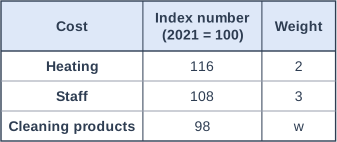
The table shows the index numbers for its three main costs, and the weights for two of them.

The weighted index number for 2025 (2021 = 100) is 104

Work out the weight w for cleaning products.
You must show your working.

Table with columns "Cost", "Index number (2021 = 100)", "Weight". Cost: Heating; Index number (2021 = 100): 116; Weight: 2 | Cost: Staff; Index number (2021 = 100): 108; Weight: 3 | Cost: Cleaning products; Index number (2021 = 100): 98; Weight: w.

Model answer

\(\dfrac{2 \times 116 + 3 \times 108 + 98w}{2 + 3 + w} = 104\)
\(556 + 98w = 104(5 + w)\)
\(556 + 98w = 520 + 104w\)
\(36 = 6w\)
\(w = 6\)
Check: \(\dfrac{232 + 324 + 588}{11} = \dfrac{1144}{11} = 104\)

Explanation

Write the weighted index formula with the unknown weight in both the top and the bottom, because w is part of the total weight. Multiply both sides by (5 + w), collect the w terms and solve. Forgetting to add w to the total of the weights is the usual error.

Mark scheme
  1. 1 mark

    M1 for \(\dfrac{2 \times 116 + 3 \times 108 + 98w}{2 + 3 + w} = 104\)

    oe, eg \(\dfrac{556 + 98w}{5 + w} = 104\). The denominator must include w.

  2. 1 mark

    M1dep for 556 + 98w = 104(5 + w) or 556 + 98w = 520 + 104w

    oe

  3. 1 mark

    M1dep for 6w = 36 or 36 = 6w

    oe

  4. 1 mark

    A1 for w = 6

    The question says 'You must show your working': 6 with no working scores 0. Trial and improvement that shows w = 6 gives a weighted index of exactly 104 (eg \(\dfrac{232 + 324 + 588}{11} = \dfrac{1144}{11} = 104\)) scores 4 marks. Using a denominator of 5 (leaving w out of the total weight) gives 556 + 98w = 520 and a negative weight, w = -0.37: M0M0M0A0.

Ready to try the rest? Every answer you write is marked against the mark scheme, so you can see exactly where the marks are.

Study Helper Hints first, answers after you try

Stuck on this one? Ask for a hint and I’ll point you in the right direction, without giving the answer away. Once you’ve checked your answer, I’ll show you how the marks are awarded.