Practise 18 exam-style questions on Independent events and conditional probability for AQA GCSE Statistics (Higher Paper 1). Write your answer as you would in the exam and get it marked in seconds against the mark scheme, point by point, with the Study Helper on hand if you get stuck.
18 questions
1–5 marks each
Instant marking
No sign-up needed
18 questions, marked as you go
Sample questions with model answers
Here are 4 of the questions in this topic, each with a model answer, an explanation of why it earns the marks and the mark scheme an examiner would use.
Question 1
1 mark
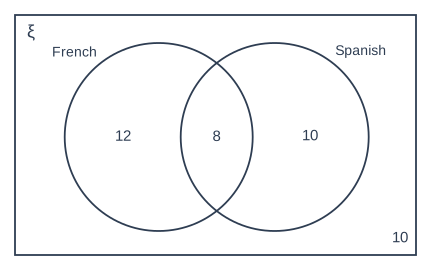
The Venn diagram shows whether the 40 students in a class study French (F) and whether they study Spanish (S). A student is chosen at random from the class.
What is \(P(S \mid F)\)?
Choose your answer.
\(\dfrac{8}{40}\)
\(\dfrac{8}{18}\)
\(\dfrac{8}{20}\)
\(\dfrac{20}{40}\)
Model answer
Given F, the student is one of the \(12 + 8 = 20\) French students. 8 of them also study Spanish. \(P(S \mid F) = \dfrac{8}{20}\)
Explanation
\(P(S \mid F)\) means the probability of S given F, so the condition F tells you which students to choose from: only the 20 inside the French circle. The common errors are dividing by the whole class (40) or getting the condition the wrong way round and dividing by the 18 Spanish students.
Mark scheme
1 mark
B1 for \(\dfrac{8}{20}\)
Accept \(\dfrac{2}{5}\) or 0.4. Given that the student studies French, there are \(12 + 8 = 20\) students to choose from, and 8 of them also study Spanish. \(\dfrac{8}{40}\) is \(P(S \cap F)\), \(\dfrac{8}{18}\) is \(P(F \mid S)\) and \(\dfrac{20}{40}\) is \(P(F)\): all B0. Any other answer, or more than one answer, scores B0.
Question 2
2 marks
In a cafe, C is the event 'a customer buys a coffee' and K is the event 'a customer buys a cake'. For a customer chosen at random, \(P(C \text{ and } K) = 0.18\) and \(P(K) = 0.45\)
The probability of C given K is the proportion of the customers who buy a cake who also buy a coffee: \(P(C \text{ and } K)\) divided by \(P(K)\). In context, 40% of customers who buy a cake also buy a coffee. An answer greater than 1 (from dividing the wrong way round) cannot be a probability.
Mark scheme
1 mark
M1 for \(\dfrac{0.18}{0.45}\)
oe
1 mark
A1 for 0.4
oe, eg \(\dfrac{2}{5}\), 40%. \(0.18 \times 0.45 = 0.081\) or \(0.45 \div 0.18 = 2.5\) scores M0A0. Correct answer with no working scores M1A1.
Question 3
3 marks
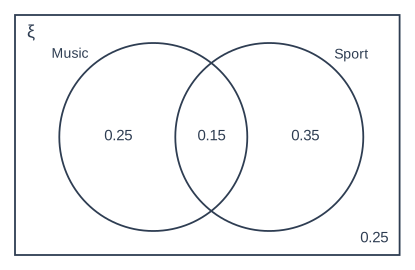
A survey asked students whether they play a musical instrument (M) and whether they play for a sports team (S). The Venn diagram shows the probabilities for a student chosen at random.
Work out \(P(S \mid M)\), and use your answer to decide whether the events M and S are independent.
Model answer
\(P(M) = 0.25 + 0.15 = 0.4\) \(P(S \mid M) = \dfrac{P(S \text{ and } M)}{P(M)} = \dfrac{0.15}{0.4} = 0.375\) \(P(S) = 0.15 + 0.35 = 0.5\) \(P(S \mid M) = 0.375\), which is not equal to \(P(S) = 0.5\), so M and S are not independent. (Students who play an instrument are less likely to play for a sports team.)
Explanation
Given M, you only look inside the Music circle, so divide the overlap (0.15) by P(M) = 0.4. If S and M were independent, knowing M would not change the probability of S, so \(P(S \mid M)\) would equal \(P(S)\). It does not (0.375 compared with 0.5), so they are not independent.
Mark scheme
1 mark
M1 for \(\dfrac{0.15}{0.25 + 0.15}\) or \(\dfrac{0.15}{0.4}\)
oe
1 mark
A1 for 0.375
oe, eg \(\dfrac{3}{8}\), 37.5%
1 mark
B1ft for not independent, because \(P(S \mid M) = 0.375\) is not equal to \(P(S) = 0.5\)
ft their \(P(S \mid M)\) compared with the correct \(P(S) = 0.15 + 0.35 = 0.5\). Alternative: \(P(M) \times P(S) = 0.4 \times 0.5 = 0.2\), which is not equal to \(P(M \text{ and } S) = 0.15\), so not independent. 'Not independent' with no correct comparison scores B0. 0.375 compared with P(M) = 0.4 is the wrong comparison: B0.
Question 4
4 marks
At a sports centre, R is the event 'a customer uses the running track' and W is the event 'a customer uses the swimming pool'. R and W are independent. \(P(R) = 0.6\) and \(P(R \text{ and } W) = 0.21\)
Work out the probability that a customer chosen at random uses neither the running track nor the swimming pool.
Model answer
R and W are independent, so \(P(R) \times P(W) = P(R \text{ and } W)\) \(0.6 \times P(W) = 0.21\), so \(P(W) = 0.21 \div 0.6 = 0.35\) P(neither) \(= P(\text{not } R) \times P(\text{not } W) = 0.4 \times 0.65 = 0.26\) (Check: \(P(R \text{ or } W) = 0.6 + 0.35 - 0.21 = 0.74\), and \(1 - 0.74 = 0.26\))
Explanation
Use the independence rule \(P(R \text{ and } W) = P(R) \times P(W)\) backwards to find P(W). If R and W are independent, so are 'not R' and 'not W', so P(neither) is the product of the two complements. A Venn diagram with regions 0.39, 0.21, 0.14 and 0.26 shows the same result.
oe, eg \(0.4 \times 0.65\), or \(1 - 0.74\), or a correct Venn diagram with 0.39, 0.21, 0.14 and their remaining value. ft their P(W) if it is between 0 and 1.
1 mark
A1 for 0.26
oe. \(1 - (0.6 + 0.35) = 0.05\) (the overlap not added back) scores M1A1M0A0. \(1 - 0.6 - 0.21 = 0.19\) scores 0. Correct answer with no working scores full marks.
Ready to try the rest? Every answer you write is marked against the mark scheme, so you can see exactly where the marks are.
Ctrl + Enter to check
Study HelperHints first, answers after you try
Stuck on this one? Ask for a hint and I’ll point you in the right direction, without giving the answer away. Once you’ve checked your answer, I’ll show you how the marks are awarded.