
Level:
Correct: 0
Incorrect: 0
Marks: 0/0
Exam Practice
Course:
Topics:
AQA A-Level Biology (Paper 1) Smart practice A mixed round aimed at your weak spots
Unit 1
Biological molecules
Unit 2
Cells
Unit 3
Organisms exchange substances with their environment
Unit 4
Genetic information, variation and relationships between organisms
DNA, genes and chromosomes
0%
Genetic diversity can arise as a result of mutation or during meiosis
Gene mutations and chromosome non-disjunction
0%
Meiosis and genetic variation
0%
Genetic diversity and adaptation
0%
Species and taxonomy
0%
Biodiversity within a community
0%
Investigating diversity
0%
Avg
score:
–
Topics
done:
0/35

The heart, cardiac cycle and cardiovascular disease

Practise 19 exam-style questions on The heart, cardiac cycle and cardiovascular disease for AQA A-Level Biology (Paper 1). Write your answer as you would in the exam and get it marked in seconds against the mark scheme, point by point, with the Study Helper on hand if you get stuck.

  • 19 questions
  • 1–8 marks each
  • Instant marking
  • No sign-up needed
19 questions, marked as you go

Sample questions with model answers

Here are 4 of the questions in this topic, each with a model answer, an explanation of why it earns the marks and the mark scheme an examiner would use.

Question 1

2 marks

Mammals have a double circulation: blood passes through the heart twice in each complete circuit of the body. Explain the advantages of a double circulation to a mammal.

Model answer

After passing through the lungs, blood returns to the heart and is pumped again by the left ventricle, so it reaches the body tissues at high pressure and flows quickly. This delivers oxygen and glucose fast enough for a mammal's high metabolic rate. At the same time, blood can be sent to the lungs at a lower pressure, which does not damage the delicate lung capillaries.

Explanation

In a single circulation (as in fish) blood loses pressure as it passes through the gas exchange capillaries before reaching the body. Returning to the heart lets mammals pump blood to the body at high pressure while keeping the pressure in the lungs low. Link the high pressure to fast delivery for a high metabolic rate rather than just saying 'more oxygen'.

Mark scheme
  1. 1 mark

    Blood returns to the heart after the lungs and is pumped again, so it reaches the body at a high pressure / flows quickly to the tissues

    Max 2. Accept 'the left ventricle pumps oxygenated blood to the body at high pressure'.

  2. 1 mark

    (So) oxygen / glucose is delivered quickly enough for a high metabolic rate / high rate of respiration / maintaining body temperature

    Ignore 'more oxygen' unqualified.

  3. 1 mark

    Blood can be pumped to the lungs at a lower pressure, so (lung) capillaries / alveoli are not damaged / less tissue fluid forms in the lungs

    Accept 'the right ventricle pumps blood to the lungs at low pressure'.

  4. 1 mark

    Oxygenated and deoxygenated blood are kept separate (so blood to the tissues has the maximum oxygen)

    Accept 'blood does not mix'.
Question 2

3 marks

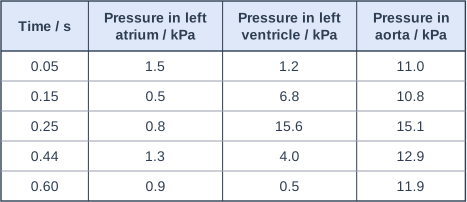
The table shows the pressures in the left atrium, left ventricle and aorta at five times during one cardiac cycle of a healthy person.

Give the two times at which both the atrioventricular valve and the semilunar valve on the left side of the heart are closed. Use the data to explain your answer.

Table with columns "Time / s", "Pressure in left atrium / kPa", "Pressure in left ventricle / kPa", "Pressure in aorta / kPa". Time / s: 0.05; Pressure in left atrium / kPa: 1.5; Pressure in left ventricle / kPa: 1.2; Pressure in aorta / kPa: 11.0 | Time / s: 0.15; Pressure in left atrium / kPa: 0.5; Pressure in left ventricle / kPa: 6.8; Pressure in aorta / kPa: 10.8 | Time / s: 0.25; Pressure in left atrium / kPa: 0.8; Pressure in left ventricle / kPa: 15.6; Pressure in aorta / kPa: 15.1 | Time / s: 0.44; Pressure in left atrium / kPa: 1.3; Pressure in left ventricle / kPa: 4.0; Pressure in aorta / kPa: 12.9 | Time / s: 0.60; Pressure in left atrium / kPa: 0.9; Pressure in left ventricle / kPa: 0.5; Pressure in aorta / kPa: 11.9.

Model answer

At 0.15 s and 0.44 s.
At both times the pressure in the left ventricle (6.8 and 4.0 kPa) is higher than in the left atrium (0.5 and 1.3 kPa), so the atrioventricular valve is closed. The pressure in the ventricle is also lower than in the aorta (10.8 and 12.9 kPa), so the semilunar valve is closed.

Explanation

Valves open and close because of pressure differences: a valve opens when the pressure behind it is higher than the pressure in front of it, and closes when the pressure in front is higher. At 0.15 s the ventricle is contracting but has not yet reached aortic pressure; at 0.44 s it is relaxing. In both cases the volume of the ventricle does not change. Compare the two pressures either side of each valve.

Mark scheme
  1. 1 mark

    0.15 s AND 0.44 s

    Both times are needed for this mark. Reject the mark if any other time is also given. In points 2 and 3, the abbreviations 'AV valve' and 'SL valve' are penalised only once per question: do not award the first point in which one replaces the full name, but credit later points that use it. Accept 'bicuspid' or 'mitral valve' for the atrioventricular valve and 'aortic valve' for the semilunar valve.

  2. 1 mark

    (At both times) pressure in the ventricle is higher than in the atrium, so the atrioventricular valve is closed

    Accept 6.8 kPa is higher than 0.5 kPa or 4.0 kPa is higher than 1.3 kPa. Points 2 and 3 can be awarded only for an explanation that uses pressures.

  3. 1 mark

    (At both times) pressure in the ventricle is lower than in the aorta, so the semilunar valve is closed

    Accept 6.8 kPa is lower than 10.8 kPa or 4.0 kPa is lower than 12.9 kPa.

Question 3

3 marks

A student wrote this method for dissecting a lamb's heart.

1 Put on a lab coat and collect the heart, a scalpel and a pair of scissors.
2 Hold the heart in one hand and cut down the side of the heart, cutting towards your fingers.
3 When you have finished, wipe the blood off the scalpel blade with your fingers and a paper towel.
4 Put the remains of the heart in the classroom bin.
5 Rinse your hands with water.

Identify three errors in this method that could harm the student or other people. For each error, suggest how the method should be changed.

Model answer

1. Step 2 - holding the heart in the hand and cutting towards the fingers could cause a cut: place the heart on a dissecting board and cut away from the body.
2. Step 3 - wiping the blade with fingers could cause a cut: hold the scalpel by its handle and put it in a beaker of disinfectant.
3. Step 4 - animal remains in the classroom bin could spread microorganisms: put them in a separate sealed disposal bag.

Explanation

Hazards in a dissection come from sharp instruments and from microorganisms on raw animal tissue. Good practice is to cut on a board away from the body, handle and clean instruments by the handle, disinfect instruments and surfaces, dispose of tissue separately, and wash hands with soap afterwards. Each mark needs both the error and the change.

Mark scheme
  1. 1 mark

    Step 2: holding the heart / cutting towards the fingers - place the heart on a dissecting board / tray and cut away from the body / fingers

    Max 3. Each point needs the error AND a suitable change. List rule: if more than three errors are given, each wrong extra answer cancels one correct answer.

  2. 1 mark

    Step 3: wiping the blade with fingers - hold instruments by the handle / place them in disinfectant / wash them with the blade pointing away

    Accept 'use forceps to hold the paper towel'.

  3. 1 mark

    Step 4: classroom bin - put the remains (and gloves / paper towels) in a separate (sealed) disposal bag / bin

    Accept 'yellow disposal bag' or 'clinical waste bag'.

  4. 1 mark

    Step 5: rinsing with water only - wash hands with soap / antibacterial hand wash

  5. 1 mark

    No step to disinfect the bench / dissecting board / instruments after the dissection - disinfect them

  6. 1 mark

    No gloves / cuts on the hands not covered - wear (disposable) gloves / cover any cuts with waterproof dressings

    Accept either change for this point.

Question 4

5 marks

Scientists carried out two studies on eating oily fish and coronary heart disease (CHD).

Study 1: The scientists recorded the diet of 38 000 adults aged 40 to 60 and followed them for 20 years. People who ate oily fish at least twice a week had a 25% lower rate of death from CHD than people who rarely ate fish.

Study 2: The scientists randomly divided 11 000 people who had already had a heart attack into two groups. For 4 years, one group took a capsule of fish oil each day and the other group took a capsule of olive oil. There was no significant difference in the rate of death from CHD between the two groups.

Evaluate the claim that eating oily fish reduces the risk of death from CHD.

Model answer

Study 1 supports the claim: it was large, lasted 20 years and found a 25% lower death rate from CHD in people who ate oily fish. However, it shows only a correlation; people who eat oily fish may also smoke less or exercise more, and their diets may have changed during the 20 years. Study 2 was randomised and controlled, so it is a better test of cause, and it found no significant difference. But it used fish oil capsules rather than oily fish, the people had already had a heart attack (and may be taking medicines), it lasted only 4 years, and olive oil may itself protect against CHD. So the evidence does not show that eating oily fish reduces the risk of death from CHD, but it does not rule it out either.

Explanation

To evaluate conflicting evidence, consider the design of each study: an observational study can show only a correlation, because other risk factors may differ between groups, while a randomised controlled trial can test cause but may not match the claim (capsules are not the same as eating fish) or the population. A good answer uses both studies, gives strengths and weaknesses, and reaches a balanced conclusion.

Mark scheme
  1. 1 mark

    (Study 1, for) people who ate oily fish (at least twice a week) had a (25%) lower death rate from CHD

    Max 3 if the answer refers to only one of the two studies. Max 5 in total.

  2. 1 mark

    (Study 1, for) large sample (38 000 people), so the results are more representative / the difference is less likely to be due to chance

    Accept 'large sample size' with a reason.

  3. 1 mark

    (Study 1, for) long study (20 years), so there was time for CHD (deaths) to develop / long-term effects of the diet could be detected

    Accept 'long time period' with a reason.

  4. 1 mark

    (Study 1, against) only a correlation: people who eat oily fish may have other healthy habits (e.g. smoke less, exercise more, eat less saturated fat), so fish may not be the cause

    Accept 'other variables were not controlled'.

  5. 1 mark

    (Study 1) diet may not have been recorded accurately / may have changed during the 20 years

    Accept 'diet may have been recorded only at the start'.

  6. 1 mark

    (Study 2) randomised and controlled (with a control capsule), so it is a better test of cause, and it found no significant difference

    Accept 'the groups were similar apart from the fish oil'.

  7. 1 mark

    (Study 2) used fish oil capsules, not oily fish, so it does not test eating fish / other substances in fish (or eating fish instead of meat) could be responsible

  8. 1 mark

    (Study 2) people had already had a heart attack / may be taking other medicines, so results may not apply to healthy people

  9. 1 mark

    (Study 2) shorter study (4 years), so a long-term effect of fish oil may have been missed

  10. 1 mark

    (Study 2) olive oil may itself reduce the risk of CHD, so it may not be a suitable control

    Accept 'the control group was not given a capsule with no active ingredient'.

Ready to try the rest? Every answer you write is marked against the mark scheme, so you can see exactly where the marks are.

Study Helper Hints first, answers after you try

Stuck on this one? Ask for a hint and I’ll point you in the right direction, without giving the answer away. Once you’ve checked your answer, I’ll show you how the marks are awarded.