
Level:
Correct: 0
Incorrect: 0
Marks: 0/0
Exam Practice
Course:
Topics:
AQA A-Level Biology (Paper 1) Smart practice A mixed round aimed at your weak spots
Unit 1
Biological molecules
Unit 2
Cells
Unit 3
Organisms exchange substances with their environment
Unit 4
Genetic information, variation and relationships between organisms
DNA, genes and chromosomes
0%
Genetic diversity can arise as a result of mutation or during meiosis
Gene mutations and chromosome non-disjunction
0%
Meiosis and genetic variation
0%
Genetic diversity and adaptation
0%
Species and taxonomy
0%
Biodiversity within a community
0%
Investigating diversity
0%
Avg
score:
–
Topics
done:
0/35

Monomers, polymers and carbohydrates

Practise 18 exam-style questions on Monomers, polymers and carbohydrates for AQA A-Level Biology (Paper 1). Write your answer as you would in the exam and get it marked in seconds against the mark scheme, point by point, with the Study Helper on hand if you get stuck.

  • 18 questions
  • 1–8 marks each
  • Instant marking
  • No sign-up needed
18 questions, marked as you go

Sample questions with model answers

Here are 4 of the questions in this topic, each with a model answer, an explanation of why it earns the marks and the mark scheme an examiner would use.

Question 1

2 marks

The figure shows the structure of a monosaccharide. The carbon atoms are numbered 1 to 6.

Name this monosaccharide. Use the figure to give the evidence for your answer.
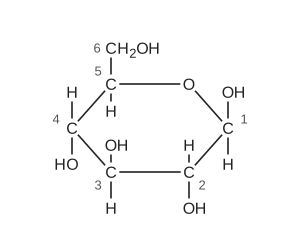
A six-membered ring of five carbon atoms and one oxygen atom, with the carbon atoms numbered 1 to 6. Carbon 1 is at the right-hand end of the ring, next to the ring oxygen: it has OH above the ring and H below. Carbon 2 (bottom right): H above, OH below. Carbon 3 (bottom left): OH above, H below. Carbon 4 (left-hand end): H above, OH below. Carbon 5 (top left): CH2OH above (carbon 6), H below.

Model answer

β-glucose. The OH group on carbon 1 is above the ring and the H atom is below it; in α-glucose the OH on carbon 1 is below the ring.

Explanation

α-glucose and β-glucose are isomers that differ only at carbon 1, the carbon next to the oxygen in the ring. In β-glucose the OH on carbon 1 is above the ring (on the same side as the CH2OH group); in α-glucose it is below. Learn to find carbon 1 on a ring structure, because questions often ask about the groups on carbons 1 and 4.

Mark scheme
  1. 1 mark

    β-glucose

    Accept beta glucose / beta-glucose. Reject α-glucose, galactose or fructose. 'Glucose' alone is not enough for this point, but the next point can still be awarded.

  2. 1 mark

    The OH (group) on carbon 1 is above the ring (and the H is below)

    Accept 'the OH on carbon 1 is on the same side of the ring as the CH₂OH / carbon 6' or 'the H and OH on carbon 1 are the other way round from α-glucose'. The answer must refer to carbon 1: 'the OH is above the ring' alone is not enough, because other carbons also have OH above the ring. Do not award this point if the answer says the OH on carbon 1 is below the ring. Ignore references to carbon 4.
Question 2

2 marks

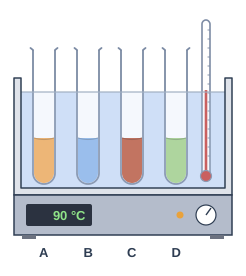
A student tested four glucose solutions, A to D, with Benedict's solution. Each tube contained the same volume of glucose solution and the same volume of Benedict's solution, and all four tubes were heated in a water bath at 90 °C for 5 minutes. The figure shows the colours of the tubes after heating.

Give the order of the solutions from the lowest to the highest concentration of glucose.

Give one reason why comparing the colours by eye gives only an estimate of the glucose concentration.

Diagram of 4 test tubes of coloured liquids in a water bath. Four test tubes of liquid stand in an electric water bath, drawn cut away to show the water, with a thermometer standing in the water; the display on its front reads 90 °C. The label under each tube and the colour of its liquid, from left to right: "A": orange; "B": blue; "C": brick-red; "D": green.

Model answer

B, D, A, C (blue, green, orange, brick red).
The colour changes gradually from blue through green, yellow and orange to red, so deciding which colour a tube is depends on a person's judgement; two solutions with similar concentrations may look the same.

Explanation

Benedict's solution changes from blue to green, yellow, orange and then brick red as the concentration of reducing sugar increases, because more blue copper(II) ions are reduced to the red precipitate. Judging colours by eye is subjective, so the test is only semi-quantitative; a colorimeter gives a numerical value of absorbance or transmission instead.

Mark scheme
  1. 1 mark

    B, D, A, C

    Accept the reverse order only if it is clearly stated as highest to lowest.

  2. 1 mark

    Colours change gradually / are a continuous range, so judging colour is subjective / intermediate colours are hard to tell apart / different people may judge the colour differently

    List rule: if more than one reason is given, a wrong or contradictory extra reason cancels the correct one. Accept 'colour cannot be measured with a number without a colorimeter' or 'two solutions with similar concentrations give the same colour'. Ignore 'human error' unqualified.

Question 3

4 marks

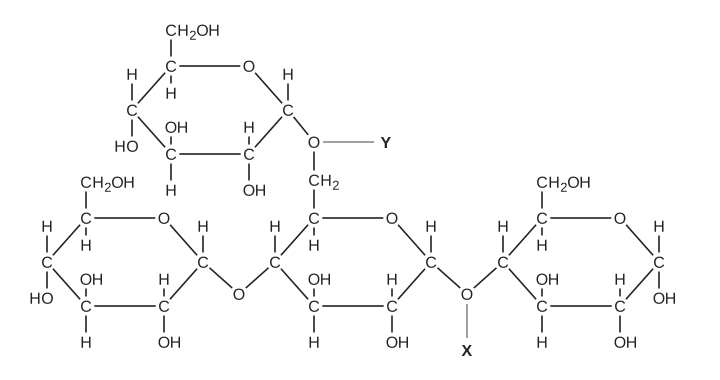
The figure shows part of a polysaccharide molecule. X and Y are glycosidic bonds.

Give the numbers of the two carbon atoms joined by bond X and the numbers of the two carbon atoms joined by bond Y.

Use the figure to explain why this molecule could be part of a glycogen molecule but could not be part of a cellulose molecule.

Part of a polysaccharide made of ring-shaped monomers, each drawn as a six-membered ring of five carbon atoms and one oxygen atom with H and OH groups above and below. Three rings form a horizontal main chain joined by oxygen atoms that sit below the chain; the oxygen between the second and third rings is labelled X. From the top of the middle ring, a CH2 group joins through an oxygen atom, labelled Y, to a fourth ring above and to the left (a side branch). The carbon atoms are not numbered.

Model answer

Bond X joins carbon 1 of one glucose to carbon 4 of the next (a 1-4 glycosidic bond). Bond Y joins carbon 1 of the glucose in the side branch to carbon 6 of a glucose in the main chain (a 1-6 glycosidic bond).
The monomers are α-glucose (the bonds from carbon 1 point below the ring), as in glycogen, whereas cellulose is made of β-glucose. The molecule is also branched by a 1-6 bond, as glycogen is, but cellulose is an unbranched chain with only 1-4 bonds.

Explanation

Number the carbons of glucose from carbon 1, the carbon next to the ring oxygen; carbon 6 is the CH2 outside the ring. Glycogen (and amylopectin) are chains of α-glucose joined by 1-4 bonds with branches attached by 1-6 bonds. Cellulose is an unbranched chain of β-glucose joined by 1-4 bonds, with alternate monomers inverted. Explanations must contrast the two molecules, not just describe one.

Mark scheme
  1. 1 mark

    X joins carbon 1 and carbon 4 / X is a 1-4 bond

    Accept α-1,4 or 1,4. Accept the numbers in either order.

  2. 1 mark

    Y joins carbon 1 and carbon 6 / Y is a 1-6 bond

    Accept α-1,6 or 1,6. Accept the numbers in either order.

  3. 1 mark

    The monomers are α-glucose (as in glycogen) but cellulose is made of β-glucose

    Accept 'the OH / the bond on carbon 1 is below the ring, so α-glucose'. Accept 'α-glucose' alone if the answer makes clear that cellulose is not made of α-glucose. Reject 'cellulose is made of α-glucose'. Accept 'in cellulose alternate monomers are inverted, but in this molecule they are all the same way up'.

  4. 1 mark

    The molecule is branched / has 1-6 (glycosidic) bonds (as in glycogen) but cellulose is unbranched / has only 1-4 bonds

    Accept 'cellulose is a straight / linear chain'. Ignore references to a helix or to hydrogen bonds (not shown in the figure).

Question 4

6 marks

Starch is the main storage carbohydrate in plant cells and glycogen is the main storage carbohydrate in animal cells.

Explain how the structures of starch and glycogen are related to their functions as energy stores.

Model answer

Starch and glycogen are both polymers of α-glucose, which can be hydrolysed to glucose and used in respiration to release energy. Both are insoluble, so they do not affect the water potential of the cell and do not draw water in by osmosis. They are large molecules, so they cannot diffuse out of the cell. Amylose in starch is helical, which makes it compact, so a lot of glucose is stored in a small space. Amylopectin and glycogen are branched, so they have many ends where enzymes can hydrolyse glycosidic bonds at the same time, releasing glucose rapidly. Glycogen is more highly branched than starch, so it releases glucose even faster, which suits animals, which are more active and have a higher metabolic rate than plants.

Explanation

For each structural feature, give the property it causes and why that helps storage: insoluble so no osmotic effect; large so cannot leave the cell; helical or branched so compact; branched so many ends for rapid hydrolysis. The best answers compare glycogen with starch. Weaker answers list features (for example 'branched') without explaining the benefit, or confuse glycogen with glucagon.

Mark scheme
  1. 1 mark

    (Both are) polymers of α-glucose, which can be hydrolysed and used in respiration (to release energy)

    Max 6. Reject β-glucose. Reject 'glucogen' and 'glucagon' for glycogen.

  2. 1 mark

    Insoluble

    Ignore 'cannot dissolve in blood'.

  3. 1 mark

    (So) do not affect the water potential of the cell / do not cause water to move into the cell by osmosis

    Accept 'osmotically inactive'. Reject 'do not affect the water potential of the blood' for starch.

  4. 1 mark

    Large molecules, so cannot leave / diffuse out of the cell / cross the cell-surface membrane

  5. 1 mark

    (Amylose in starch is) helical / coiled, so compact / a lot of glucose stored in a small space

    Accept 'glycogen is compact' for this point.

  6. 1 mark

    Branched (amylopectin and glycogen), so many ends for enzymes to act on / for hydrolysis

    Accept 'many terminal glucose units'.

  7. 1 mark

    (So) glucose can be released rapidly (when needed)

  8. 1 mark

    Glycogen is more (highly) branched than starch, so it releases glucose faster, suiting the higher metabolic rate / greater energy needs of animals

    Accept 'animals are more active'. The comparison with starch is needed.

Ready to try the rest? Every answer you write is marked against the mark scheme, so you can see exactly where the marks are.

Study Helper Hints first, answers after you try

Stuck on this one? Ask for a hint and I’ll point you in the right direction, without giving the answer away. Once you’ve checked your answer, I’ll show you how the marks are awarded.