Level:
Correct: 0
Incorrect: 0
Marks: 0/0
Exam Practice
Course:
Topics:
AQA A-Level Biology (Paper 1) Smart practice A mixed round aimed at your weak spots
Unit 1
Biological molecules
Unit 2
Cells
Unit 3
Organisms exchange substances with their environment
Unit 4
Genetic information, variation and relationships between organisms
DNA, genes and chromosomes
0%
Genetic diversity can arise as a result of mutation or during meiosis
Gene mutations and chromosome non-disjunction
0%
Meiosis and genetic variation
0%
Genetic diversity and adaptation
0%
Species and taxonomy
0%
Biodiversity within a community
0%
Investigating diversity
0%
Avg
score:
–
Topics
done:
0/35

Surface area to volume ratio

Practise 16 exam-style questions on Surface area to volume ratio for AQA A-Level Biology (Paper 1). Write your answer as you would in the exam and get it marked in seconds against the mark scheme, point by point, with the Study Helper on hand if you get stuck.

  • 16 questions
  • 1–9 marks each
  • Instant marking
  • No sign-up needed
16 questions, marked as you go

Sample questions with model answers

Here are 4 of the questions in this topic, each with a model answer, an explanation of why it earns the marks and the mark scheme an examiner would use.

Question 1

2 marks

A cube-shaped cell has a surface area to volume ratio of 0.25:1, where the surface area is in μm² and the volume is in μm³.

Calculate the length of one side of this cell, in μm.

Show your working.

Model answer

For a cube of side s: surface area = 6s² and volume = s³
Surface area ÷ volume = 6s² ÷ s³ = 6 ÷ s
6 ÷ s = 0.25
s = 6 ÷ 0.25 = 24 μm

Explanation

For any cube the surface area to volume ratio simplifies to 6 ÷ side length, which shows directly why larger cubes have smaller ratios. Rearrange to find the side: s = 6 ÷ ratio. Check by working out the surface area and volume of a 24 μm cube.

Mark scheme
  1. 1 mark

    Correct method: for a cube, surface area ÷ volume = 6s² ÷ s³ = 6 ÷ s, so 6 ÷ s = 0.25 / s = 6 ÷ 0.25; or a correct final answer of 24 with no working

    A correct answer of 24 μm with no working scores 2 marks (points 1 and 2). Accept a correct trial method, e.g. showing that a 24 μm cube has surface area 3456 μm² and volume 13 824 μm³. Accept for 1 mark: 6 ÷ s = 0.25 shown with an arithmetic error OR 1.5 (0.25 × 6, rearranged incorrectly).

  2. 1 mark

    24 (μm)

Question 2

3 marks

African elephants live in hot climates. They have very large, thin ears containing many blood vessels close to the surface, and they flap their ears in hot weather.

Use your knowledge of surface area to volume ratio to explain how these features help an elephant.

Model answer

An elephant is very large, so it has a small surface area to volume ratio and finds it difficult to lose the heat released by respiration in its large volume, especially in a hot climate. Its large, thin ears greatly increase its surface area without adding much volume. Blood flowing through the vessels near the surface of the ears loses heat to the air, and flapping the ears moves air over them, increasing the rate of heat loss.

Explanation

Large animals have the opposite problem to small ones: a small surface area to volume ratio makes it hard to lose heat. Body features such as large thin ears, with blood vessels close to the surface, increase the surface available for heat loss. Link each feature to surface area or heat loss.

Mark scheme
  1. 1 mark

    An elephant is large so has a small surface area to volume ratio

    Max 3.

  2. 1 mark

    (So) it is difficult to lose the heat released by respiration / metabolism in its large volume

    Accept 'generated by respiration'. Reject 'produces energy'.

  3. 1 mark

    Large, thin ears increase the surface area (for heat loss) without adding much volume

  4. 1 mark

    Heat is lost from the blood near the surface (to the air) / flapping moves air over the ears, increasing heat loss

Question 3

4 marks

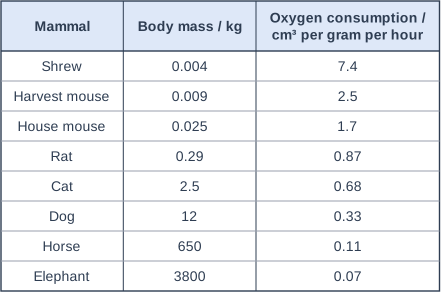
The table shows the rate of oxygen consumption, per gram of body mass, of some mammals at rest.

Calculate how many times greater the rate of oxygen consumption per gram is in the shrew than in the horse. Give your answer to 2 significant figures.

Use your knowledge of surface area to volume ratio to explain why small mammals have a higher rate of oxygen consumption per gram than large mammals.

Table with columns "Mammal", "Body mass / kg", "Oxygen consumption / cm³ per gram per hour". Mammal: Shrew; Body mass / kg: 0.004; Oxygen consumption / cm³ per gram per hour: 7.4 | Mammal: Harvest mouse; Body mass / kg: 0.009; Oxygen consumption / cm³ per gram per hour: 2.5 | Mammal: House mouse; Body mass / kg: 0.025; Oxygen consumption / cm³ per gram per hour: 1.7 | Mammal: Rat; Body mass / kg: 0.29; Oxygen consumption / cm³ per gram per hour: 0.87 | Mammal: Cat; Body mass / kg: 2.5; Oxygen consumption / cm³ per gram per hour: 0.68 | Mammal: Dog; Body mass / kg: 12; Oxygen consumption / cm³ per gram per hour: 0.33 | Mammal: Horse; Body mass / kg: 650; Oxygen consumption / cm³ per gram per hour: 0.11 | Mammal: Elephant; Body mass / kg: 3800; Oxygen consumption / cm³ per gram per hour: 0.07.

Model answer

Shrew ÷ horse = 7.4 ÷ 0.11 = 67 times greater

Small mammals have a larger surface area to volume ratio, so they lose heat to their surroundings faster for each gram of body mass. To maintain their body temperature they need a higher rate of respiration per gram, to release more heat, and respiration uses oxygen.

Explanation

Mammals keep a constant body temperature, so they must replace the heat they lose. Small mammals lose heat faster for their size because of their larger surface area to volume ratio, so their metabolic rate per gram is higher. Say respiration 'releases' energy or heat - never 'produces energy'.

Mark scheme
  1. 1 mark

    67; a correct answer with no working scores this mark

    Max 4. A correct answer with no working scores the mark. Working: 7.4 ÷ 0.11 = 67.3. Do not accept 67.3 (not to 2 significant figures) or 0.015 (inverted).

  2. 1 mark

    Small mammals have a larger surface area to volume ratio

    Points 2 to 5: max 3. Accept the converse for large mammals.

  3. 1 mark

    (So) they lose heat faster (per gram / per unit volume)

    Accept 'lose more heat for their size'.

  4. 1 mark

    (So) they need a higher rate of (aerobic) respiration (per gram), which uses more oxygen

  5. 1 mark

    To release (more) heat / to maintain (a constant) body temperature

    Accept 'generates heat'. Reject 'produces energy' or 'produces heat energy'.

Question 4

5 marks

Paramecium is a single-celled organism about 0.2 mm long that lives in pond water. A rabbit is a mammal with a mass of about 2 kg.

Explain why the rabbit needs a specialised gas exchange surface and a mass transport system to supply its cells with oxygen, but Paramecium does not.

Model answer

Paramecium is very small, so it has a large surface area to volume ratio and diffusion across its cell-surface membrane supplies enough oxygen for its volume. The diffusion distance to every part of the cell is short. The rabbit is much larger, so it has a small surface area to volume ratio: its body surface is too small to absorb enough oxygen for its large volume, and the diffusion distance to its inner cells is so long that diffusion would be far too slow. Its lungs provide a gas exchange surface, the alveoli, with a very large surface area and a short diffusion distance, and its blood, a mass transport system, carries the oxygen from the lungs to all the cells of the body.

Explanation

As an organism gets larger its volume increases faster than its surface area, so the ratio falls and the distance from the surface to the inner cells grows. A specialised exchange surface fixes the first problem and mass transport fixes the second. A common error is to say the rabbit 'needs more oxygen' without linking this to surface area to volume ratio or diffusion distance.

Mark scheme
  1. 1 mark

    Paramecium (is small so) has a large surface area to volume ratio

    Max 5.

  2. 1 mark

    (So) diffusion across its cell-surface membrane / body surface supplies enough oxygen for its volume / needs

  3. 1 mark

    Paramecium has a short diffusion distance (to all parts of the cell)

  4. 1 mark

    The rabbit (is large so) has a small surface area to volume ratio

  5. 1 mark

    (So) its body surface is too small to absorb enough oxygen for its (large) volume / metabolic needs

    Accept 'it needs more oxygen than diffusion across its body surface could supply'.

  6. 1 mark

    The rabbit has a long diffusion distance to its inner cells, so diffusion (from the surface) would be too slow

  7. 1 mark

    Its gas exchange surface (the alveoli in the lungs) has a large surface area and a short diffusion distance

    Accept a correct named feature of the alveoli. Insufficient: 'it has lungs' alone.

  8. 1 mark

    Mass transport (blood in the circulatory system) carries oxygen from the gas exchange surface to all cells / maintains the diffusion gradient

Ready to try the rest? Every answer you write is marked against the mark scheme, so you can see exactly where the marks are.

Study Helper Hints first, answers after you try

Stuck on this one? Ask for a hint and I’ll point you in the right direction, without giving the answer away. Once you’ve checked your answer, I’ll show you how the marks are awarded.