
Level:
Correct: 0
Incorrect: 0
Marks: 0/0
Exam Practice
Course:
Topics:
AQA A-Level Biology (Paper 1) Smart practice A mixed round aimed at your weak spots
Unit 1
Biological molecules
Unit 2
Cells
Unit 3
Organisms exchange substances with their environment
Unit 4
Genetic information, variation and relationships between organisms
DNA, genes and chromosomes
0%
Genetic diversity can arise as a result of mutation or during meiosis
Gene mutations and chromosome non-disjunction
0%
Meiosis and genetic variation
0%
Genetic diversity and adaptation
0%
Species and taxonomy
0%
Biodiversity within a community
0%
Investigating diversity
0%
Avg
score:
–
Topics
done:
0/35

Active transport and co-transport

Practise 17 exam-style questions on Active transport and co-transport for AQA A-Level Biology (Paper 1). Write your answer as you would in the exam and get it marked in seconds against the mark scheme, point by point, with the Study Helper on hand if you get stuck.

  • 17 questions
  • 1–8 marks each
  • Instant marking
  • No sign-up needed
17 questions, marked as you go

Sample questions with model answers

Here are 4 of the questions in this topic, each with a model answer, an explanation of why it earns the marks and the mark scheme an examiner would use.

Question 1

2 marks

Explain what is meant by co-transport.

Model answer

In co-transport, a carrier protein moves two different substances across a membrane at the same time, for example sodium ions and glucose. One substance (sodium ions) moves down its concentration gradient, and this allows the other (glucose) to be moved against its concentration gradient.

Explanation

Co-transport does not use ATP directly: the energy comes from one substance diffusing down its concentration gradient. That gradient is maintained by active transport elsewhere in the cell, such as the sodium-potassium pump, which does use ATP. In the ileum, sodium ions and glucose (or amino acids) enter the epithelial cells together through co-transport proteins.

Mark scheme
  1. 1 mark

    Two different substances are moved across a membrane together by the same carrier protein

    Accept 'a co-transport protein moves an ion and a molecule at the same time'. Accept a correct example, e.g. sodium ions and glucose.

  2. 1 mark

    One substance moves down its concentration gradient, which allows / provides the energy for the other to move against its concentration gradient

    Accept 'sodium ions diffusing in down their gradient drive the uptake of glucose against its gradient'. Reject 'the co-transport protein hydrolyses ATP'.
Question 2

3 marks

The free surface of a cell lining the ileum, facing the lumen, measures 9 μm × 9 μm. It is covered by 2500 microvilli. Each microvillus is a cylinder 1.2 μm long and 0.1 μm in diameter.

Curved surface area of a cylinder = π × diameter × length. Use π = 3.14

Assume that the surface area of the membrane with microvilli = area of the flat surface + total curved surface area of the microvilli.

Calculate how many times greater the surface area of this membrane is with microvilli than it would be without microvilli. Give your answer to 2 significant figures.

Explain how microvilli increase the rate of absorption of glucose by the cell.

Model answer

Area of flat surface = 9 × 9 = 81 μm²
Curved area of one microvillus = 3.14 × 0.1 × 1.2 = 0.3768 μm²
Total curved area = 2500 × 0.3768 = 942 μm²
Surface area with microvilli = 81 + 942 = 1023 μm²
1023 ÷ 81 = 12.6 = 13 times greater (2 s.f.)

The microvilli give much more cell-surface membrane, which can hold more co-transport proteins, so more glucose can be absorbed at the same time.

Explanation

Work out the area of the flat surface (9 × 9) and of the microvilli (number × π × diameter × length), add them, and divide by the flat area. Microvilli are folds of the cell-surface membrane of a single cell; they are not the same as villi, which are folds of the whole lining, made of many cells. A larger area of membrane holds more carrier and co-transport proteins, so the rate of absorption increases.

Mark scheme
  1. 1 mark

    Correct method: (81 + 2500 × 3.14 × 0.1 × 1.2) ÷ 81, i.e. 1023 ÷ 81; or a correct final answer of 13 with no working

    A correct answer of 13 with no working scores 2 marks (points 1 and 2). Accept for 1 mark: 12.6 or 12.63 (correct value not rounded to 2 significant figures) OR 942 or 1023 (a correct area in μm² but no ratio) OR 12 or 11.6 (the flat surface area not added).

  2. 1 mark

    13

    Must be given to 2 significant figures for this mark.

  3. 1 mark

    More membrane, so more (co-transport / carrier) proteins, so more glucose can be absorbed at the same time

    Insufficient: 'larger surface area' alone. Reject references to villi.

Question 3

3 marks

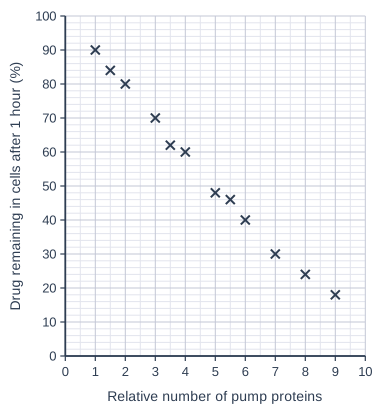
Some cancer cells have a carrier protein in their cell-surface membrane that uses ATP to pump anticancer drugs out of the cell. Scientists measured the relative number of these pump proteins in cells from 12 tumours, and the percentage of an anticancer drug that remained inside the cells 1 hour after it was added.

The graph shows their results.

Describe and explain the relationship shown in the graph. Suggest why adding a respiratory inhibitor would make these cancer cells more likely to be killed by the drug.

Scatter graph on a grid of small squares. The horizontal axis is "Relative number of pump proteins", from 0 to 10, numbered every 1, with 2 small squares between numbered values (each small square is 0.5). The vertical axis is "Drug remaining in cells after 1 hour (%)", from 0 to 100, numbered every 10, with 5 small squares between numbered values (each small square is 2). 12 points are plotted as crosses: (1, 90), (1.5, 84), (2, 80), (3, 70), (3.5, 62), (4, 60), (5, 48), (5.5, 46), (6, 40), (7, 30), (8, 24) and (9, 18).

Model answer

There is a negative correlation: the more pump proteins a cell has, the smaller the percentage of the drug left inside it after 1 hour (90% with 1 unit of pump protein, 18% with 9 units). More pump proteins means more drug molecules can be actively transported out of the cell at the same time. A respiratory inhibitor would reduce the production of ATP, so the pumps could not move the drug out; more drug would stay in the cells and kill them.

Explanation

The rate of active transport depends on the number of carrier proteins and on the supply of ATP. These pumps make cancer cells resistant to drugs by removing the drug before it can act, so blocking the ATP supply (or the pump itself) keeps the drug inside the cell. A correlation alone does not prove cause, but here the explanation is supported by what the pump is known to do.

Mark scheme
  1. 1 mark

    As the number of pump proteins increases, the percentage of drug remaining (in the cells) decreases / negative correlation

    Accept a correct description using values from the graph.

  2. 1 mark

    More pump proteins, so more drug is actively transported out of the cells at the same time / per unit time

    Accept 'more carriers to move the drug out against its concentration gradient'.

  3. 1 mark

    A respiratory inhibitor reduces ATP production, so the pumps cannot remove the drug, so more drug stays in the cells (to kill them)

    The idea of less ATP for the pump is needed. Reject 'less energy is produced'.

Question 4

5 marks

Young salmon hatch in rivers and later move into the sea. In the sea they gain sodium and chloride ions from the water they drink. Cells in their gills called chloride cells move these ions out of the blood into the sea water, against their concentration gradients.

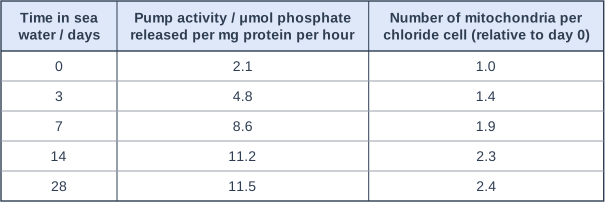
Scientists moved young salmon from fresh water into sea water. They measured the activity of the sodium-potassium pump protein in the chloride cells, as the rate at which it released phosphate from ATP, and the number of mitochondria in these cells. The table shows their results.

Calculate the percentage increase in pump activity between day 0 and day 28. Give your answer to 3 significant figures.

Use the information to explain how these changes help the salmon to survive in sea water.

Table with columns "Time in sea water / days", "Pump activity / μmol phosphate released per mg protein per hour", "Number of mitochondria per chloride cell (relative to day 0)". Time in sea water / days: 0; Pump activity / μmol phosphate released per mg protein per hour: 2.1; Number of mitochondria per chloride cell (relative to day 0): 1.0 | Time in sea water / days: 3; Pump activity / μmol phosphate released per mg protein per hour: 4.8; Number of mitochondria per chloride cell (relative to day 0): 1.4 | Time in sea water / days: 7; Pump activity / μmol phosphate released per mg protein per hour: 8.6; Number of mitochondria per chloride cell (relative to day 0): 1.9 | Time in sea water / days: 14; Pump activity / μmol phosphate released per mg protein per hour: 11.2; Number of mitochondria per chloride cell (relative to day 0): 2.3 | Time in sea water / days: 28; Pump activity / μmol phosphate released per mg protein per hour: 11.5; Number of mitochondria per chloride cell (relative to day 0): 2.4.

Model answer

Percentage increase = (11.5 - 2.1) ÷ 2.1 × 100 = 9.4 ÷ 2.1 × 100 = 448%

After the move to sea water the pump activity rose from 2.1 to 11.5 units, so the chloride cells have more active pump proteins and can move more sodium (and chloride) ions out of the blood. Moving ions against their concentration gradient needs ATP, which the pump hydrolyses, releasing phosphate. The number of mitochondria more than doubled, so more ATP can be produced by aerobic respiration for this active transport. This stops the concentration of ions in the blood rising, so the water potential of the blood does not fall and the salmon does not lose too much water by osmosis.

Explanation

Percentage increase = (new - original) ÷ original × 100, so divide by the day 0 value. The rate of active transport depends on the number of carrier (pump) proteins and on the supply of ATP. Measuring the release of phosphate is a way of measuring ATP hydrolysis by the pump. The chloride cells adapt to sea water by having more pump proteins and more mitochondria. Remember that mitochondria produce ATP; they do not 'produce energy'.

Mark scheme
  1. 1 mark

    Correct method: (11.5 - 2.1) ÷ 2.1 × 100; or a correct final answer of 448 with no working

    Max 5. Points 3 to 6: max 3. A correct answer of 448% with no working scores 2 marks (points 1 and 2). Accept for 1 mark: 4.48 (not multiplied by 100) OR 81.7 (difference divided by 11.5) OR 447.6 or 450 (correct value not given to 3 significant figures).

  2. 1 mark

    448 (%)

  3. 1 mark

    More pump activity / more pump proteins, so more (sodium and chloride) ions are moved out of the blood by active transport

  4. 1 mark

    More mitochondria, so more (aerobic) respiration / more ATP is produced

    Reject 'more energy is produced'.

  5. 1 mark

    ATP is hydrolysed / needed to move the ions against their concentration gradient

    Accept 'the release of phosphate shows the pump hydrolysing ATP'.

  6. 1 mark

    (So) the ion concentration of the blood does not rise / the water potential of the blood does not fall, so the salmon does not lose (too much) water by osmosis

    Accept 'prevents the blood becoming too concentrated'.

Ready to try the rest? Every answer you write is marked against the mark scheme, so you can see exactly where the marks are.

Study Helper Hints first, answers after you try

Stuck on this one? Ask for a hint and I’ll point you in the right direction, without giving the answer away. Once you’ve checked your answer, I’ll show you how the marks are awarded.