
Level:
Correct: 0
Incorrect: 0
Marks: 0/0
Exam Practice
Course:
Topics:
AQA A-Level Biology (Paper 1) Smart practice A mixed round aimed at your weak spots
Unit 1
Biological molecules
Unit 2
Cells
Unit 3
Organisms exchange substances with their environment
Unit 4
Genetic information, variation and relationships between organisms
DNA, genes and chromosomes
0%
Genetic diversity can arise as a result of mutation or during meiosis
Gene mutations and chromosome non-disjunction
0%
Meiosis and genetic variation
0%
Genetic diversity and adaptation
0%
Species and taxonomy
0%
Biodiversity within a community
0%
Investigating diversity
0%
Avg
score:
–
Topics
done:
0/35

Gene mutations and chromosome non-disjunction

Practise 17 exam-style questions on Gene mutations and chromosome non-disjunction for AQA A-Level Biology (Paper 1). Write your answer as you would in the exam and get it marked in seconds against the mark scheme, point by point, with the Study Helper on hand if you get stuck.

  • 17 questions
  • 1–8 marks each
  • Instant marking
  • No sign-up needed
17 questions, marked as you go

Sample questions with model answers

Here are 4 of the questions in this topic, each with a model answer, an explanation of why it earns the marks and the mark scheme an examiner would use.

Question 1

2 marks

The base sequences of part of the same strand of two alleles of a gene are shown.

Allele 1:   TACGTCAAGCTGACA
Allele 2:   TACGACAAGCGACA

Allele 2 was produced from allele 1 by two gene mutations. Name each type of mutation and give the position of the base involved in allele 1, counting from the left.

Model answer

1. A base substitution at base 5: T is replaced by A.
2. A base deletion at base 11: the T is lost, so allele 2 is one base shorter.

Explanation

Line the sequences up from the left. The first difference is at base 5, where T becomes A, but the sequences then match again, so this is a substitution. At base 11 allele 1 has a T that allele 2 lacks; after this, allele 2 matches allele 1 shifted by one base, and allele 2 has 14 bases instead of 15, so this is a deletion. Both kinds of mutation change the base sequence of the gene.

Mark scheme
  1. 1 mark

    Substitution at base 5 / the T at position 5 replaced by A

    1 mark for each mutation with its type and position. Accept 'fifth base changed from T to A'.

  2. 1 mark

    Deletion at base 11 / the T at position 11 lost

    Accept 'eleventh base (T) removed'. Reject addition or insertion. Reject a deletion at any other position.
Question 2

3 marks

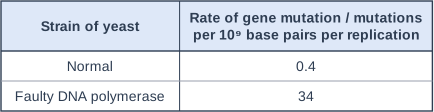
DNA polymerase in most cells can remove a nucleotide that has been added with the wrong base during DNA replication. Scientists compared the rate of gene mutation in a normal strain of yeast with the rate in a strain whose DNA polymerase cannot remove wrongly added nucleotides. The table shows their results.

Calculate how many times greater the mutation rate is in the strain with the faulty DNA polymerase.

Explain why the strain with the faulty DNA polymerase has a higher rate of gene mutation.

Table with columns "Strain of yeast", "Rate of gene mutation / mutations per 10⁹ base pairs per replication". Strain of yeast: Normal; Rate of gene mutation / mutations per 10⁹ base pairs per replication: 0.4 | Strain of yeast: Faulty DNA polymerase; Rate of gene mutation / mutations per 10⁹ base pairs per replication: 34.

Model answer

34 ÷ 0.4 = 85 times greater.

During DNA replication, nucleotides with the wrong base are sometimes added by DNA polymerase in both strains. In the faulty strain these wrongly paired bases are not removed, so they stay in the new DNA, changing its base sequence (base substitutions) and being passed on to daughter cells.

Explanation

Gene mutations arise spontaneously during DNA replication when a nucleotide with a non-complementary base is added. Most such errors are normally removed straight away, so the mutation rate stays very low. If the polymerase cannot correct its errors, far more of them stay in the DNA as changes in the base sequence. Divide the faulty strain's rate by the normal rate to find how many times greater it is.

Mark scheme
  1. 1 mark

    85 (times); a correct answer of 85 with no working scores this mark

    Max 3. A correct answer of 85 (accept 85 times or × 85) with no working scores this mark. Reject 0.012 (inverted) and 33.6 (the difference).

  2. 1 mark

    Nucleotides with non-complementary / wrong bases are sometimes added during replication (in both strains)

    Max 2 for points 2 to 4. Accept 'base-pairing errors happen during replication'.

  3. 1 mark

    In the faulty strain, these wrongly paired bases are not removed / corrected

  4. 1 mark

    So the base sequence of the new DNA is changed / base substitutions remain and are passed on (to daughter cells)

    Accept 'more changes to the base sequence of DNA'.

Question 3

3 marks

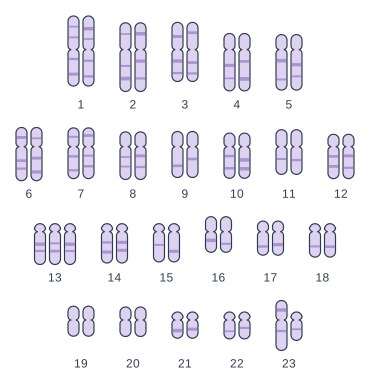
The figure shows the karyotype of a baby, arranged from the chromosomes of one body cell.

Give the total number of chromosomes in each body cell of this baby.

Name the process during meiosis in one of the baby's parents that most probably produced this mutation.

Explain why this is described as a mutation in the number of chromosomes and not as a gene mutation.

Diagram of a karyotype: the chromosomes from one body cell, arranged in 23 pairs in four rows, from the largest pair at the top left to the smallest; the pairs are numbered 1 to 23. Each chromosome is drawn as a banded rod pinched at one point. In pairs 1 to 22 the two chromosomes of each pair look the same, except that pair 13 has three chromosomes instead of two. In pair 23 the two chromosomes are different: one is medium-sized and the other is much smaller.

Model answer

Total number of chromosomes = 47 (three copies of chromosome 13).

Process: non-disjunction (a pair of homologous chromosomes, or of sister chromatids, failed to separate in meiosis).

The baby has a whole extra chromosome 13, so the number of chromosomes has changed. A gene mutation is a change in the base sequence of a gene, and here the base sequences of the genes are normal; there is simply an extra copy of every gene on chromosome 13.

Explanation

A normal human body cell has 46 chromosomes in 23 pairs; this karyotype has three copies of chromosome 13, so it has 47. This kind of mutation arises by non-disjunction during meiosis in a parent: two chromosome 13s (homologues or sister chromatids) fail to separate and move to the same pole, giving a gamete with 24 chromosomes. It changes the number of chromosomes, not the base sequence of any gene, which is what distinguishes it from a gene mutation such as a substitution or deletion. Spell the process non-disjunction, not 'non-disfunction'.

Mark scheme
  1. 1 mark

    47

    Reject 46, 69 or 23.

  2. 1 mark

    (Chromosome) non-disjunction

    Accept a description: homologous chromosomes / sister chromatids failed to separate (in meiosis). Insufficient: trisomy or aneuploidy (these name the result, not the process). Reject 'non-disfunction', polyploidy and any gene mutation (substitution, deletion).

  3. 1 mark

    There is a whole extra chromosome / three copies of chromosome 13, but the base sequence of the genes is not changed

    Both ideas are needed: an extra (whole) chromosome AND no change in the base sequence (of a gene). Accept 'a gene mutation is a change in the base sequence; here the genes are normal but there is an extra copy of chromosome 13'. Insufficient: 'there are 47 chromosomes' on its own.

Question 4

4 marks

In a population of a flowering plant, 2.0% of pollen grains and 1.5% of egg cells carry one extra chromosome because of non-disjunction during meiosis. All the other gametes have the normal number of chromosomes. Fertilisation is random.

Calculate the percentage of zygotes that will have exactly one extra chromosome.

Calculate the percentage of zygotes that will have two extra chromosomes.

The percentage of seedlings with an extra chromosome was found to be lower than the percentage you calculated for zygotes. Suggest one reason why.

Model answer

Exactly one extra chromosome = (abnormal pollen × normal egg) + (normal pollen × abnormal egg)
= (0.020 × 0.985) + (0.980 × 0.015) = 0.0197 + 0.0147 = 0.0344 = 3.44%

Two extra chromosomes = 0.020 × 0.015 = 0.0003 = 0.03%

Many zygotes with an extra chromosome do not develop into seedlings, because the extra chromosome upsets development, so they die as embryos or seeds.

Explanation

With random fertilisation, the probability of two independent events both happening is found by multiplying their probabilities. A zygote has exactly one extra chromosome if the pollen is abnormal and the egg normal, or the other way round, so add those two products. Simply adding 2.0% and 1.5% gives 3.5%, which wrongly includes the 0.03% of zygotes that received an extra chromosome from both gametes. Changes in chromosome number often stop normal development, so fewer survive to become seedlings.

Mark scheme
  1. 1 mark

    Correct method, e.g. (0.020 × 0.985) + (0.980 × 0.015); or a correct final answer of 3.44 (accept 3.4)% with no working

    A correct answer of 3.44% (accept 3.4) with no working scores 2 marks (points 1 and 2). Accept for 1 mark: evidence of 1.97 and 1.47 OR 0.0344 (correct proportion, not converted to a percentage) OR 3.47 (zygotes with at least one extra chromosome, 2.0 + 1.5 - 0.03). Do not award any mark for 3.5 (2.0 + 1.5).

  2. 1 mark

    3.44 (%)

    Accept 3.4.

  3. 1 mark

    0.03 (%)

    Accept 0.0003 only if it is clearly labelled as a proportion, not a percentage. Accept 0.030. Reject 3.5 or 0.3.

  4. 1 mark

    (Many) zygotes / embryos / seeds with an extra chromosome die / do not develop / are not viable

    List rule: if more than one reason is given, a wrong or contradictory extra reason cancels the correct one. Accept 'gametes with an extra chromosome are less likely to take part in fertilisation'. Accept 'pollen with an extra chromosome is less likely to germinate or reach the egg'. Ignore 'sampling error' on its own.

Ready to try the rest? Every answer you write is marked against the mark scheme, so you can see exactly where the marks are.

Study Helper Hints first, answers after you try

Stuck on this one? Ask for a hint and I’ll point you in the right direction, without giving the answer away. Once you’ve checked your answer, I’ll show you how the marks are awarded.