
Level:
Correct: 0
Incorrect: 0
Marks: 0/0
Exam Practice
Course:
Topics:
AQA A-Level Biology (Paper 1) Smart practice A mixed round aimed at your weak spots
Unit 1
Biological molecules
Unit 2
Cells
Unit 3
Organisms exchange substances with their environment
Unit 4
Genetic information, variation and relationships between organisms
DNA, genes and chromosomes
0%
Genetic diversity can arise as a result of mutation or during meiosis
Gene mutations and chromosome non-disjunction
0%
Meiosis and genetic variation
0%
Genetic diversity and adaptation
0%
Species and taxonomy
0%
Biodiversity within a community
0%
Investigating diversity
0%
Avg
score:
–
Topics
done:
0/35

DNA replication

Practise 17 exam-style questions on DNA replication for AQA A-Level Biology (Paper 1). Write your answer as you would in the exam and get it marked in seconds against the mark scheme, point by point, with the Study Helper on hand if you get stuck.

  • 17 questions
  • 1–9 marks each
  • Instant marking
  • No sign-up needed
17 questions, marked as you go

Sample questions with model answers

Here are 4 of the questions in this topic, each with a model answer, an explanation of why it earns the marks and the mark scheme an examiner would use.

Question 1

2 marks

DNA polymerase joins DNA nucleotides together, but it cannot join RNA nucleotides together.

Use your knowledge of enzymes and of nucleotide structure to explain why.

Model answer

RNA nucleotides contain ribose instead of deoxyribose, so they have a different shape from DNA nucleotides. They are not complementary to the active site of DNA polymerase, so they cannot bind to it and no enzyme-substrate complexes form.

Explanation

Enzymes are specific because the shape of the active site is complementary to only one substrate (or a few very similar ones). Ribose has an OH group where deoxyribose has H, which changes the shape of the nucleotide enough to prevent binding. Say 'complementary' rather than 'the same shape'.

Mark scheme
  1. 1 mark

    RNA nucleotides contain ribose (not deoxyribose), so they have a different shape / structure

    Accept 'RNA nucleotides contain uracil' only with the idea of a different shape.

  2. 1 mark

    (So RNA nucleotides) are not complementary to / do not fit / bind to the active site of DNA polymerase, so no enzyme-substrate complexes form

    Accept ES complex. Reject 'the active site is on the nucleotide' or 'same shape as the active site'.
Question 2

3 marks

Explain the importance of hydrogen bonds in the semi-conservative replication of DNA.

Model answer

DNA helicase breaks the hydrogen bonds between complementary bases, so the double helix unwinds and the two strands separate. Each hydrogen bond is weak, so little energy is needed to separate the strands. This exposes the bases, so each strand can act as a template. Free DNA nucleotides form hydrogen bonds with the complementary bases on the template strand, which holds them in position until DNA polymerase joins them. In each new DNA molecule, hydrogen bonds hold the new strand and the template strand together.

Explanation

Hydrogen bonds matter twice in replication: breaking them separates the strands and exposes the bases, and forming new ones between complementary bases lines up the free nucleotides on each template. Each hydrogen bond is weak, so the strands separate easily without breaking the phosphodiester bonds of the backbones. DNA polymerase forms phosphodiester bonds, not hydrogen bonds - a common error.

Mark scheme
  1. 1 mark

    Hydrogen bonds between complementary bases are broken by DNA helicase, so the two strands separate / the double helix unwinds

    Max 3. Reject 'phosphodiester bonds are broken'. Accept phonetic spellings of helicase.

  2. 1 mark

    Each hydrogen bond is weak, so the strands are separated easily / with little energy

    Do not accept 'hydrogen bonds are strong'. Ignore 'many hydrogen bonds make DNA stable' unless linked to replication.

  3. 1 mark

    Separating the strands exposes the bases, so each strand can act as a template

    Accept 'both strands are copied'.

  4. 1 mark

    Hydrogen bonds form between the bases of free (DNA) nucleotides and the complementary bases on the template strand / complementary base pairing holds the free nucleotides in position

    Reject 'DNA polymerase forms the hydrogen bonds' and 'free bases' for free nucleotides.

  5. 1 mark

    Hydrogen bonds hold each new strand and its template strand together (as a double helix)

    Accept 'the new DNA molecule is held together by hydrogen bonds between the original and the new strand'.

Question 3

3 marks

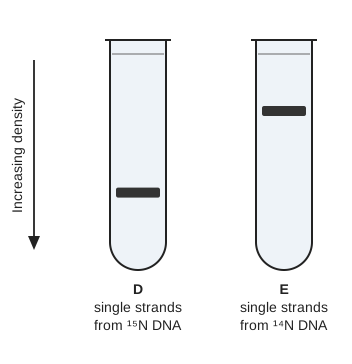
Scientists can separate the two strands of DNA by heating it. The single strands can then be centrifuged in a density gradient. The figure shows the results for single strands from DNA containing only ¹⁵N (tube D) and single strands from DNA containing only ¹⁴N (tube E).

Bacteria whose DNA contained only ¹⁵N were grown for one generation in a medium containing only ¹⁴N. Their DNA was extracted, heated to separate the strands and centrifuged.

In the dispersive model of DNA replication, each strand of a new DNA molecule is made of a mixture of sections of the original DNA and sections of new DNA.

Describe and explain the results expected if DNA replication is semi-conservative, and the results expected if it is dispersive.

Two centrifuge tubes, labelled D and E, side by side. An arrow on the left labelled Increasing density points down the tubes. Tube D, captioned single strands from 15N DNA, has one band low in the tube. Tube E, captioned single strands from 14N DNA, has one band high in the tube.

Model answer

Semi-conservative: two bands of equal size, one at the level of the band in tube D and one at the level of the band in tube E. Each DNA molecule contains one complete original ¹⁵N strand and one complete new ¹⁴N strand, so when the strands are separated there are equal numbers of ¹⁵N strands and ¹⁴N strands.
Dispersive: one band, halfway between the levels in tubes D and E, because every strand contains a mixture of ¹⁵N sections and ¹⁴N sections.

Explanation

Without heating, both models give one intermediate band after one generation. Separating the strands shows what each individual strand is made of: whole old and whole new strands (semi-conservative) or mixed strands (dispersive). This is an example of refining a procedure so that an experiment can distinguish between hypotheses.

Mark scheme
  1. 1 mark

    Semi-conservative: two bands, at the same levels as the bands in tubes D and E

    Max 2 if the answer describes the results for only one model. Max 3 overall. Accept 'a heavy single-strand band and a light single-strand band'.

  2. 1 mark

    (Equal amounts, because) each molecule contains one complete original ¹⁵N strand and one complete new ¹⁴N strand

  3. 1 mark

    Dispersive: one band, between / halfway between the levels of the bands in tubes D and E

  4. 1 mark

    (Because) every strand contains a mixture of ¹⁵N and ¹⁴N (sections)

Question 4

4 marks

A human chromosome contains 2.4 × 10⁸ base pairs. During replication, DNA is copied at replication forks. Each replication fork moves along the DNA at 2400 base pairs per minute. Replication begins at a starting point on the DNA, and two replication forks move away from that point in opposite directions.

Calculate the time, in days, that it would take to replicate this chromosome if replication began at only one starting point. Give your answer to 2 significant figures.

In human cells, replication of all the DNA is completed in about 8 hours. Calculate the minimum number of starting points needed to replicate this chromosome in 8 hours.

Model answer

Time with one starting point = 2.4 × 10⁸ ÷ (2 × 2400) = 50 000 minutes
50 000 ÷ (60 × 24) = 34.7 days = 35 days (2 s.f.)

Base pairs copied from one starting point in 8 hours = 2 × 2400 × 8 × 60 = 2 304 000
Number of starting points = 2.4 × 10⁸ ÷ 2 304 000 = 104.2
Minimum number of starting points = 105

Explanation

Two forks move from each starting point, so each starting point copies 4800 base pairs per minute. With a single starting point, replicating one chromosome would take over a month, so eukaryotic DNA must be replicated from many starting points at once. Round the number of starting points up, because 104 would not be enough. Common errors are using one fork instead of two and forgetting to convert minutes to days.

Mark scheme
  1. 1 mark

    Correct method for the time, e.g. 2.4 × 10⁸ ÷ (2 × 2400) = 50 000 minutes, divided by (60 × 24); or a correct final answer of 35 (days) with no working

    A correct answer of 35 days with no working scores 2 marks (points 1 and 2). Accept for 1 mark: 34.7 or 34.72 (not given to 2 significant figures) OR 69 / 69.4 (only one fork used) OR 50 000 minutes / 833 hours (not converted to days).

  2. 1 mark

    35 (days)

    Do not accept 34.7 for this mark.

  3. 1 mark

    Correct method for the number of starting points, e.g. 2.4 × 10⁸ ÷ (2 × 2400 × 8 × 60) = 104.2; or a correct final answer of 105 with no working

    A correct answer of 105 with no working scores 2 marks (points 3 and 4). Accept for 1 mark: 104 or 104.2 (not rounded up to a whole number of starting points) OR 208 or 209 (one fork per starting point). ECF from a wrong time: accept (time from the first part in hours) ÷ 8, rounded up.

  4. 1 mark

    105

    Do not accept 104.

Ready to try the rest? Every answer you write is marked against the mark scheme, so you can see exactly where the marks are.

Study Helper Hints first, answers after you try

Stuck on this one? Ask for a hint and I’ll point you in the right direction, without giving the answer away. Once you’ve checked your answer, I’ll show you how the marks are awarded.