
Level:
Correct: 0
Incorrect: 0
Marks: 0/0
Exam Practice
Course:
Topics:
AQA A-Level Biology (Paper 1) Smart practice A mixed round aimed at your weak spots
Unit 1
Biological molecules
Unit 2
Cells
Unit 3
Organisms exchange substances with their environment
Unit 4
Genetic information, variation and relationships between organisms
DNA, genes and chromosomes
0%
Genetic diversity can arise as a result of mutation or during meiosis
Gene mutations and chromosome non-disjunction
0%
Meiosis and genetic variation
0%
Genetic diversity and adaptation
0%
Species and taxonomy
0%
Biodiversity within a community
0%
Investigating diversity
0%
Avg
score:
–
Topics
done:
0/35

Genome, proteome, transcription and splicing

Practise 17 exam-style questions on Genome, proteome, transcription and splicing for AQA A-Level Biology (Paper 1). Write your answer as you would in the exam and get it marked in seconds against the mark scheme, point by point, with the Study Helper on hand if you get stuck.

  • 17 questions
  • 1–8 marks each
  • Instant marking
  • No sign-up needed
17 questions, marked as you go

Sample questions with model answers

Here are 4 of the questions in this topic, each with a model answer, an explanation of why it earns the marks and the mark scheme an examiner would use.

Question 1

2 marks

Part of the template strand of a gene has this base sequence:

TACGGTCAAGCT

Give the base sequence of the mRNA transcribed from this part of the template strand.

Give the base sequence of the same part of the other DNA strand (the strand that is not used as the template).

Model answer

mRNA: AUG CCA GUU CGA
Other DNA strand: ATG CCA GTT CGA

Explanation

During transcription, free RNA nucleotides pair with the template strand by complementary base pairing: A on the template pairs with U, T with A, C with G and G with C. The other DNA strand is also complementary to the template, so it has the same sequence as the mRNA except that it has T where the mRNA has U. Common errors are putting T in the mRNA or U in the DNA.

Mark scheme
  1. 1 mark

    (mRNA) AUGCCAGUUCGA

    Accept the sequence with spaces, e.g. AUG CCA GUU CGA. Do not accept a sequence containing T.

  2. 1 mark

    (Other DNA strand) ATGCCAGTTCGA

    Accept with spaces, e.g. ATG CCA GTT CGA. Do not accept a sequence containing U.
Question 2

2 marks

In bacteria, ribosomes can begin to translate a molecule of mRNA while it is still being transcribed from the DNA.

Explain why this cannot happen in a human cell.

Model answer

In a human cell, transcription takes place in the nucleus, but the ribosomes are in the cytoplasm, separated from the DNA by the nuclear envelope. Also, the RNA first made is pre-mRNA, which must be spliced to remove its introns before the mRNA leaves the nucleus through a nuclear pore and is translated.

Explanation

In prokaryotes, transcription produces mRNA directly in the cytoplasm, where the ribosomes are, so translation can start straight away. In eukaryotes, transcription produces pre-mRNA in the nucleus; it must be spliced and the mRNA must leave through the nuclear pores before ribosomes can translate it.

Mark scheme
  1. 1 mark

    (In human cells) transcription occurs in the nucleus but translation occurs (at ribosomes) in the cytoplasm / the nuclear envelope separates the DNA from the ribosomes

    Max 2. Accept 'bacteria have no nucleus, so the DNA and ribosomes are both in the cytoplasm' only if the human cell is also described.

  2. 1 mark

    Pre-mRNA must first be spliced / have its introns removed before it can be translated

    Accept 'the RNA first made is pre-mRNA, which contains introns'.

  3. 1 mark

    mRNA must leave the nucleus through nuclear pores (after transcription and splicing are complete)

Question 3

4 marks

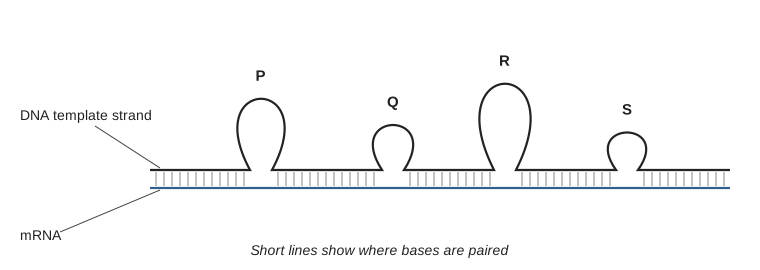
Scientists separated the two strands of the DNA of one gene from a eukaryotic cell. They mixed the template strand with mRNA for this gene, taken from the cytoplasm of the same type of cell. Where the bases of the mRNA were complementary to the bases of the DNA, the two strands paired. The figure shows what the scientists saw with an electron microscope.

Explain why the loops labelled P, Q, R and S formed, and give the number of exons in this gene.

The scientists repeated the experiment with pre-mRNA from the nucleus instead of mRNA from the cytoplasm. Suggest the result. Explain your answer.

A long horizontal strand labelled DNA template strand, with a second strand labelled mRNA running parallel just below it. Short vertical lines join the two strands in five separate regions. Between these regions, the DNA strand forms four loops that rise above the mRNA; the loops are labelled P, Q, R and S from left to right and are of different sizes, R being the largest and S the smallest. A note says short lines show where bases are paired.

Model answer

The loops are introns. The mRNA from the cytoplasm has been spliced, so its introns were removed; the DNA of each intron has no complementary sequence on the mRNA and stays unpaired as a loop. The paired regions are the exons, so the gene has 5 exons (separated by 4 introns). With pre-mRNA, no loops would form: pre-mRNA has not yet been spliced and still contains the introns, so it would pair with the whole length of the template strand.

Explanation

Mature mRNA contains only the exons joined together, so it can pair only with the exon regions of the template strand; each intron loops out. Four loops between five paired regions means four introns and five exons. Pre-mRNA is a complementary copy of the whole gene, so it pairs along its full length. A common error is to count the loops as exons.

Mark scheme
  1. 1 mark

    The loops are introns / non-coding sequences of the DNA

    Max 4.

  2. 1 mark

    Introns were removed from the mRNA (by splicing), so the mRNA has no complementary sequence to pair with these regions of DNA

    Accept 'the loops have no complementary bases on the mRNA'.

  3. 1 mark

    5 (exons)

    Do not accept 4.

  4. 1 mark

    (Pre-mRNA) no loops would form / the pre-mRNA would pair along the whole length of the DNA

  5. 1 mark

    Because pre-mRNA has not been spliced / still contains the introns, so it is complementary to the whole template strand

Question 4

5 marks

One human gene is 2.3 × 10⁶ base pairs long and contains 79 exons. The pre-mRNA transcribed from this gene is the same length as the gene. After splicing, the mRNA is 1.4 × 10⁴ nucleotides long.

Calculate the mean length of one intron in this gene. Give your answer in standard form, to 3 significant figures.

More than 99% of the pre-mRNA of this gene is removed by splicing. Describe what happens during splicing, and explain why the mRNA still codes for the complete polypeptide.

Model answer

A gene with 79 exons has 78 introns.
Total length of the introns = 2.3 × 10⁶ - 1.4 × 10⁴ = 2 286 000 nucleotides
Mean length of one intron = 2 286 000 ÷ 78 = 29 308 = 2.93 × 10⁴ nucleotides (3 s.f.)

During splicing, the introns are removed from the pre-mRNA and the exons are joined together. The introns are non-coding: only the exons code for the amino acid sequence of the polypeptide, so the mRNA still contains every codon of the polypeptide, even though most of the pre-mRNA has been removed.

Explanation

In a gene, introns separate the exons, so a gene with 79 exons has 78 introns; their total length is the length of the pre-mRNA minus the length of the spliced mRNA. Common errors are dividing by 79 and forgetting to subtract the mRNA. Splicing removes the introns and joins the exons; because introns do not code for amino acids, removing even most of the pre-mRNA loses no coding sequence.

Mark scheme
  1. 1 mark

    Correct method: (2.3 × 10⁶ - 1.4 × 10⁴) ÷ 78; or a correct final answer of 2.93 × 10⁴ (nucleotides / base pairs) with no working

    A correct answer of 2.93 × 10⁴ with no working scores 2 marks (points 1 and 2). Accept for 1 mark: 2.89 × 10⁴ (divided by 79, the number of exons, instead of 78 introns) OR 2.95 × 10⁴ (length of the mRNA not subtracted) OR 29 300 or 29 308 (not in standard form) OR 2.9 × 10⁴ (not to 3 significant figures) OR evidence of 2.286 × 10⁶ / 2 286 000 (total length of the introns). Points 1 and 2 are for the calculation; points 3 to 5 are for splicing.

  2. 1 mark

    2.93 × 10⁴ (nucleotides / base pairs)

    Ignore a missing unit.

  3. 1 mark

    Introns are removed / cut out (of the pre-mRNA)

    Accept 'non-coding sequences are removed'. Reject 'exons are removed'.

  4. 1 mark

    The exons are joined (together)

    Accept 'the remaining (coding) sequences are joined'.

  5. 1 mark

    Introns do not code for amino acids / only the exons code for the amino acid sequence, so no codons for the polypeptide are lost

    Accept 'introns are non-coding, so the mRNA still contains all the coding sequence'. Ignore 'introns are not needed' unqualified.

Ready to try the rest? Every answer you write is marked against the mark scheme, so you can see exactly where the marks are.

Study Helper Hints first, answers after you try

Stuck on this one? Ask for a hint and I’ll point you in the right direction, without giving the answer away. Once you’ve checked your answer, I’ll show you how the marks are awarded.