Question 1
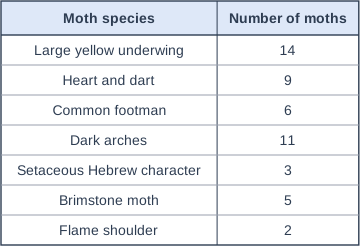
2 marksEcologists set a light trap overnight beside a hedgerow on a farm. The next morning, they identified and counted the moths in the trap. The table shows their results.
The index of diversity, d, can be calculated using the formula
d = N(N - 1) ÷ Σn(n - 1)
where N = total number of moths of all species and n = total number of moths of each species.
Calculate the index of diversity of the moths in the trap. Give your answer to 2 decimal places.
Model answer
N = 14 + 9 + 6 + 11 + 3 + 5 + 2 = 50
N(N - 1) = 50 × 49 = 2450
Σn(n - 1) = (14 × 13) + (9 × 8) + (6 × 5) + (11 × 10) + (3 × 2) + (5 × 4) + (2 × 1)
= 182 + 72 + 30 + 110 + 6 + 20 + 2 = 422
d = 2450 ÷ 422 = 5.8057
d = 5.81 (to 2 decimal places)
Explanation
N is the total number of individuals of all species (50 moths), not the number of species (7) - using the number of species is the commonest error. Work out n(n - 1) for each species separately, add the values to get Σn(n - 1), then divide N(N - 1) by this total. Write down N(N - 1) and Σn(n - 1): each can earn a mark even if the final answer is wrong.
Mark scheme
-
1 mark
Correct method, e.g. N(N - 1) = 50 × 49 = 2450 OR Σn(n - 1) = 422; or a correct final answer of 5.81 with no working
A correct answer of 5.81 with no working scores 2 marks. Accept for 1 mark: evidence of 2450 (correct N(N - 1)) OR evidence of 422 (correct Σn(n - 1)) OR 5.8, 5.80 or 5.806 (correct value not given correctly to 2 decimal places). Do not award this mark for using N = 7 (the number of species instead of the number of moths).
-
1 mark
5.81
Only 5.81 scores this mark. Ignore any unit.