
Level:
Correct: 0
Incorrect: 0
Marks: 0/0
Exam Practice
Course:
Topics:
AQA A-Level Biology (Paper 1) Smart practice A mixed round aimed at your weak spots
Unit 1
Biological molecules
Unit 2
Cells
Unit 3
Organisms exchange substances with their environment
Unit 4
Genetic information, variation and relationships between organisms
DNA, genes and chromosomes
0%
Genetic diversity can arise as a result of mutation or during meiosis
Gene mutations and chromosome non-disjunction
0%
Meiosis and genetic variation
0%
Genetic diversity and adaptation
0%
Species and taxonomy
0%
Biodiversity within a community
0%
Investigating diversity
0%
Avg
score:
–
Topics
done:
0/35

Human gas exchange, ventilation and lung disease

Practise 18 exam-style questions on Human gas exchange, ventilation and lung disease for AQA A-Level Biology (Paper 1). Write your answer as you would in the exam and get it marked in seconds against the mark scheme, point by point, with the Study Helper on hand if you get stuck.

  • 18 questions
  • 1–9 marks each
  • Instant marking
  • No sign-up needed
18 questions, marked as you go

Sample questions with model answers

Here are 4 of the questions in this topic, each with a model answer, an explanation of why it earns the marks and the mark scheme an examiner would use.

Question 1

2 marks

In mammals, the gas exchange surface is inside the body, in the lungs, and air has to be moved to it by ventilation.

Explain why it is an advantage to a mammal living on land that its gas exchange surface is inside the body.

Model answer

The alveolar surface is thin and moist, so water evaporates from it. Inside the body, the air in contact with it is kept moist, so much less water is lost than if the surface were exposed to the dry outside air, and the thin, delicate surface is also protected from damage.

Explanation

This is the same compromise seen in insects and plants: an efficient gas exchange surface must be thin and moist, but such a surface loses water. Keeping it deep inside the body, ventilated through narrow airways, reduces evaporation and protects it. 'It is protected' scores only when linked to a thin or delicate surface.

Mark scheme
  1. 1 mark

    The gas exchange surface is thin/moist, so water would evaporate from it (if it were exposed to the air)

    Max 2.

  2. 1 mark

    Inside the body less water is lost (by evaporation) / the air in the lungs is moist so the surface does not dry out

    Accept 'reduces water loss' for this point.

  3. 1 mark

    The thin/delicate surface is protected (from damage) inside the body

    Ignore 'protected' unqualified, with no reference to the surface being thin or delicate, or to damage.
Question 2

3 marks

Before modern ventilators, some patients whose breathing muscles were paralysed were kept alive in an 'iron lung'. The patient lay inside a sealed metal chamber with only their head outside it. A pump lowered the air pressure inside the chamber, then let it return to atmospheric pressure, about 15 times a minute.

Explain how lowering the air pressure inside the chamber caused air to enter the patient's lungs.

Model answer

When the pump lowers the pressure in the chamber, the pressure outside the patient's chest becomes lower than the pressure inside it, so the chest wall and ribs move outwards. This increases the volume of the thoracic cavity and lungs, so the pressure in the alveoli falls below atmospheric pressure. The patient's head is outside the chamber, so air at atmospheric pressure flows in through the mouth, nose and trachea, down the pressure gradient, into the lungs.

Explanation

The iron lung does from the outside what the diaphragm and external intercostal muscles normally do from the inside: it increases the volume of the thoracic cavity, which lowers the pressure in the lungs below atmospheric pressure. Answers must follow the chain: volume increases, pressure falls, air flows in down a pressure gradient. When the chamber returns to atmospheric pressure, the elastic lungs recoil and air is breathed out.

Mark scheme
  1. 1 mark

    Pressure outside the chest becomes lower (than inside), so the chest wall / ribs move outwards (and the diaphragm moves down)

    Max 3.

  2. 1 mark

    (So) the volume of the thoracic cavity / lungs increases

    Accept thorax for thoracic cavity.

  3. 1 mark

    (So) the pressure in the lungs/alveoli falls below atmospheric pressure

  4. 1 mark

    Air enters through the mouth/nose/trachea, which are outside the chamber at atmospheric pressure, down a pressure gradient

    Accept 'air moves from the higher pressure outside into the lungs'.

Question 3

4 marks

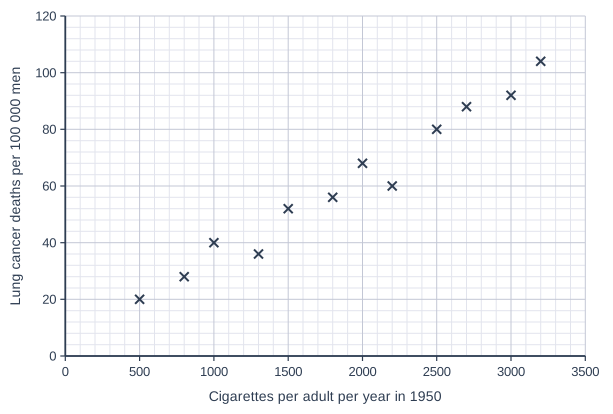
Scientists collected data from 12 countries. For each country they recorded the mean number of cigarettes smoked per adult in 1950 and the death rate from lung cancer in men in 1970. The graph shows their results.

Describe the relationship shown by the graph.

Suggest why the scientists used data on smoking from 20 years before the data on lung cancer deaths.

Explain why these data alone do not show that smoking causes lung cancer.

Scatter graph on a grid of small squares. The horizontal axis is "Cigarettes per adult per year in 1950", from 0 to 3500, numbered every 500, with 5 small squares between numbered values (each small square is 100). The vertical axis is "Lung cancer deaths per 100 000 men", from 0 to 120, numbered every 20, with 5 small squares between numbered values (each small square is 4). 12 points are plotted as crosses: (500, 20), (800, 28), (1000, 40), (1300, 36), (1500, 52), (1800, 56), (2000, 68), (2200, 60), (2500, 80), (2700, 88), (3000, 92) and (3200, 104).

Model answer

The graph shows a positive correlation: countries where more cigarettes were smoked per adult in 1950 had higher lung cancer death rates in men in 1970.
Lung cancer takes many years to develop after people start smoking, so the scientists compared smoking with deaths 20 years later.
A correlation does not show causation. Other factors that differ between countries, such as air pollution or jobs involving exposure to chemicals, could affect lung cancer death rates. Also, the data are national averages, so they do not show whether the men who died were the people who smoked.

Explanation

Data comparing whole countries can show a correlation and suggest a hypothesis, but cannot prove cause: countries differ in many ways, and averages do not link individual smokers to individual deaths. Evidence that smoking causes lung cancer comes from studies following individual smokers and non-smokers, and from finding the mechanism (carcinogens in smoke damaging DNA). The 20-year gap reflects how long lung cancer takes to develop.

Mark scheme
  1. 1 mark

    Positive correlation / as the number of cigarettes smoked increases, the death rate from lung cancer increases

    Max 4. Accept 'strong positive correlation'.

  2. 1 mark

    Lung cancer takes many years to develop (after smoking starts) / there is a long time lag between exposure and death

  3. 1 mark

    Correlation does not show causation / the data do not show how smoking could cause lung cancer (a mechanism)

    Points 3 to 6: max 2.

  4. 1 mark

    Other factors could affect the death rate in different countries, e.g. air pollution, jobs involving exposure to dust or chemicals, genetic differences, the age of the population, differences in diagnosis or recording

    Credit one example. Ignore 'other factors' with no example.

  5. 1 mark

    The data are means for whole countries, so they do not show whether the people who died of lung cancer were smokers

  6. 1 mark

    The smoking data are for all adults but the deaths are only for men

Question 4

5 marks

A spirometer is a chamber of air or oxygen floating in a tank of water. A person breathes in and out of the chamber through a tube and a mouthpiece, and the up-and-down movement of the chamber is recorded as a trace.

A student wants to use a spirometer to measure her tidal volume and breathing rate at rest.

Describe how she should use the spirometer to obtain valid measurements, and give the safety precautions she should take.

Model answer

She should sit quietly for a few minutes so that her breathing is at its resting rate, then put on a nose clip so that all the air she breathes passes through the spirometer. She should breathe through the mouthpiece for a short time to get used to it before starting the recording, then breathe normally while the trace is recorded for at least a minute. She should repeat the recording on other occasions and calculate a mean.

Safety: the mouthpiece should be disinfected before use; fresh soda lime must be used so that carbon dioxide is absorbed and not rebreathed; the spirometer should be filled with medical-grade oxygen and not used for too long; and she should stop immediately if she feels dizzy or unwell.

Explanation

Valid resting measurements need the person to be at rest and breathing normally, with all the air passing through the spirometer (a nose clip), recorded for a known time and repeated. The main hazards are a build-up of carbon dioxide (prevented by soda lime), too little oxygen and infection from a shared mouthpiece. Forgetting the nose clip is a common error: some air then bypasses the spirometer and the tidal volume is underestimated.

Mark scheme
  1. 1 mark

    Wear a nose clip, so that all the air breathed in and out passes through the spirometer

    Max 3 if the answer does not give any safety precaution. Max 5. Points 1 to 5 are method points and points 6 to 10 are safety precautions.

  2. 1 mark

    Sit still / rest for a few minutes before recording, so that breathing is at its resting rate

    Accept 'breathe normally (do not breathe deliberately deeply or quickly)'.

  3. 1 mark

    Breathe through the mouthpiece for a short time before starting the recording, to get used to it

  4. 1 mark

    Record for a known time (e.g. at least 1 minute), so that the number of breaths per minute can be found / several breaths can be measured

    Ignore 'record the trace' with no reference to time.

  5. 1 mark

    Repeat the recording (on different occasions) and calculate a mean

    Ignore 'repeat it' with no idea of calculating a mean.

  6. 1 mark

    Use fresh soda lime to absorb carbon dioxide, so that carbon dioxide does not build up and is not rebreathed

    Accept 'check that the soda lime is still active'.

  7. 1 mark

    Disinfect/sterilise the mouthpiece before use / use a new (disposable) mouthpiece

  8. 1 mark

    Stop immediately if she feels dizzy, faint or unwell

  9. 1 mark

    Do not use the spirometer if she has asthma or another lung or heart condition / epilepsy

  10. 1 mark

    Fill the chamber with (medical-grade) oxygen / do not breathe from it for too long (the oxygen in it is used up)

Ready to try the rest? Every answer you write is marked against the mark scheme, so you can see exactly where the marks are.

Study Helper Hints first, answers after you try

Stuck on this one? Ask for a hint and I’ll point you in the right direction, without giving the answer away. Once you’ve checked your answer, I’ll show you how the marks are awarded.