
Level:
Correct: 0
Incorrect: 0
Marks: 0/0
Exam Practice
Course:
Topics:
AQA A-Level Biology (Paper 1) Smart practice A mixed round aimed at your weak spots
Unit 1
Biological molecules
Unit 2
Cells
Unit 3
Organisms exchange substances with their environment
Unit 4
Genetic information, variation and relationships between organisms
DNA, genes and chromosomes
0%
Genetic diversity can arise as a result of mutation or during meiosis
Gene mutations and chromosome non-disjunction
0%
Meiosis and genetic variation
0%
Genetic diversity and adaptation
0%
Species and taxonomy
0%
Biodiversity within a community
0%
Investigating diversity
0%
Avg
score:
–
Topics
done:
0/35

Genetic diversity and adaptation

Practise 21 exam-style questions on Genetic diversity and adaptation for AQA A-Level Biology (Paper 1). Write your answer as you would in the exam and get it marked in seconds against the mark scheme, point by point, with the Study Helper on hand if you get stuck.

  • 21 questions
  • 1–7 marks each
  • Instant marking
  • No sign-up needed
20 questions, marked as you go

Sample questions with model answers

Here are 4 of the questions in this topic, each with a model answer, an explanation of why it earns the marks and the mark scheme an examiner would use.

Question 1

2 marks

Pollen beetles are insect pests of oilseed rape crops. Some populations of pollen beetles are now resistant to the insecticides most often used against them. Farmers are advised not to use the same insecticide every time they spray, but to change between insecticides that kill insects in different ways.

Use your knowledge of selection to explain this advice.

Model answer

If the same insecticide is used every time, it is a constant selection pressure: beetles with a resistance allele survive and reproduce, so the frequency of the allele rises quickly. A beetle that is resistant to one insecticide is unlikely to be resistant to one that kills in a different way, so changing insecticides kills the beetles resistant to the first one, and resistance becomes common much more slowly.

Explanation

Resistance to each insecticide usually depends on a different allele, for example one that changes that insecticide's target protein. Rotating insecticides means no single resistance allele is favoured every time the crop is sprayed. As always with selection, the insecticide does not cause resistance; it selects for an allele that is already present.

Mark scheme
  1. 1 mark

    Using the same insecticide every time is a constant selection pressure: resistant beetles survive and reproduce, so the frequency of the resistance allele increases (quickly)

    Max 2. Reject 'the insecticide causes resistance / mutation'. Reject 'immune' for resistant.

  2. 1 mark

    Beetles resistant to one insecticide are unlikely to be resistant to an insecticide that works in a different way / will be killed by the other insecticide

    Accept 'a different insecticide kills the beetles that are resistant to the first one'.

  3. 1 mark

    So (changing insecticides) the frequency of each resistance allele increases more slowly / resistance takes longer to become common
Question 2

3 marks

In some countries, low doses of antibiotics are added to the food of farm animals, such as pigs and chickens, to make them grow faster. This practice is banned in the UK.

Use your knowledge of selection to explain why adding antibiotics to animal food could make some infections in humans harder to treat.

Model answer

The antibiotics in the food are a constant selection pressure on the bacteria living in the animals: non-resistant bacteria are killed, while bacteria with a resistance allele survive and reproduce, passing on the allele. Over many generations the frequency of the resistance allele increases. These resistant bacteria can pass to humans, in meat or by contact with the animals, and cause infections that cannot be treated with the same antibiotics.

Explanation

Any regular use of an antibiotic selects for resistant bacteria, and low doses given to whole herds every day are an especially strong and constant selection pressure. The final step - resistant bacteria reaching people - links the selection to the question. Do not say that the antibiotic makes the bacteria mutate, or that the animals become 'immune'.

Mark scheme
  1. 1 mark

    The antibiotics are a (constant) selection pressure on bacteria in the animals / kill non-resistant bacteria

    Max 2 if the answer does not mention resistant bacteria passing to humans. Max 3 overall. Reject 'the antibiotics cause mutations / resistance'.

  2. 1 mark

    Bacteria with a resistance allele survive AND reproduce, passing on the allele

    Reject 'immune' for resistant. Reject 'gene' for allele.

  3. 1 mark

    The frequency of the resistance allele (in bacteria in the animals) increases over generations

    Ignore 'the number of alleles increases'.

  4. 1 mark

    Resistant bacteria can pass to humans (e.g. in meat / food or by contact with animals) and cause infections that the antibiotic(s) cannot treat

    Accept 'the same antibiotics would not work on these infections in humans'.

Question 3

4 marks

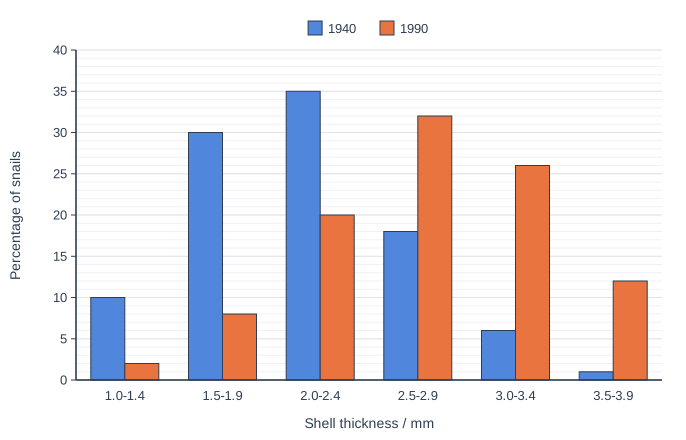
A species of sea snail lives on rocky shores. Its shell thickness is controlled by several genes. In 1950, a species of crab that crushes snail shells with its claws arrived on one coast. Scientists measured the shell thickness of snails from this coast that had been collected in 1940 and in 1990.

The figure shows their results.

Name the type of selection shown by these results. Use the figure to explain how this change in shell thickness happened.

Dual bar chart of percentage of snails for each shell thickness / mm, comparing 1940 and 1990 (a key above the chart shows which bar is which). 1.0-1.4: 1940 10, 1990 2; 1.5-1.9: 1940 30, 1990 8; 2.0-2.4: 1940 35, 1990 20; 2.5-2.9: 1940 18, 1990 32; 3.0-3.4: 1940 6, 1990 26; 3.5-3.9: 1940 1, 1990 12.

Model answer

This is directional selection. In 1940 the most common shell thickness was 2.0-2.4 mm, but in 1990 it was 2.5-2.9 mm, and the percentage of snails with shells at least 3.0 mm thick rose from 7% to 38%. After 1950 the crabs were a selection pressure: snails with thicker shells were less likely to be crushed and eaten, so they survived and reproduced, passing on their alleles for thick shells. Over many generations, the frequency of these alleles increased.

Explanation

Directional selection favours one extreme of the range, so the whole distribution shifts in that direction; here it shifted towards thicker shells after a new selection pressure (the crab) arrived. Quote values from the figure to describe the shift, then explain it in terms of survival, reproduction and allele frequency.

Mark scheme
  1. 1 mark

    Directional (selection)

    Max 4. Reject stabilising selection or any other type of selection.

  2. 1 mark

    The most common (modal) shell thickness increased from 2.0-2.4 mm (in 1940) to 2.5-2.9 mm (in 1990) / the percentage of snails with shells at least 3.0 mm thick rose from 7% to 38%

    Accept 'the mean shell thickness increased' or any correct comparison quoting values from the figure.

  3. 1 mark

    The crab is a selection pressure: snails with thicker shells are less likely to be crushed / eaten (than snails with thin shells)

    Accept converse.

  4. 1 mark

    (Snails with thick shells) survive AND reproduce, passing on their alleles (for thick shells)

    Reject 'gene' for allele.

  5. 1 mark

    (Over generations) the frequency of alleles for thick shells increases

    Ignore 'the number of alleles increases'.

Question 4

6 marks

Describe how a student could use aseptic techniques to compare the effect of three different antiseptic solutions on the growth of a bacterium. The student is given a broth culture of the bacterium, sterile agar plates and paper discs.

Do not include details of risk assessment or of disposal of the plates in your answer.

Model answer

Wash your hands and disinfect the bench, and work close to a lit Bunsen burner so that rising air carries microorganisms away from the plate. Remove the lid of the culture bottle and pass its neck through the flame. Use a sterile pipette to put a small volume of the broth culture onto the agar, lifting the lid of the plate only at an angle, and spread it evenly with a sterile spreader to make a lawn. Put the used pipette and spreader straight into disinfectant. Soak equal-sized paper discs in each antiseptic for the same time, and one in sterile water as a control, and place them on the lawn with sterile forceps. Fix the lid with two short pieces of tape and incubate the plate upside down at 25 °C for 48 hours. Measure the diameter of the clear zone round each disc and calculate its area; the larger the clear zone, the more effective the antiseptic. Repeat with more plates and calculate a mean for each antiseptic.

Explanation

A full answer covers the aseptic steps (hands and bench, flame, sterile pipette and spreader, lid at an angle), the comparison (identical discs, a water control) and the results (incubation at 25 °C, measuring clear zones, repeats). Common errors are flaming the lid or plate, using a loop to spread a liquid culture, and incubating at 37 °C, which could encourage human pathogens.

Mark scheme
  1. 1 mark

    Wash hands OR disinfect the bench (before starting) OR put the used pipette / spreader into disinfectant immediately after use

    Max 4 if the answer does not describe any aseptic technique (points 1 to 6). Max 6 overall. Point 1: any one of these for the mark; accept antiseptic wipes or a named disinfectant. Ignore 'sterilise hands' and 'wear gloves'.

  2. 1 mark

    Flame the neck of the culture bottle (after removing the lid)

    Reject 'flame the lid' or 'flame the plate'.

  3. 1 mark

    Work close to a (lit) Bunsen burner (so that upward air currents carry microorganisms away from the plate)

    Accept 'convection current' for upward air current. Reject 'the flame sterilises / kills microorganisms in the air'.

  4. 1 mark

    Use a sterile pipette / syringe to transfer the broth culture onto the agar

    Reject 'loop' for pipette.

  5. 1 mark

    Spread the culture (evenly to make a lawn) with a sterile spreader

    Accept a sterile loop for the spreader. Accept a glass spreader dipped in alcohol and flamed, or a spreader dipped in disinfectant and rinsed in sterile water.

  6. 1 mark

    Lift the lid of the plate only slightly / at an angle (and replace it quickly)

    Ignore 'work quickly' alone.

  7. 1 mark

    Soak equal-sized paper discs in each antiseptic (same volume / same time) and place them on the lawn with sterile forceps

  8. 1 mark

    Include a (control) disc soaked in sterile water

    Ignore 'a control' unqualified.

  9. 1 mark

    Fix the lid with (two) pieces of tape, not sealed all the way round OR incubate (upside down) at 25 °C (for 24-72 hours)

    Either of these for the mark. Accept any incubation temperature from 25 to 30 °C. Reject incubation at 37 °C.

  10. 1 mark

    Measure the diameter of the clear zone around each disc (and calculate its area), a larger clear zone showing a more effective antiseptic

    Accept 'zone of inhibition'.

  11. 1 mark

    Repeat with several plates for each antiseptic and calculate a mean

Ready to try the rest? Every answer you write is marked against the mark scheme, so you can see exactly where the marks are.

Study Helper Hints first, answers after you try

Stuck on this one? Ask for a hint and I’ll point you in the right direction, without giving the answer away. Once you’ve checked your answer, I’ll show you how the marks are awarded.