Level:
Correct: 0
Incorrect: 0
Marks: 0/0
Exam Practice
Course:
Topics:
AQA A-Level Biology (Paper 1) Smart practice A mixed round aimed at your weak spots
Unit 1
Biological molecules
Unit 2
Cells
Unit 3
Organisms exchange substances with their environment
Unit 4
Genetic information, variation and relationships between organisms
DNA, genes and chromosomes
0%
Genetic diversity can arise as a result of mutation or during meiosis
Gene mutations and chromosome non-disjunction
0%
Meiosis and genetic variation
0%
Genetic diversity and adaptation
0%
Species and taxonomy
0%
Biodiversity within a community
0%
Investigating diversity
0%
Avg
score:
–
Topics
done:
0/35

HIV, monoclonal antibodies and the ELISA test

Practise 19 exam-style questions on HIV, monoclonal antibodies and the ELISA test for AQA A-Level Biology (Paper 1). Write your answer as you would in the exam and get it marked in seconds against the mark scheme, point by point, with the Study Helper on hand if you get stuck.

  • 19 questions
  • 1–8 marks each
  • Instant marking
  • No sign-up needed
19 questions, marked as you go

Sample questions with model answers

Here are 4 of the questions in this topic, each with a model answer, an explanation of why it earns the marks and the mark scheme an examiner would use.

Question 1

3 marks

A drug that kills dividing cells is used to treat a type of leukaemia, a cancer of white blood cells. Scientists have attached this drug to a monoclonal antibody that binds to an antigen found only on the surface of these leukaemia cells.

Explain why treatment with the drug attached to the antibody is likely to cause fewer side effects than treatment with the drug alone.

Model answer

The monoclonal antibody has antigen-binding sites complementary only to the antigen on the leukaemia cells, so it binds to these cells and not to healthy cells. The drug is therefore delivered to, and concentrated at, the leukaemia cells. Fewer healthy dividing cells, such as those in bone marrow, hair follicles and the lining of the gut, are exposed to the drug and killed, and a lower dose can be used, so there are fewer side effects.

Explanation

Monoclonal antibodies are identical, with the same antigen-binding site, so they bind specifically to one antigen. Attaching a drug to such an antibody targets the drug to cells carrying that antigen. Drugs that kill dividing cells also harm healthy dividing tissues, so targeting reduces side effects. Use 'complementary' and avoid calling the binding site an active site.

Mark scheme
  1. 1 mark

    The antibody is complementary to (only) the antigen on the leukaemia cells, so it binds only to leukaemia cells

    Max 3. Reject 'active site'. Reject 'same shape' for complementary.

  2. 1 mark

    (So) the drug is delivered to / concentrated at the leukaemia cells

  3. 1 mark

    Fewer healthy (dividing) cells are damaged/killed (e.g. cells of the bone marrow, hair follicles or gut lining)

  4. 1 mark

    A lower dose of the drug can be used
Question 2

3 marks

Scientists are planning the first trial of a new monoclonal antibody drug in humans. The drug has already been tested on human cells grown in the laboratory and on animals.

Suggest three features of the trial design that would reduce the risk to the volunteers. Give a reason for each feature.

Model answer

1. Start with a very low dose, much lower than the dose found to be safe in animals, because humans may respond differently from animals.
2. Give the drug to one volunteer first and wait before treating the others, so that if the first volunteer has a serious reaction no one else is given the drug.
3. Increase the dose gradually, moving to a higher dose only when no serious side effects have been seen at the lower dose.

Explanation

The first trials in humans test safety rather than effectiveness, so they are designed to limit the number of people exposed to an unknown risk and to stop the trial at the first sign of harm. Animal results do not always predict human responses, especially for drugs that act on the immune system, so doses start low and rise slowly, and volunteers are treated one at a time and closely monitored. Each suggestion needs a reason to score.

Mark scheme
  1. 1 mark

    Start with a very low dose (lower than the dose found safe in animals), because humans may respond differently from animals

    Max 3. List rule: if more than three features are given, each wrong extra feature cancels one correct feature. Each feature needs a reason to gain its mark.

  2. 1 mark

    Increase the dose gradually, only if no serious side effects are seen at the lower dose (so that harmful doses are not reached)

  3. 1 mark

    Give the drug to one volunteer at a time / wait before treating the next volunteer, so that a reaction in one person stops the trial before others are treated

  4. 1 mark

    Use a small number of volunteers, so that few people are at risk if the drug is harmful

  5. 1 mark

    Monitor volunteers closely (in hospital) with emergency treatment available, so that side effects can be treated quickly

  6. 1 mark

    Screen volunteers and exclude people with health conditions or allergies that would increase their risk

    Ignore 'informed consent' (it does not reduce the risk).

Question 3

4 marks

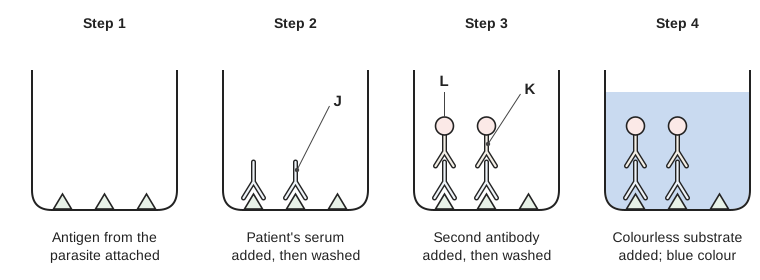
The diagram shows the steps in an ELISA test used to find out whether a patient has antibodies against a parasite.

Name molecule J and the substance labelled L.

Explain why the well is washed after the second antibody, K, is added and before the substrate is added.

Four drawings of the same well in cross-section, side by side, headed Step 1 to Step 4. Step 1: three small triangles are attached to the bottom of the well; caption 'Antigen from the parasite attached'. Step 2: Y-shaped molecules labelled J are bound, upside down, to two of the triangles; caption 'Patient's serum added, then washed'. Step 3: a second Y-shaped molecule, labelled K, is bound upside down to the stem of each of the first molecules, and a small circle, labelled L, is attached to the top of each K; caption 'Second antibody added, then washed'. Step 4: the same molecules, with the well now filled with blue liquid; caption 'Colourless substrate added; blue colour'.

Model answer

J is the patient's antibody against the parasite antigen. L is an enzyme.

Washing removes any second antibody (K) that has not bound to the patient's antibody. If unbound K remained, its enzyme would convert the substrate into the coloured product even if the patient had no antibodies against the parasite, giving a false positive result.

Explanation

In this indirect ELISA, the second antibody binds to the patient's antibody, and the enzyme attached to it produces the colour. Each wash removes anything that has not bound specifically, so a colour appears only if the patient's antibody is present to hold the enzyme-linked antibody in the well. A common error is to say that washing removes 'the antigen' or 'excess substrate'.

Mark scheme
  1. 1 mark

    J: (patient's) antibody (against the parasite antigen)

    Accept 'antibody from the patient's serum/blood'. Reject 'antigen'.

  2. 1 mark

    L: enzyme

    Ignore the names of particular enzymes. Reject 'substrate', 'dye' or 'antigen'.

  3. 1 mark

    (Washing) removes second antibody/K that has not bound (to J) / removes unbound enzyme-linked antibody

    Insufficient: 'removes excess' unqualified.

  4. 1 mark

    Otherwise the enzyme would convert the substrate and produce a colour even if the patient had no antibodies against the parasite (a false positive)

    Accept 'so that a colour shows that the patient's antibody is present'.

Question 4

6 marks

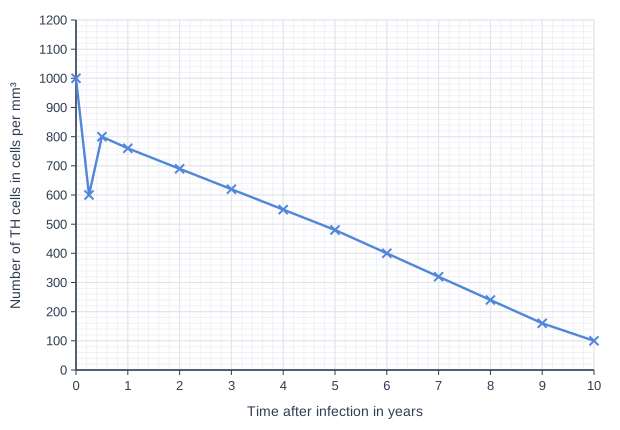
The graph shows the number of helper T cells (TH cells) in the blood of a person during the 10 years after they were infected with HIV. The person received no treatment.

Calculate the mean rate of decrease in the number of TH cells between year 2 and year 8. Give your answer in cells per mm³ per year.

A person is diagnosed with AIDS when their TH cell count falls below 200 cells per mm³. Use the graph to estimate when this person developed AIDS.

In the first few months after infection, the number of TH cells fell and then rose again. Explain why.

Suggest why this person had few infections during the first seven years.

Line graph of Number of TH cells in cells per mm³ (y-axis, 0 to 1200) against time after infection in years (x-axis, 0 to 10). The line joins the points (0, 1000), (0.25, 600), (0.5, 800), (1, 760), (2, 690), (3, 620), (4, 550), (5, 480), (6, 400), (7, 320), (8, 240), (9, 160), (10, 100).

Model answer

Rate of decrease = (690 - 240) ÷ (8 - 2) = 450 ÷ 6 = 75 cells per mm³ per year

The count fell below 200 cells per mm³ about 8.5 years after infection, so the person developed AIDS at about 8.5 years.

At first, HIV replicated rapidly inside TH cells and destroyed them, so the number fell. The immune response (antibodies and cytotoxic T cells) then reduced the amount of virus, so fewer TH cells were destroyed and the number rose again as new TH cells were made.

During the first seven years the TH cell count stayed above about 300 cells per mm³, so there were still enough TH cells to stimulate B cells, TC cells and phagocytes, and the immune system could control other infections.

Explanation

For a mean rate, divide the change in the count (690 - 240) by the time taken (6 years). To find when the count crossed 200, read across from 200 on the y-axis to the line and down to the time axis: halfway between the points for years 8 and 9. AIDS develops only when TH cells fall so low that the immune system can no longer respond effectively to other pathogens.

Mark scheme
  1. 1 mark

    Correct method, e.g. (690 - 240) ÷ 6; or a correct final answer of 75 with no working

    A correct answer of 75 (cells per mm³ per year) with no working scores 2 marks (points 1 and 2). Accept for 1 mark: 450 (difference not divided by 6) OR 64.3 (difference divided by 7).

  2. 1 mark

    75 (cells per mm³ per year)

  3. 1 mark

    8.5 years (accept 8.4 to 8.6)

    Accept 'eight and a half years after infection'.

  4. 1 mark

    (Fall) HIV replicates inside TH cells and destroys/kills them

  5. 1 mark

    (Rise) the immune response/antibodies/TC cells reduce the amount of HIV, so fewer TH cells are destroyed (and the number recovers as new TH cells are made)

  6. 1 mark

    The TH cell count was still above about 300 per mm³, so there were enough TH cells to stimulate B cells/TC cells/phagocytes (to destroy other pathogens)

    Accept any value read from the graph for years 1 to 7, or 'well above 200 per mm³'.

Ready to try the rest? Every answer you write is marked against the mark scheme, so you can see exactly where the marks are.

Study Helper Hints first, answers after you try

Stuck on this one? Ask for a hint and I’ll point you in the right direction, without giving the answer away. Once you’ve checked your answer, I’ll show you how the marks are awarded.