
Level:
Correct: 0
Incorrect: 0
Marks: 0/0
Exam Practice
Course:
Topics:
AQA A-Level Biology (Paper 1) Smart practice A mixed round aimed at your weak spots
Unit 1
Biological molecules
Unit 2
Cells
Unit 3
Organisms exchange substances with their environment
Unit 4
Genetic information, variation and relationships between organisms
DNA, genes and chromosomes
0%
Genetic diversity can arise as a result of mutation or during meiosis
Gene mutations and chromosome non-disjunction
0%
Meiosis and genetic variation
0%
Genetic diversity and adaptation
0%
Species and taxonomy
0%
Biodiversity within a community
0%
Investigating diversity
0%
Avg
score:
–
Topics
done:
0/35

Structure of eukaryotic cells

Practise 18 exam-style questions on Structure of eukaryotic cells for AQA A-Level Biology (Paper 1). Write your answer as you would in the exam and get it marked in seconds against the mark scheme, point by point, with the Study Helper on hand if you get stuck.

  • 18 questions
  • 1–8 marks each
  • Instant marking
  • No sign-up needed
18 questions, marked as you go

Sample questions with model answers

Here are 4 of the questions in this topic, each with a model answer, an explanation of why it earns the marks and the mark scheme an examiner would use.

Question 1

3 marks

In complex multicellular organisms, specialised cells are organised into tissues, tissues into organs and organs into organ systems.

Classify each of these structures as a specialised cell, a tissue, an organ or an organ system. Write each structure followed by its level of organisation.

xylem   leaf   guard cell   squamous epithelium   digestive system

Explain why a leaf is described as an organ.

Model answer

Xylem - tissue; leaf - organ; guard cell - specialised cell; squamous epithelium - tissue; digestive system - organ system.

A leaf is an organ because it is made of several different tissues, such as epidermis, mesophyll, xylem and phloem, which work together to carry out a function, photosynthesis.

Explanation

A tissue is a group of similar cells that carry out a particular function (xylem, squamous epithelium); an organ is a group of different tissues working together (leaf); an organ system is a group of organs working together (digestive system). A guard cell is a single specialised cell. Saying that a leaf is 'made of many cells' does not explain why it is an organ: the key idea is several different tissues.

Mark scheme
  1. 2 marks

    Xylem - tissue AND leaf - organ AND guard cell - (specialised) cell AND squamous epithelium - tissue AND digestive system - organ system

    2 marks for all five correct; 1 mark for three or four correct; 0 marks for two or fewer correct. Accept 'system' for organ system and 'epithelial tissue' for tissue. Reject 'organ' for xylem and 'tissue' for leaf. If two levels are given for one structure, that structure is wrong.

  2. 1 mark

    (A leaf is made of) several/different tissues (working together) to carry out a function / photosynthesis

    Accept named tissues, e.g. epidermis, (palisade or spongy) mesophyll, xylem and phloem. 'Different tissues' or 'more than one tissue' is needed: reject 'made of many cells' and 'made of different cells' without the idea of tissues. Ignore 'performs a function' on its own.
Question 2

3 marks

In a rare inherited condition, the Golgi apparatus cannot add a chemical 'tag' to hydrolytic enzymes. In healthy cells, this tag directs the enzymes into vesicles that become lysosomes. Without the tag, the enzymes are packaged into vesicles that fuse with the cell-surface membrane.

Suggest and explain the effects of this condition on the cells and blood of an affected person.

Model answer

Without the tag, the hydrolytic enzymes are secreted from the cells by exocytosis, so their concentration in the blood is high. The lysosomes therefore contain few or no hydrolytic enzymes, so worn-out organelles and other material taken into lysosomes cannot be hydrolysed. Undigested material builds up inside the lysosomes, which swell and damage the cells.

Explanation

Lysosomes form as vesicles that bud off the Golgi apparatus containing hydrolytic enzymes; the Golgi sorts proteins into the right vesicles. If the enzymes are sent to the cell-surface membrane instead, they are released outside the cell, and the lysosomes cannot digest worn-out organelles or other material, which accumulates. Good answers explain both the effect in the cells and the effect in the blood.

Mark scheme
  1. 1 mark

    Hydrolytic enzymes are released/secreted from cells (by exocytosis), so there is a high concentration of these enzymes in the blood/tissue fluid

    Max 3. Accept 'enzymes leave the cell / end up outside the cell, in the blood'.

  2. 1 mark

    Lysosomes lack/have few hydrolytic enzymes

    Accept 'lysosomes are empty / do not contain enzymes'.

  3. 1 mark

    So worn-out organelles / old molecules / (taken-in) material are not hydrolysed/digested/broken down (by lysosomes)

    Accept 'cannot break down pathogens taken in by phagocytosis'. Accept 'cell components cannot be recycled'.

  4. 1 mark

    So undigested material builds up in lysosomes/cells (and damages or enlarges the cells)

    Accept 'lysosomes become swollen with undigested substances'.

Question 3

4 marks

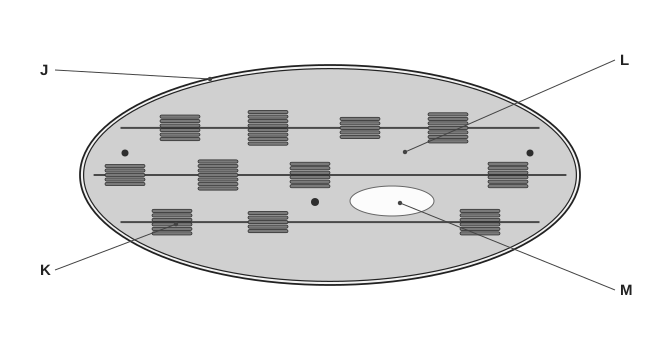
The figure shows a chloroplast drawn as it appears in an electron micrograph. It came from a leaf that had been in bright light for several hours.

Give the letter of the part where light is absorbed by chlorophyll.

Give the letter of a store of starch.

Suggest and explain how the appearance of the chloroplast would differ if it came from a leaf that had been kept in the dark for 48 hours.

A drawing of a chloroplast in the style of an electron micrograph: an oval organelle with a double outer boundary. Inside are many stacks of thin flattened discs, joined by long thin membranes running along the organelle, in a grey background, with a pale oval body near the centre and a few small dark dots. Label J points to the outer boundary; K to one of the stacks of discs; L to the grey background between the stacks; M to the pale oval body.

Model answer

Light absorbed by chlorophyll: K
Store of starch: M

In a leaf kept in the dark for 48 hours, the starch grains (M) would be smaller or absent. In the dark there is no photosynthesis, so no new sugar is made to form starch, and the stored starch is hydrolysed to sugars, which are used in respiration or transported to other parts of the plant.

Explanation

Chlorophyll is in the thylakoid membranes, which are stacked into grana (K), so this is where light is absorbed; the stroma (L) contains enzymes and starch grains (M), and J is the double membrane (envelope). Starch is a storage polysaccharide made from the sugar produced in photosynthesis. In the dark no sugar is made and the stored starch is hydrolysed and used, so the starch grains shrink or disappear. Watch the spelling of stroma ('stoma' is a pore in a leaf), and do not call a starch grain a vacuole.

Mark scheme
  1. 1 mark

    K

    Max 4. Points 4 and 5: max 1. If more than one letter is given for a part, do not award that mark. K is a granum (a stack of thylakoids). Accept a correct name only if it matches the letter.

  2. 1 mark

    M

    M is a starch grain. Reject L (stroma).

  3. 1 mark

    M / the starch grain(s) would be smaller / fewer / absent

    Accept 'less starch' or 'no starch grains'. Reject 'M would be larger'. Ignore changes to other parts unless they are wrong.

  4. 1 mark

    (In the dark) no photosynthesis, so no (new) sugar/glucose is made to form starch / so the starch is not replaced

    Insufficient: 'no photosynthesis' with no link to starch or sugar.

  5. 1 mark

    Starch is hydrolysed/broken down (to sugars/glucose) and used in respiration / transported to other parts of the plant

    Accept 'starch is used up as a respiratory substrate'. Reject 'starch is broken down by photosynthesis'.

Question 4

6 marks

Mitochondria and chloroplasts are both found in the cells of plant leaves.

Compare the structure of a mitochondrion with the structure of a chloroplast.

Model answer

Similarities: both organelles are surrounded by a double membrane (envelope). Both have an internal membrane system with a large surface area. Both contain a fluid with enzymes - the matrix in a mitochondrion and the stroma in a chloroplast - and both contain their own DNA and ribosomes.

Differences: in a mitochondrion the inner membrane is folded into cristae, but a chloroplast contains thylakoids stacked into grana. Chloroplasts contain chlorophyll and may contain starch grains, but mitochondria do not. Chloroplasts are usually larger than mitochondria.

Explanation

'Compare' needs both similarities and differences, and each difference should mention both organelles ('cristae in mitochondria but thylakoids in chloroplasts'). The double membrane, large internal membrane area, enzyme-containing fluid, DNA and ribosomes are shared features; cristae versus grana, chlorophyll and starch grains are differences. Watch the spelling of stroma: 'stoma' is a pore in a leaf.

Mark scheme
  1. 1 mark

    Both have a double membrane / envelope

    Max 4 if the answer gives only similarities or only differences. Points 1 to 9: 1 mark each, max 6. Each difference must describe both organelles, or be a clear comparative.

  2. 1 mark

    Mitochondria have an inner membrane folded into cristae AND chloroplasts have thylakoids (stacked into grana)

    Accept lamellae for thylakoids. Reject 'mitochondria have grana' or 'chloroplasts have cristae'.

  3. 1 mark

    Both have an inner membrane system with a large surface area

    Accept 'cristae and thylakoids both give a large surface area'.

  4. 1 mark

    Both have a fluid interior containing enzymes: the matrix in mitochondria and the stroma in chloroplasts

    Reject 'stoma'. Accept 'matrix and stroma are equivalent'.

  5. 1 mark

    Both contain (their own) DNA

    Accept 'both contain circular DNA / DNA not associated with histones'.

  6. 1 mark

    Both contain ribosomes

    Accept 'both have (small/70S) ribosomes'.

  7. 1 mark

    Chloroplasts contain chlorophyll/pigments AND mitochondria do not

  8. 1 mark

    Chloroplasts (may) contain starch grains / lipid droplets AND mitochondria do not

  9. 1 mark

    Chloroplasts are (usually) larger than mitochondria

    Accept a correct size comparison, e.g. chloroplasts about 2 to 10 μm long and mitochondria about 1 to 5 μm.

Ready to try the rest? Every answer you write is marked against the mark scheme, so you can see exactly where the marks are.

Study Helper Hints first, answers after you try

Stuck on this one? Ask for a hint and I’ll point you in the right direction, without giving the answer away. Once you’ve checked your answer, I’ll show you how the marks are awarded.