
Level:
Correct: 0
Incorrect: 0
Marks: 0/0
Exam Practice
Course:
Topics:
AQA A-Level Biology (Paper 1) Smart practice A mixed round aimed at your weak spots
Unit 1
Biological molecules
Unit 2
Cells
Unit 3
Organisms exchange substances with their environment
Unit 4
Genetic information, variation and relationships between organisms
DNA, genes and chromosomes
0%
Genetic diversity can arise as a result of mutation or during meiosis
Gene mutations and chromosome non-disjunction
0%
Meiosis and genetic variation
0%
Genetic diversity and adaptation
0%
Species and taxonomy
0%
Biodiversity within a community
0%
Investigating diversity
0%
Avg
score:
–
Topics
done:
0/35

Membrane structure, diffusion and osmosis

Practise 21 exam-style questions on Membrane structure, diffusion and osmosis for AQA A-Level Biology (Paper 1). Write your answer as you would in the exam and get it marked in seconds against the mark scheme, point by point, with the Study Helper on hand if you get stuck.

  • 21 questions
  • 1–8 marks each
  • Instant marking
  • No sign-up needed
20 questions, marked as you go

Sample questions with model answers

Here are 4 of the questions in this topic, each with a model answer, an explanation of why it earns the marks and the mark scheme an examiner would use.

Question 1

2 marks

A student investigated the water potential of parsnip tissue. She placed parsnip cylinders in sucrose solutions with different water potentials for 3 hours, then calculated the percentage change in mass of each cylinder.

The graph shows her results and her line of best fit.

Use the graph to find the water potential of the parsnip tissue. Explain how you obtained your answer.
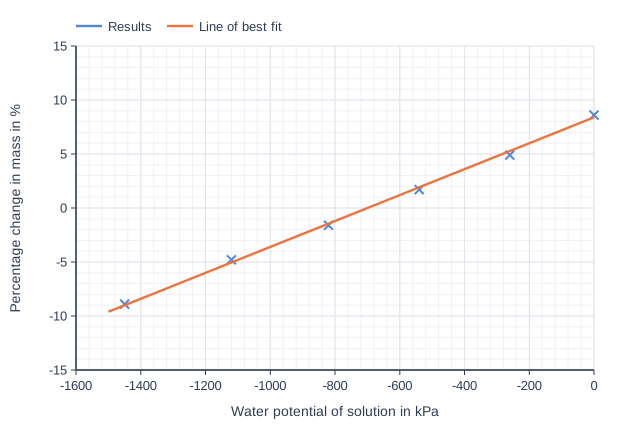
Line graph of percentage change in mass in % (y-axis, -15 to 15) against water potential of solution in kPa (x-axis, -1600 to 0). "Results" is shown as plotted points only (no line), at (-1450, -8.9), (-1120, -4.8), (-820, -1.6), (-540, 1.7), (-260, 4.9), (0, 8.6). "Line of best fit" joins the points (-1500, -9.6), (0, 8.4).

Model answer

-700 kPa. This is the water potential where the line of best fit crosses 0% change in mass. At this water potential there is no net movement of water by osmosis into or out of the tissue, so the water potential of the tissue equals the water potential of the solution.

Explanation

This is the calibration-curve method of required practical 3: tissue gains mass in solutions with a higher water potential than its own and loses mass in solutions with a lower water potential. The intercept on the x-axis (zero change in mass) gives the solution whose water potential equals that of the tissue. Read the value from the line of best fit, not from the nearest plotted point, and keep the negative sign.

Mark scheme
  1. 1 mark

    -700 kPa (accept -680 to -720)

    The value must be negative. A value in this range scores this mark with or without an explanation.

  2. 1 mark

    Where the line crosses 0% change in mass there is no net movement of water (by osmosis), so the water potential of the tissue equals that of the solution

    Accept 'where the line crosses the x-axis' only if linked to no net water movement or to equal water potentials. Insufficient: 'where the line crosses the axis' alone.

Question 2

3 marks

Describe how channel proteins and carrier proteins allow substances to cross a cell-surface membrane by facilitated diffusion.

Model answer

Channel proteins form water-filled pores through the membrane. Each type is specific, so only particular ions or molecules of the right size and charge can diffuse through it. Carrier proteins bind a specific molecule at a binding site that is complementary to it; the carrier then changes shape and releases the molecule on the other side of the membrane. In both cases the substance moves down its concentration gradient, so the process is passive and does not use ATP.

Explanation

Facilitated diffusion is the passive movement of ions and polar molecules, which cannot pass through the hydrophobic core of the bilayer, through specific proteins. Channel proteins provide a hydrophilic pore; carrier proteins bind the molecule and change shape. A common error is to say that facilitated diffusion uses ATP or can move substances against a gradient: that is active transport.

Mark scheme
  1. 1 mark

    Channel proteins form pores / channels (lined with hydrophilic groups) through the membrane

    Max 2 if the answer describes only channel proteins or only carrier proteins. Max 3. Accept 'water-filled pores'.

  2. 1 mark

    Channel proteins are specific: they let through only particular ions / molecules (of a certain size or charge)

    Accept 'each type of channel is specific to one ion'.

  3. 1 mark

    Carrier proteins bind a specific molecule (at a binding site that is complementary to it)

    Accept 'attach to'. Do not credit 'active site' as the binding site.

  4. 1 mark

    Carrier proteins change shape and release the molecule on the other side of the membrane

    Accept 'change in tertiary structure'. Reject if the change in shape is said to need ATP.

  5. 1 mark

    Both move substances down a concentration gradient / are passive / do not use ATP

    Reject 'against a concentration gradient' or 'uses ATP'. Ignore 'along / with a gradient'.

Question 3

4 marks

Glucose enters muscle cells by facilitated diffusion through a carrier protein.

- In resting muscle cells, most of these carrier proteins are in the membranes of vesicles inside the cell. During exercise, the vesicles fuse with the cell-surface membrane.
- Inside the cell, glucose is quickly converted into glucose phosphate, which cannot pass through the carrier protein.

Use this information to explain how muscle cells are able to take up glucose rapidly during exercise.

Model answer

During exercise the vesicles fuse with the cell-surface membrane, adding more carrier proteins to it. More glucose molecules can therefore be carried across the membrane at the same time, so the rate of facilitated diffusion increases. Inside the cell, glucose is converted straight into glucose phosphate, which keeps the concentration of glucose in the cytoplasm low. This maintains a steep concentration gradient of glucose from the blood into the cell, so glucose keeps diffusing in; and because glucose phosphate cannot pass through the carrier, it cannot leave the cell.

Explanation

The rate of facilitated diffusion depends on the number of carrier proteins in the membrane and on the size of the concentration gradient. Adding carriers from vesicles increases the first; removing glucose as soon as it enters (by converting it to glucose phosphate, or using it in respiration) maintains the second. Facilitated diffusion is passive, so do not say that the carriers use ATP.

Mark scheme
  1. 1 mark

    (When the vesicles fuse) more carrier proteins are added to the cell-surface membrane

    Max 4.

  2. 1 mark

    So more glucose molecules can cross the membrane at the same time / the rate of facilitated diffusion increases

    Accept 'the rate is not limited by the number of carriers'. Ignore 'more surface area' alone.

  3. 1 mark

    Converting glucose to glucose phosphate keeps the concentration of glucose inside the cell low

    Accept 'glucose is used in respiration, so its concentration in the cell stays low' for this point.

  4. 1 mark

    (So) a (steep) concentration gradient of glucose (into the cell) is maintained

    The concentration gradient must be mentioned. Accept 'diffusion gradient'.

  5. 1 mark

    Glucose phosphate cannot leave through the carrier, so the glucose taken up is not lost from the cell

    Accept 'glucose does not diffuse back out'.

Question 4

5 marks

Compare and contrast simple diffusion and facilitated diffusion across a cell-surface membrane.

Model answer

Similarities: both are passive processes that do not use ATP, and in both there is net movement of a substance down its concentration gradient until equilibrium is reached.

Differences: in simple diffusion molecules pass directly through the phospholipid bilayer, but in facilitated diffusion they pass through channel or carrier proteins. Simple diffusion is of small, non-polar or lipid-soluble molecules such as oxygen, whereas facilitated diffusion moves ions and polar or larger molecules such as glucose. Facilitated diffusion is specific, because each protein moves only particular substances, and its rate is limited by the number of proteins, so it levels off at high concentrations; the rate of simple diffusion keeps rising as the concentration gradient increases.

Explanation

'Compare and contrast' needs at least one similarity and several differences, and each difference must say what happens in both processes. The key idea is that the hydrophobic interior of the bilayer lets small non-polar molecules through but not ions or polar molecules, which need proteins. Facilitated diffusion is still passive: answers that say it uses ATP confuse it with active transport.

Mark scheme
  1. 1 mark

    Both are passive / do not use ATP (from respiration)

    Max 4 if the answer gives no similarity. Max 5. Each difference (points 3 to 6) must describe both processes or make the contrast clear, e.g. 'only facilitated diffusion is specific'.

  2. 1 mark

    Both involve net movement down a concentration gradient / from a higher to a lower concentration (until equilibrium)

    Reject 'against a concentration gradient'. Ignore 'along a gradient'.

  3. 1 mark

    Simple diffusion is through the phospholipid bilayer, whereas facilitated diffusion is through (channel or carrier) proteins

    Accept 'facilitated diffusion needs proteins but simple diffusion does not'.

  4. 1 mark

    Simple diffusion is of small / non-polar / lipid-soluble molecules, whereas facilitated diffusion is of polar / charged / larger / water-soluble molecules or ions

    Accept a correct named example of each, e.g. oxygen and glucose.

  5. 1 mark

    Facilitated diffusion is specific / selective (each protein moves particular substances), but simple diffusion is not

  6. 1 mark

    The rate of facilitated diffusion is limited by the number of proteins / reaches a maximum, but the rate of simple diffusion keeps increasing as the concentration gradient increases

    Accept 'facilitated diffusion can become saturated'.

Ready to try the rest? Every answer you write is marked against the mark scheme, so you can see exactly where the marks are.

Study Helper Hints first, answers after you try

Stuck on this one? Ask for a hint and I’ll point you in the right direction, without giving the answer away. Once you’ve checked your answer, I’ll show you how the marks are awarded.