
Level:
Correct: 0
Incorrect: 0
Marks: 0/0
Exam Practice
Course:
Topics:
AQA A-Level Biology (Paper 1) Smart practice A mixed round aimed at your weak spots
Unit 1
Biological molecules
Unit 2
Cells
Unit 3
Organisms exchange substances with their environment
Unit 4
Genetic information, variation and relationships between organisms
DNA, genes and chromosomes
0%
Genetic diversity can arise as a result of mutation or during meiosis
Gene mutations and chromosome non-disjunction
0%
Meiosis and genetic variation
0%
Genetic diversity and adaptation
0%
Species and taxonomy
0%
Biodiversity within a community
0%
Investigating diversity
0%
Avg
score:
–
Topics
done:
0/35

Phloem and translocation by mass flow

Practise 16 exam-style questions on Phloem and translocation by mass flow for AQA A-Level Biology (Paper 1). Write your answer as you would in the exam and get it marked in seconds against the mark scheme, point by point, with the Study Helper on hand if you get stuck.

  • 16 questions
  • 1–7 marks each
  • Instant marking
  • No sign-up needed
16 questions, marked as you go

Sample questions with model answers

Here are 4 of the questions in this topic, each with a model answer, an explanation of why it earns the marks and the mark scheme an examiner would use.

Question 1

2 marks

The diagram shows phloem tissue seen in longitudinal section.

Name the structures labelled A and B.
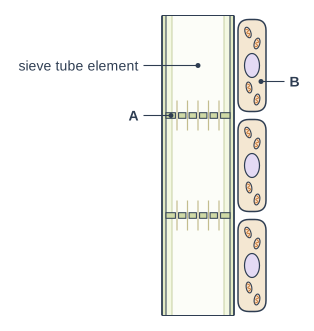
Diagram: a wide vertical tube made of cells joined end to end, separated by cross walls full of holes, with thin strands passing through the holes; a thin layer of material lines its walls. Beside it on the right are three narrow cells, each with a large oval structure, small sausage-shaped structures and dense contents. Label A points to one of the cross walls full of holes across the wide tube; label B points to one of the narrow cells beside the wide tube; the label "sieve tube element" points to the inside of the wide tube.

Model answer

A is a sieve plate.
B is a companion cell.

Explanation

Phloem is made of sieve tube elements joined end to end; the end walls between them are sieve plates, perforated by pores through which the sap flows. Each sieve tube element has one or more companion cells beside it, with a nucleus and many mitochondria, which carry out the metabolic processes the sieve tube element cannot.

Mark scheme
  1. 1 mark

    A: sieve plate

    Reject 'sieve tube', 'cell wall' or 'end wall' alone for A.

  2. 1 mark

    B: companion cell

    Reject 'guard cell' or 'parenchyma'.
Question 2

3 marks

Scientists applied a respiratory inhibitor to the leaves of a plant. The inhibitor stops the production of ATP. Within 30 minutes, the rate of translocation of sucrose out of the leaves fell by 90%.

Explain how this result supports the mass flow hypothesis.

Model answer

Without ATP, the companion cells cannot actively transport sucrose into the sieve tubes in the leaves. So the water potential inside the sieve tubes is not lowered and less water enters them from the xylem by osmosis. No high hydrostatic pressure builds up at the source, so there is no pressure gradient to drive mass flow, and translocation slows down. The mass flow hypothesis predicts exactly this, because it depends on active loading at the source.

Explanation

Mass flow itself is passive, but setting up the pressure gradient depends on the active loading of sucrose, which needs ATP from respiration. Evidence that metabolic inhibitors stop translocation therefore supports the hypothesis. Make the chain of cause and effect clear: no ATP, no loading, no osmosis, no pressure, no flow.

Mark scheme
  1. 1 mark

    No / less ATP in the companion cells, so no active transport

    Max 3.

  2. 1 mark

    So sucrose is not loaded into the sieve tubes (at the source)

  3. 1 mark

    So the water potential in the sieve tubes is not lowered / less water enters (from the xylem) by osmosis

  4. 1 mark

    So no high hydrostatic pressure / no pressure gradient forms, so there is little mass flow (from source to sink)

    Reject 'diffusion' for mass flow.

Question 3

4 marks

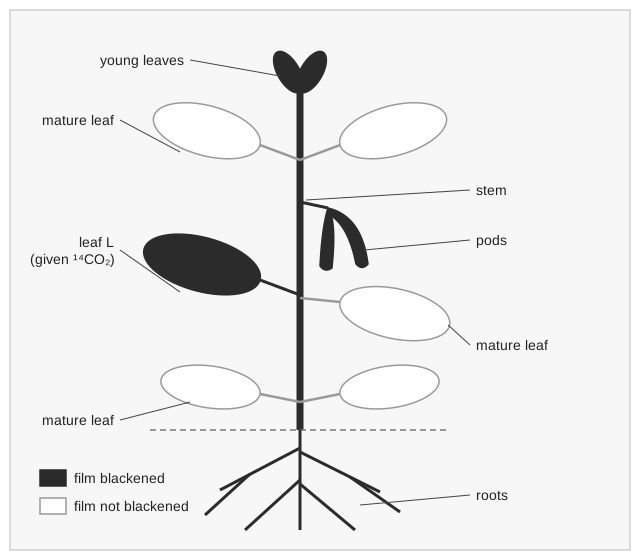
A scientist supplied radioactive carbon dioxide (¹⁴CO₂) to one mature leaf, leaf L, of a bean plant, while the plant was in the light. Six hours later, she placed the plant flat against X-ray film in the dark for several days. Radioactivity blackens X-ray film.

The figure shows the result, called an autoradiograph.

Explain why the plant was kept in the light while it was supplied with ¹⁴CO₂.

Explain the pattern of blackening on the film.

An autoradiograph of a whole bean plant lying flat. A key shows dark areas as 'film blackened' and white areas as 'film not blackened'. Labels show the young leaves at the top, the stem, two pods hanging from the stem, six mature leaves in three pairs, leaf L (given ¹⁴CO₂) on the left of the middle pair, and the roots below a dashed soil line. Dark (blackened): leaf L, the whole stem, the young leaves, the pods and the roots. White (not blackened): the five other mature leaves.

Model answer

The plant was kept in the light so that leaf L could photosynthesise and incorporate the ¹⁴C into sugars such as sucrose.

The ¹⁴C-labelled sucrose was translocated in the phloem from leaf L, which is a source, along the stem both upwards and downwards. It reached the sinks - the young leaves, the pods and the roots - where it is used for respiration and growth or stored, so these parts blackened the film. The other mature leaves are also sources: they make their own sucrose by photosynthesis and export it, so they did not import any labelled sucrose and their part of the film is not blackened.

Explanation

Radioactive tracers show where the products of photosynthesis go. Sucrose moves from sources to sinks, and a mature leaf exports sucrose rather than importing it. The pattern also shows that translocation goes in both directions in the stem: up to the young leaves and pods, and down to the roots.

Mark scheme
  1. 1 mark

    (Light is needed for) photosynthesis, so the ¹⁴C is incorporated into sugars / sucrose / organic substances (in leaf L)

    Accept 'the carbon dioxide is fixed into glucose / sugars'.

  2. 1 mark

    The ¹⁴C-labelled sucrose is translocated in the phloem from leaf L (the source) through the stem

  3. 1 mark

    To sinks: (at least two of) the young leaves, pods and roots, where it is used for growth / respiration / storage

    At least two sinks must be named. Insufficient: 'to the rest of the plant'.

  4. 1 mark

    The other mature leaves are sources / make their own sugars by photosynthesis, so they do not import sucrose (so their part of the film is not blackened)

Question 4

6 marks

Potato plants store starch in underground stems called tubers.

Use the mass flow hypothesis to explain how sucrose made in the leaves of a potato plant is moved to its developing tubers.

Model answer

In the leaves, which are the source, companion cells use ATP to actively transport sucrose into the sieve tube elements. This lowers the water potential inside the sieve tube elements, so water enters them from the nearby xylem by osmosis, which produces a high hydrostatic pressure at the source end. At the tubers, which are the sink, sucrose is actively transported out of the sieve tubes into the storage cells and converted to starch. This raises the water potential in the sieve tubes, so water leaves and the hydrostatic pressure is lower at the sink end. The pressure gradient between source and sink pushes the solution through the sieve tubes to the tubers by mass flow.

Explanation

Mass flow has three stages: loading at the source (active, using ATP from companion cells), which draws in water by osmosis and raises the pressure; flow of the whole solution down the pressure gradient; and unloading at the sink, where sucrose is used or stored. A common error is to describe sucrose 'diffusing' along the phloem: diffusion is far too slow, and translocation is the bulk flow of a solution under pressure.

Mark scheme
  1. 1 mark

    In the leaf (source), sucrose is actively transported / loaded into the sieve tube elements (phloem)

    Max 6. Accept co-transport with hydrogen ions (H⁺), but it is not required. Accept sieve tube / sieve cell for sieve tube element.

  2. 1 mark

    By companion cells (using ATP)

  3. 1 mark

    This lowers the water potential in the sieve tube elements (at the source)

    Accept Ψ for water potential. Reject 'lowers the water potential of the water'.

  4. 1 mark

    Water enters the sieve tube elements from the xylem by osmosis

    Reject 'sucrose enters by osmosis'.

  5. 1 mark

    This produces a high (hydrostatic) pressure in the sieve tubes at the source

  6. 1 mark

    At the tuber (sink), sucrose is unloaded / removed from the sieve tubes (by active transport or facilitated diffusion) and converted to starch / stored

    Reject 'sucrose diffuses into the tuber' unqualified. Accept 'used in respiration' for growing cells of the tuber.

  7. 1 mark

    Water leaves the sieve tubes (by osmosis), so the (hydrostatic) pressure is lower at the sink

  8. 1 mark

    The pressure gradient (from source to sink) causes mass flow of the solution through the sieve tubes (and sieve plates) to the tuber

    Reject 'diffusion' along the phloem for mass flow.

Ready to try the rest? Every answer you write is marked against the mark scheme, so you can see exactly where the marks are.

Study Helper Hints first, answers after you try

Stuck on this one? Ask for a hint and I’ll point you in the right direction, without giving the answer away. Once you’ve checked your answer, I’ll show you how the marks are awarded.