
Level:
Correct: 0
Incorrect: 0
Marks: 0/0
Exam Practice
Course:
Topics:
AQA A-Level Biology (Paper 1) Smart practice A mixed round aimed at your weak spots
Unit 1
Biological molecules
Unit 2
Cells
Unit 3
Organisms exchange substances with their environment
Unit 4
Genetic information, variation and relationships between organisms
DNA, genes and chromosomes
0%
Genetic diversity can arise as a result of mutation or during meiosis
Gene mutations and chromosome non-disjunction
0%
Meiosis and genetic variation
0%
Genetic diversity and adaptation
0%
Species and taxonomy
0%
Biodiversity within a community
0%
Investigating diversity
0%
Avg
score:
–
Topics
done:
0/35

Lipids

Practise 17 exam-style questions on Lipids for AQA A-Level Biology (Paper 1). Write your answer as you would in the exam and get it marked in seconds against the mark scheme, point by point, with the Study Helper on hand if you get stuck.

  • 17 questions
  • 1–8 marks each
  • Instant marking
  • No sign-up needed
17 questions, marked as you go

Sample questions with model answers

Here are 4 of the questions in this topic, each with a model answer, an explanation of why it earns the marks and the mark scheme an examiner would use.

Question 1

2 marks

The figure shows three fatty acids, J, K and L.

Give the letter of the fatty acid that is polyunsaturated.

Explain how you can tell from the figure that fatty acid K is saturated.
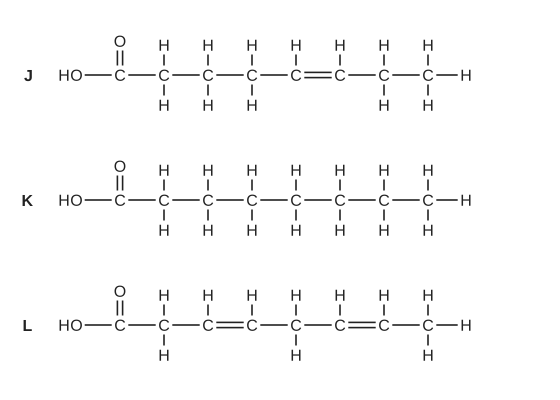
Displayed formulae of three molecules, labelled J, K and L. Each has HO-C(=O)- at the left, followed by a chain of seven carbon atoms with hydrogen atoms, ending in H. J: the fourth and fifth carbon atoms of the chain are joined by a double bond, and each of these two carbons has one H atom. K: all bonds between carbon atoms are single and each carbon of the chain has two H atoms (three at the end). L: two double bonds, between the second and third and between the fifth and sixth carbon atoms of the chain; each of these four carbons has one H atom.

Model answer

L is polyunsaturated (it has two C=C double bonds).
K is saturated because there are no carbon-carbon double bonds in its hydrocarbon chain: every carbon atom in the chain carries the maximum number of hydrogen atoms.

Explanation

Saturated fatty acids have only single C-C bonds in the R-group; monounsaturated ones have one C=C and polyunsaturated ones have two or more. The C=O in the carboxyl group (COOH) is present in every fatty acid and does not count, so 'no double bonds' is not precise enough.

Mark scheme
  1. 1 mark

    L

    Reject J (one C=C only: monounsaturated).

  2. 1 mark

    K has no carbon-carbon double bonds / only single bonds between the carbon atoms / every carbon atom in the chain has the maximum number of hydrogen atoms

    Do not accept 'K has no double bonds' alone, because K has a C=O double bond in its carboxyl group; accept 'no double bonds in the R-group / hydrocarbon chain'. Accept 'each carbon in the chain has two hydrogen atoms (three at the end)'.
Question 2

3 marks

Scientists wanted to make the phospholipids in a culture of cells radioactive, without making the triglycerides in the cells radioactive. They could supply the cells with a radioactive isotope of carbon, hydrogen, oxygen or phosphorus.

Which element should they use? Explain your answer.

Suggest one other type of molecule in the cells that would also become radioactive.

Model answer

Phosphorus. Phospholipids contain phosphorus in their phosphate group, but triglycerides contain only carbon, hydrogen and oxygen, so only the phospholipids (of these two lipids) would be labelled.
DNA (or RNA, or ATP) would also be labelled, because its nucleotides contain phosphate.

Explanation

Triglycerides, like carbohydrates, contain only C, H and O, so a label in any of these elements would appear in triglycerides as well. Phosphorus is found in the phosphate group of phospholipids and also in every nucleotide, so DNA, RNA and ATP would be labelled too. Questions like this test whether you know which elements each biological molecule contains.

Mark scheme
  1. 1 mark

    Phosphorus

    Accept ³²P / P. Reject carbon, hydrogen or oxygen.

  2. 1 mark

    Phospholipids contain phosphorus (in the phosphate group) but triglycerides do not / triglycerides contain only carbon, hydrogen and oxygen

    Accept 'triglycerides have no phosphate group'. Ignore 'phospholipids have phosphate in their name'.

  3. 1 mark

    DNA / RNA / ATP / ADP / nucleotides

    Accept any named molecule containing phosphate, e.g. NADP. List rule: if more than one molecule is given, each wrong extra answer cancels a correct one. Accept 'phosphorylated proteins'. Reject proteins (unqualified), glucose, starch and amino acids.

Question 3

4 marks

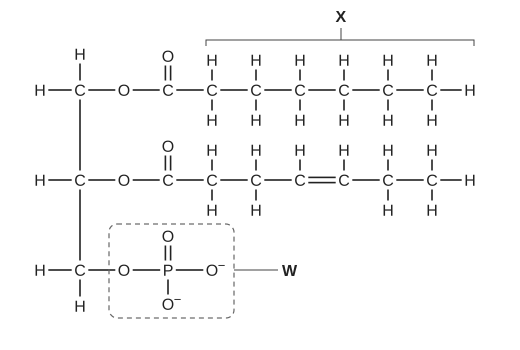
The figure shows a phospholipid molecule. W and X label parts of the molecule.

Give the letter of the part that is hydrophilic and the letter of the part that is hydrophobic.

Explain why the hydrophilic part is hydrophilic.

Describe how the structure of a triglyceride differs from the structure of this phospholipid.

Displayed formula of a lipid molecule. On the left, a vertical chain of three carbon atoms (glycerol), each with H on its left. The top and middle carbons are each joined through an oxygen atom to a carbon with a double-bonded oxygen, followed by a chain of six carbon atoms with hydrogen atoms; the middle chain has one carbon-carbon double bond. The bottom carbon is joined through an oxygen atom to a phosphorus atom, which has a double-bonded oxygen above it, an O with a negative charge below it and another O with a negative charge to its right. A dashed box around the oxygen, phosphorus and the three oxygens attached to it is labelled W. A bracket over the six-carbon chain of the top row is labelled X.

Model answer

W (the phosphate-containing group) is hydrophilic and X (the hydrocarbon chain of a fatty acid) is hydrophobic.
The phosphate group is charged (polar), so it is attracted to water molecules and forms hydrogen bonds with them.
In a triglyceride, the third carbon of glycerol is joined by an ester bond to a third fatty acid instead of to a phosphate-containing group.

Explanation

In a phospholipid one of the fatty acids of a triglyceride is replaced by a phosphate-containing group. The charged phosphate 'head' is hydrophilic, while the non-polar fatty acid 'tails' are hydrophobic. This combination of a hydrophilic and a hydrophobic part explains how phospholipids behave in water. A common error is to swap the two.

Mark scheme
  1. 1 mark

    W is hydrophilic

    Reject X for this point.

  2. 1 mark

    X is hydrophobic

    Reject W for this point.

  3. 1 mark

    W / the phosphate (group) is charged / polar, so it is attracted to / forms hydrogen bonds with water (molecules)

    Accept 'has negative charges'. Ignore 'it likes water' with no reference to charge or polarity.

  4. 1 mark

    A triglyceride has a (third) fatty acid (joined by an ester bond) in place of the phosphate(-containing) group

    Accept 'a triglyceride has three fatty acids and no phosphate group'.

Question 4

5 marks

Many animals store energy as triglycerides in fat tissue.

Explain how the structure of triglycerides makes them suited to this function.

Model answer

The hydrocarbon chains of the fatty acids contain many C-H bonds and very little oxygen, so a large amount of energy is released when triglycerides are respired - about twice as much per gram as carbohydrate. This means a low mass of triglyceride stores a lot of energy, which helps animals that move. Triglycerides are insoluble in water (hydrophobic), so they do not affect the water potential of cells and can be stored as droplets in large amounts without water. When they are needed, their ester bonds are hydrolysed to release glycerol and fatty acids, which are respired; their high hydrogen content also means a lot of metabolic water is released.

Explanation

Link each structural feature to the property it gives: many C-H bonds lead to a high energy yield per gram; non-polar and insoluble lead to no osmotic effect and no stored water; high hydrogen content leads to metabolic water. Biology uses 'releases energy', never 'produces energy'. Answers that just list properties (light, insoluble) without the structural reason gain fewer marks.

Mark scheme
  1. 1 mark

    (The fatty acid chains have) many C-H bonds / a high ratio of hydrogen to oxygen atoms / a high ratio of C-H bonds to carbon atoms

    Max 5.

  2. 1 mark

    (So) a lot of energy is released when they are respired / more energy per gram than carbohydrate

    Accept 'about twice as much energy per gram as carbohydrate'. Reject 'produce energy' or 'make energy'.

  3. 1 mark

    (So) a low mass is needed to store the energy / light for the energy they store (useful to animals that move)

  4. 1 mark

    Insoluble (in water) / hydrophobic / non-polar

  5. 1 mark

    (So) do not affect the water potential of cells / do not cause water to move by osmosis

  6. 1 mark

    (Insoluble, so) can be stored in large amounts (as droplets) without water being stored with them

    Accept 'compact store'.

  7. 1 mark

    Release a lot of (metabolic) water when respired (because of their high hydrogen content)

  8. 1 mark

    Can be hydrolysed (at ester bonds) into glycerol and fatty acids, which are used in respiration

Ready to try the rest? Every answer you write is marked against the mark scheme, so you can see exactly where the marks are.

Study Helper Hints first, answers after you try

Stuck on this one? Ask for a hint and I’ll point you in the right direction, without giving the answer away. Once you’ve checked your answer, I’ll show you how the marks are awarded.