
Level:
Correct: 0
Incorrect: 0
Marks: 0/0
Exam Practice
Course:
Topics:
AQA A-Level Biology (Paper 1) Smart practice A mixed round aimed at your weak spots
Unit 1
Biological molecules
Unit 2
Cells
Unit 3
Organisms exchange substances with their environment
Unit 4
Genetic information, variation and relationships between organisms
DNA, genes and chromosomes
0%
Genetic diversity can arise as a result of mutation or during meiosis
Gene mutations and chromosome non-disjunction
0%
Meiosis and genetic variation
0%
Genetic diversity and adaptation
0%
Species and taxonomy
0%
Biodiversity within a community
0%
Investigating diversity
0%
Avg
score:
–
Topics
done:
0/35

B lymphocytes, antibodies and vaccination

Practise 18 exam-style questions on B lymphocytes, antibodies and vaccination for AQA A-Level Biology (Paper 1). Write your answer as you would in the exam and get it marked in seconds against the mark scheme, point by point, with the Study Helper on hand if you get stuck.

  • 18 questions
  • 1–9 marks each
  • Instant marking
  • No sign-up needed
18 questions, marked as you go

Sample questions with model answers

Here are 4 of the questions in this topic, each with a model answer, an explanation of why it earns the marks and the mark scheme an examiner would use.

Question 1

2 marks

Each of the following gives a person immunity to a disease.

W Antibodies pass from a mother to her fetus across the placenta.
X A child recovers from chickenpox.
Y A person is given an injection of antibodies taken from the blood of donors.
Z A person is given an injection of an attenuated (weakened) virus.

Give the letter, W, X, Y or Z, of the example of each of the following: natural active immunity, natural passive immunity, artificial active immunity and artificial passive immunity. Use each letter once.

Model answer

Natural active: X
Natural passive: W
Artificial active: Z
Artificial passive: Y

Explanation

Active immunity means the person's own immune system makes antibodies and memory cells after meeting an antigen; passive immunity means ready-made antibodies are received. 'Natural' means it happens without medical intervention (infection, the placenta, breast milk); 'artificial' means it results from medical intervention (vaccination, an injection of antibodies). So recovering from an infection is natural active immunity, and a vaccine gives artificial active immunity.

Mark scheme
  1. 2 marks

    Natural active: X; natural passive: W; artificial active: Z; artificial passive: Y

    2 marks for all four correct; 1 mark for two or three correct; 0 marks for one or none correct. If more than one letter is given for a type of immunity, that type is wrong.
Question 2

3 marks

Give three differences between active immunity and passive immunity.

Model answer

1. Active immunity involves memory cells; passive immunity does not.
2. In active immunity antibodies are made by the person's own plasma cells; in passive immunity antibodies are introduced from another person or animal.
3. Active immunity takes time to develop; passive immunity is immediate.

Explanation

Active immunity follows exposure to an antigen (by infection or vaccination), so the person's own lymphocytes respond, plasma cells make antibody and memory cells give long-term protection. Passive immunity is the transfer of ready-made antibodies (across the placenta, in breast milk or by injection), so it acts at once but lasts only until the antibodies are broken down. Each difference must describe both types of immunity.

Mark scheme
  1. 1 mark

    Active involves memory cells AND passive does not

    Max 3. List rule: if more than three differences are given, each wrong or contradictory extra answer cancels one correct answer. Each difference must describe both types of immunity or make a clear comparison.

  2. 1 mark

    Active: antibodies are made by the person's own plasma cells/B cells AND passive: antibodies come from another individual/organism

    Accept 'passive: antibodies are given'.

  3. 1 mark

    Active is long-term AND passive is short-term

    Accept 'active lasts longer'.

  4. 1 mark

    Active takes time to develop AND passive is immediate

    Accept 'active has a delay/lag'.

  5. 1 mark

    Active requires exposure to the antigen AND passive does not involve exposure to the antigen

Question 3

4 marks

Define antibody.

Each antibody molecule has two antigen-binding sites. Explain how antibodies cause bacteria to agglutinate and how this helps the body to destroy the bacteria.

Model answer

An antibody is a protein, produced by plasma cells, that binds specifically to one antigen: its antigen-binding sites are complementary to that antigen.

Each antibody has two antigen-binding sites, so one antibody can bind to antigens on two different bacteria at the same time. As many antibodies bind, the bacteria are joined into clumps (agglutination). The clumped bacteria cannot spread easily, and phagocytes can engulf many bacteria at once, so the bacteria are destroyed more quickly by phagocytosis.

Explanation

An antibody is a protein made by plasma cells that binds specifically to the antigen its binding sites are complementary to. Agglutination happens because each antibody has two binding sites, so antibodies act as bridges between bacterial cells, forming clumps of antigen-antibody complexes. Antibodies do not destroy bacteria themselves; the clumps are destroyed by phagocytes, which engulf them and digest them with lysozymes. A common error is to say that the antibodies 'kill' or 'engulf' the bacteria.

Mark scheme
  1. 1 mark

    (A) protein (produced by plasma cells/B cells) that binds specifically to an antigen / that is complementary to one antigen

    Max 4. Point 1 is the definition; it needs a protein AND the idea of binding specifically to, or being complementary to, an antigen. Accept glycoprotein or immunoglobulin for protein. Ignore 'Y-shaped'. Reject a definition of an antigen (e.g. 'a molecule that stimulates an immune response').

  2. 1 mark

    Each antibody binds to antigens on two (different) bacteria (at the same time)

    Points 2 to 5: max 3.

  3. 1 mark

    Many antibodies bind, so the bacteria are clumped together / antigen-antibody complexes form clumps

    Accept 'bacteria are stuck together'.

  4. 1 mark

    Phagocytes engulf the clumps / many bacteria at once / clumps are easier for phagocytes to find and engulf

    Accept 'phagocytes bind to the antibodies on the clumps'. Reject 'antibodies engulf' or 'antibodies kill the bacteria'.

  5. 1 mark

    Clumped bacteria cannot spread through the body / cannot move to or enter host cells

Question 4

7 marks

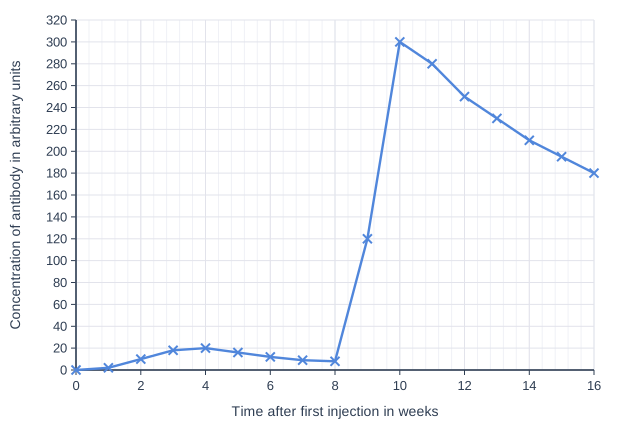
A group of volunteers was given two injections of a vaccine containing an inactivated bacterial toxin. The first injection was given at week 0 and the second at week 8.

The graph shows the mean concentration of antibody against the toxin in the volunteers' blood.

Calculate the mean rate of increase in antibody concentration between week 8 and week 10. Give your answer in arbitrary units per week.

Explain why very little antibody appeared in the blood during the first week after the first injection.

Explain the differences between the responses to the first and second injections.

Suggest why the antibody concentration fell after week 10.

Line graph of concentration of antibody in arbitrary units (y-axis, 0 to 320) against time after first injection in weeks (x-axis, 0 to 16). The line joins the points (0, 0), (1, 2), (2, 10), (3, 18), (4, 20), (5, 16), (6, 12), (7, 9), (8, 8), (9, 120), (10, 300), (11, 280), (12, 250), (13, 230), (14, 210), (15, 195), (16, 180).

Model answer

Rate = (300 - 8) ÷ (10 - 8) = 292 ÷ 2 = 146 arbitrary units per week

After the first injection only a few B cells have receptors complementary to the toxin. It takes time for these to be selected, to divide by mitosis to form a clone and to develop into plasma cells, so very little antibody appears in the first week.

The first injection produced memory cells. At the second injection these memory cells recognised the antigen and divided rapidly into large numbers of plasma cells, so antibody was produced much faster and in much greater amounts: it reached a peak of 300 arbitrary units two weeks after the second injection, compared with a peak of 20 arbitrary units four weeks after the first injection, and stayed high for longer.

After week 10 the antibodies were gradually broken down, and the plasma cells died and were not replaced, so the concentration fell.

Explanation

The secondary response is faster, larger and longer-lasting than the primary response because memory cells are already present: there are many more cells with complementary receptors, and they divide rapidly into plasma cells. The delay in the primary response is the time needed for clonal selection, clonal expansion and differentiation. For a rate, divide the change in concentration (300 - 8) by the change in time (2 weeks).

Mark scheme
  1. 1 mark

    Correct method, e.g. (300 - 8) ÷ 2; or a correct final answer of 146 (arbitrary units per week) with no working

    A correct answer of 146 with no working scores 2 marks (points 1 and 2). Accept for 1 mark: 292 (difference not divided by 2) OR 150 (300 ÷ 2, the week 8 value not subtracted).

  2. 1 mark

    146 (arbitrary units per week)

  3. 1 mark

    (First week) few B cells are complementary to the antigen at first / time is needed for clonal selection, mitosis/clonal expansion and differentiation into plasma cells

    Accept any one of these processes taking time, with the idea of a delay.

  4. 1 mark

    Memory cells (produced after the first injection) are present at the second injection

    Points 4 to 6 explain the differences.

  5. 1 mark

    Memory cells divide rapidly (by mitosis) into (many) plasma cells / there are many more B cells with complementary receptors than at the first injection

  6. 1 mark

    (So) antibody is produced faster and in much greater amounts (e.g. a peak of 300 two weeks after the second injection compared with 20 four weeks after the first)

    Accept a correct comparison of the rate of rise, the peak or how long the concentration stays high.

  7. 1 mark

    Antibodies are broken down/removed and the plasma cells die/are not replaced (once the toxin has been removed)

    Insufficient: 'the antibodies are used up'.

Ready to try the rest? Every answer you write is marked against the mark scheme, so you can see exactly where the marks are.

Study Helper Hints first, answers after you try

Stuck on this one? Ask for a hint and I’ll point you in the right direction, without giving the answer away. Once you’ve checked your answer, I’ll show you how the marks are awarded.