Practise 19 exam-style questions on Digestion and absorption for AQA A-Level Biology (Paper 1). Write your answer as you would in the exam and get it marked in seconds against the mark scheme, point by point, with the Study Helper on hand if you get stuck.
19 questions
1–8 marks each
Instant marking
No sign-up needed
19 questions, marked as you go
Sample questions with model answers
Here are 4 of the questions in this topic, each with a model answer, an explanation of why it earns the marks and the mark scheme an examiner would use.
Question 1
2 marks
Disaccharidases such as maltase are bound to the cell-surface membranes of the epithelial cells lining the ileum, rather than being released into the lumen.
Suggest two advantages of this.
Model answer
1. Glucose is produced right next to the co-transport proteins in the membrane, so it can be absorbed quickly. 2. The enzymes stay in place and are not carried away with the gut contents, so they can be used again and again.
Explanation
Membrane-bound disaccharidases and dipeptidases carry out the final stage of digestion at the surface of the epithelial cells, on the microvilli. Producing monosaccharides exactly where the co-transport proteins are keeps their concentration high at the membrane, which speeds up absorption. Enzymes free in the lumen would move on with the food and be lost.
Mark scheme
1 mark
Monosaccharides / glucose are produced next to the (co-transport / carrier) proteins that absorb them, so they are absorbed quickly / their concentration stays high at the cell surface
List rule: if more than two advantages are given, each wrong or contradictory extra answer cancels one correct answer. Accept 'glucose does not have to diffuse through the lumen to reach the cells' or 'maintains a (high) concentration / concentration gradient of glucose for absorption'.
1 mark
The enzymes are not lost / carried away with the contents of the gut, so they can be used again
Accept 'the enzymes are not egested'. Insufficient: 'the enzymes are held in place' with no advantage.
Question 2
3 marks
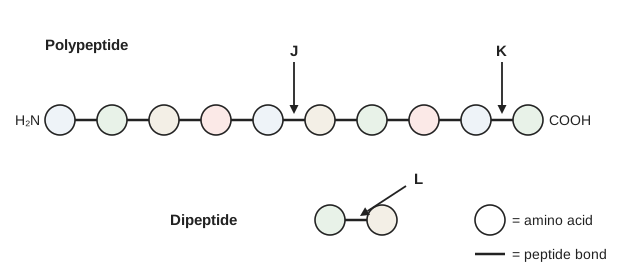
The diagram shows a polypeptide and a dipeptide in the human gut. Arrows J, K and L point to peptide bonds.
Name the type of enzyme that hydrolyses bond J, bond K and bond L during digestion.
Endopeptidases hydrolyse peptide bonds within a polypeptide chain, producing shorter peptides. Exopeptidases hydrolyse the peptide bonds at the ends of a chain, removing terminal amino acids. Membrane-bound dipeptidases on the epithelial cells of the ileum hydrolyse the bond between the two amino acids of a dipeptide. The prefixes help: endo- means within and exo- means outside.
Mark scheme
1 mark
J - endopeptidase
1 mark for each bond (points 1 to 3). Accept phonetic spellings. Accept a correctly named endopeptidase (pepsin, trypsin or chymotrypsin) for J.
1 mark
K - exopeptidase
Reject endopeptidase for K. Accept carboxypeptidase for K.
1 mark
L - (membrane-bound) dipeptidase
Reject exopeptidase or endopeptidase for L.
Question 3
4 marks
The flow chart shows the digestion of starch in the human gut.
Name substance X.
Name the enzyme that catalyses step 1 and the enzyme that catalyses step 2.
Give the precise location of the enzyme that catalyses step 2.
Model answer
X is maltose. Step 1 is catalysed by amylase. Step 2 is catalysed by maltase (a disaccharidase). Maltase is bound to the cell-surface membranes of the epithelial cells lining the ileum.
Explanation
Amylase, from the salivary glands and the pancreas, hydrolyses glycosidic bonds in starch to produce maltose. Maltase is a membrane-bound disaccharidase on the microvilli of the epithelial cells of the ileum; it hydrolyses maltose to glucose, which is then absorbed by co-transport. Take care with spelling: maltose is the sugar and maltase the enzyme. A common error is to describe starch being digested straight to glucose in one step.
Mark scheme
1 mark
(X =) maltose
Reject maltase for X.
1 mark
(Step 1 =) amylase
Accept salivary amylase or pancreatic amylase. Insufficient: 'carbohydrase' alone.
1 mark
(Step 2 =) maltase / disaccharidase
Reject maltose for the enzyme. Reject amylase or sucrase.
1 mark
Bound to the cell-surface membranes (of the microvilli) of the epithelial cells lining the ileum
Accept 'membrane-bound, on the epithelial cells of the small intestine'. Insufficient: 'small intestine' or 'ileum' alone.
Question 4
6 marks
Describe how lipids in food are digested in the small intestine and how the products of their digestion enter the epithelial cells lining the ileum.
Do not include what happens to the products after they enter the epithelial cells.
Model answer
In the small intestine, bile salts emulsify the lipids into small droplets, which greatly increases their surface area. Lipase then hydrolyses the ester bonds in the triglycerides, producing monoglycerides and fatty acids. Bile salts combine with these monoglycerides and fatty acids to form tiny micelles, which keep them in solution and carry them to the surface of the epithelial cells, keeping their concentration high next to the cells. There the monoglycerides and fatty acids are released and, because they are lipid-soluble, they diffuse across the phospholipid bilayer of the cell-surface membrane into the cells.
Explanation
Bile salts have two separate roles: emulsification, which increases the surface area for lipase, and micelle formation, which carries the products of digestion to the epithelium. Lipase hydrolyses ester bonds to give monoglycerides and fatty acids, which cross the membrane by simple diffusion because they are lipid-soluble. Common errors are to say that emulsification forms micelles or is a hydrolysis reaction, that micelles themselves cross the membrane, or that the products enter by facilitated diffusion or co-transport.
Mark scheme
1 mark
Bile salts emulsify lipids into (small) droplets
Max 6. Reject 'bile salts digest / hydrolyse lipids'.
1 mark
This increases the surface area (for lipase)
Accept 'more lipid exposed to lipase'.
1 mark
Lipase hydrolyses ester bonds (in triglycerides)
Reject 'peptide' or 'glycosidic bonds'.
1 mark
Producing monoglycerides and fatty acids
Accept glycerol for monoglycerides.
1 mark
Bile salts combine with monoglycerides and fatty acids to form micelles
Reject 'micelles are formed by emulsification'.
1 mark
Micelles make the monoglycerides / fatty acids (more) soluble in water / carry them (through the watery contents of the lumen) to the epithelial cells
Accept 'bring / transport them to the lining of the ileum'. For monoglycerides / fatty acids accept glycerol; ignore 'lipids' or 'triglycerides'.
1 mark
Micelles release them at the cell-surface membrane / maintain a high concentration of monoglycerides / fatty acids next to the epithelial cells
Accept 'keep up a concentration gradient into the cells'.
1 mark
Monoglycerides and fatty acids diffuse across the phospholipid bilayer (because they are lipid-soluble / non-polar)
Reject 'facilitated diffusion' or 'co-transport'. Ignore 'micelles are absorbed'; the mark needs monoglycerides or fatty acids diffusing.
Ready to try the rest? Every answer you write is marked against the mark scheme, so you can see exactly where the marks are.
Ctrl + Enter to check
Study HelperHints first, answers after you try
Stuck on this one? Ask for a hint and I’ll point you in the right direction, without giving the answer away. Once you’ve checked your answer, I’ll show you how the marks are awarded.