
Level:
Correct: 0
Incorrect: 0
Marks: 0/0
Exam Practice
Course:
Topics:
AQA A-Level Biology (Paper 1) Smart practice A mixed round aimed at your weak spots
Unit 1
Biological molecules
Unit 2
Cells
Unit 3
Organisms exchange substances with their environment
Unit 4
Genetic information, variation and relationships between organisms
DNA, genes and chromosomes
0%
Genetic diversity can arise as a result of mutation or during meiosis
Gene mutations and chromosome non-disjunction
0%
Meiosis and genetic variation
0%
Genetic diversity and adaptation
0%
Species and taxonomy
0%
Biodiversity within a community
0%
Investigating diversity
0%
Avg
score:
–
Topics
done:
0/35

General properties of proteins

Practise 17 exam-style questions on General properties of proteins for AQA A-Level Biology (Paper 1). Write your answer as you would in the exam and get it marked in seconds against the mark scheme, point by point, with the Study Helper on hand if you get stuck.

  • 17 questions
  • 1–7 marks each
  • Instant marking
  • No sign-up needed
17 questions, marked as you go

Sample questions with model answers

Here are 4 of the questions in this topic, each with a model answer, an explanation of why it earns the marks and the mark scheme an examiner would use.

Question 1

2 marks

The figure shows a molecule formed from three amino acids.

Give the number of water molecules released when this molecule was formed.

Give the number of the amino acid whose R group could form a disulfide bridge with another part of a polypeptide.
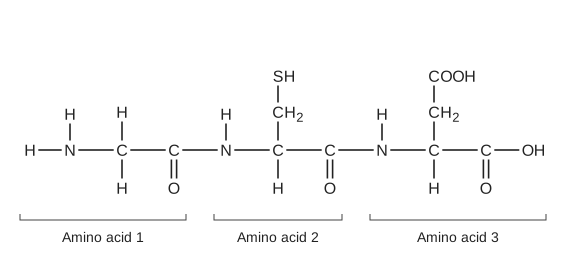
Displayed formula of a chain of three amino acids, labelled amino acid 1, amino acid 2 and amino acid 3 from left to right. The chain runs N-C-C-N-C-C-N-C-C from left to right, starting with H-N(H) on the left and ending with C(=O)-OH on the right. Each middle carbon has an H below it and an R group above it: amino acid 1 has H as its R group; amino acid 2 has CH2-SH; amino acid 3 has CH2-COOH. Each C=O carbon (except the last) is bonded to the N of the next amino acid, which carries an H.

Model answer

Two water molecules (one for each of the two peptide bonds).
Amino acid 2: its R group (CH2SH) contains sulfur, and two SH groups can form a disulfide bridge.

Explanation

Each peptide bond is formed by a condensation reaction that releases one water molecule, so three amino acids joined by two peptide bonds release two water molecules. A disulfide bridge is a strong covalent S-S bond that forms between the SH groups in the R groups of two cysteine amino acids, which may be far apart in the primary structure.

Mark scheme
  1. 1 mark

    2 / two

    Reject 3 (there are two peptide bonds).

  2. 1 mark

    2 / amino acid 2

    Its R group contains sulfur / an SH group. Reject 3.

Question 2

3 marks

Glycine and alanine are amino acids. One molecule of glycine and one molecule of alanine can join to form two different dipeptides.

Explain how two different dipeptides can be formed. Refer to the groups involved in your answer.

Model answer

A peptide bond forms in a condensation reaction between the carboxyl (COOH) group of one amino acid and the amine (NH2) group of the other, releasing a molecule of water. Either amino acid can provide the carboxyl group. If glycine's carboxyl group joins alanine's amine group, the dipeptide is glycine-alanine, with a free amine group on glycine; if alanine's carboxyl group joins glycine's amine group, it is alanine-glycine. These two dipeptides have different sequences, so they are different molecules.

Explanation

A peptide bond always links the carboxyl group of one amino acid to the amine group of the next, so every polypeptide has a free amine group at one end and a free carboxyl group at the other. With two different amino acids, swapping which one provides the carboxyl group reverses the sequence and gives a different dipeptide. This is why the order of amino acids (the primary structure) matters.

Mark scheme
  1. 1 mark

    Condensation (reaction) between the carboxyl / COOH group of one amino acid and the amine / NH₂ group of the other

    Accept 'the OH of the carboxyl group and an H of the amine group are removed'. Reject hydrolysis.

  2. 1 mark

    Forms a peptide bond and releases a molecule of water

    Both ideas are needed. Reject glycosidic or ester bond.

  3. 1 mark

    Either amino acid can provide the carboxyl group (and the other the amine group), so the amino acids can be joined in either order / glycine-alanine or alanine-glycine

    Accept 'the sequence can be reversed, so the free amine group is on glycine in one dipeptide and on alanine in the other'. Ignore 'they can join either way round' with no reference to which group each amino acid provides or to sequence.

Question 3

3 marks

Collagen is a protein in tendons, which join muscles to bones. A collagen molecule consists of three polypeptide chains wound tightly around each other to form a rope-like triple helix. In each chain, every third amino acid is glycine, which has the smallest R group, a single hydrogen atom. The glycine R groups face the centre of the triple helix, where the three chains are closest together.

Suggest why glycine is needed at these positions.

Explain why collagen has a quaternary structure.

Suggest how the structure of collagen gives tendons their strength.

Model answer

Glycine's R group is just a hydrogen atom, so the three chains can be wound very closely together; any larger R group would not fit in the crowded centre of the triple helix.
Collagen has a quaternary structure because each molecule is made of more than one polypeptide chain (three).
The three tightly wound chains are held together by many hydrogen bonds, so the molecule, like a rope, resists being pulled apart.

Explanation

This applies protein structure to an unfamiliar protein: the size of an R group affects how closely chains can pack, and quaternary structure means more than one polypeptide, not exactly four. The many hydrogen bonds between closely packed chains give collagen its tensile strength, in the same way as many hydrogen bonds between cellulose chains strengthen plant cell walls.

Mark scheme
  1. 1 mark

    Glycine's R group is small, so the chains can be packed / wound closely together (larger R groups would not fit in the centre)

  2. 1 mark

    (Collagen consists of) more than one polypeptide / three polypeptides

    Reject 'because it has four polypeptides' and 'because it has three tertiary structures' with no reference to polypeptides.

  3. 1 mark

    Many hydrogen bonds between the chains / many bonds between molecules hold the chains together, so they resist being pulled apart

    Accept 'cross-links between collagen molecules'. Accept 'tightly wound chains (like a rope)' only with the idea of bonds between chains.

Question 4

6 marks

Enzymes and antibodies are proteins that have binding sites with a very specific shape.

Describe the structure of a protein and explain how this structure produces a binding site with a specific shape.

Do not include the process of protein synthesis in your answer.

Model answer

The primary structure of a protein is the sequence of amino acids in its polypeptide chain, joined by peptide bonds formed in condensation reactions. The chain coils into α-helices or folds into β-pleated sheets, held by hydrogen bonds: this is the secondary structure. The polypeptide then folds further into a specific 3-D tertiary structure, held by hydrogen bonds, ionic bonds and disulfide bridges between R groups. Some proteins, such as antibodies, have a quaternary structure of more than one polypeptide. The sequence of amino acids determines which R groups are next to each other and so where these bonds form; this gives a unique 3-D shape, including the binding site, which is complementary to one particular molecule, such as an enzyme's substrate or an antibody's antigen.

Explanation

Describe each level with the bonds that hold it, then make the link to specificity: sequence leads to the positions of bonds between R groups, then the exact tertiary shape, then a complementary binding site. Many answers lose marks by stating that quaternary structure means four polypeptides, or by describing transcription and translation, which the question excludes.

Mark scheme
  1. 1 mark

    Primary structure is the sequence of amino acids (in a polypeptide)

    Max 6. Max 5 from points 1 to 6. Reject 'sequence of bases' for this point.

  2. 1 mark

    Amino acids are joined by peptide bonds (formed by condensation reactions)

  3. 1 mark

    Secondary structure: the polypeptide coils into an α-helix or folds into a β-pleated sheet, held by hydrogen bonds

  4. 1 mark

    Tertiary structure: the polypeptide folds further into a specific 3-D shape

    Accept 'globular shape'.

  5. 1 mark

    The tertiary structure is held by hydrogen bonds, ionic bonds and disulfide bridges (between R groups)

    At least two of these bonds are needed. Accept hydrophobic interactions as one of them.

  6. 1 mark

    Quaternary structure: (some proteins have) more than one polypeptide (held together by the same types of bond)

    Reject 'four polypeptides'.

  7. 1 mark

    The primary structure / sequence determines where these bonds form, so it determines the exact 3-D shape of the binding site

    Accept 'a change in the sequence can change the shape of the binding site'.

  8. 1 mark

    The binding site is complementary to (the shape of) one particular molecule, e.g. the substrate or antigen, so only that molecule can bind

Ready to try the rest? Every answer you write is marked against the mark scheme, so you can see exactly where the marks are.

Study Helper Hints first, answers after you try

Stuck on this one? Ask for a hint and I’ll point you in the right direction, without giving the answer away. Once you’ve checked your answer, I’ll show you how the marks are awarded.