
Level:
Correct: 0
Incorrect: 0
Marks: 0/0
Exam Practice
Course:
Topics:
AQA A-Level Biology (Paper 1) Smart practice A mixed round aimed at your weak spots
Unit 1
Biological molecules
Unit 2
Cells
Unit 3
Organisms exchange substances with their environment
Unit 4
Genetic information, variation and relationships between organisms
DNA, genes and chromosomes
0%
Genetic diversity can arise as a result of mutation or during meiosis
Gene mutations and chromosome non-disjunction
0%
Meiosis and genetic variation
0%
Genetic diversity and adaptation
0%
Species and taxonomy
0%
Biodiversity within a community
0%
Investigating diversity
0%
Avg
score:
–
Topics
done:
0/35

Haemoglobin and the transport of oxygen

Practise 18 exam-style questions on Haemoglobin and the transport of oxygen for AQA A-Level Biology (Paper 1). Write your answer as you would in the exam and get it marked in seconds against the mark scheme, point by point, with the Study Helper on hand if you get stuck.

  • 18 questions
  • 1–8 marks each
  • Instant marking
  • No sign-up needed
18 questions, marked as you go

Sample questions with model answers

Here are 4 of the questions in this topic, each with a model answer, an explanation of why it earns the marks and the mark scheme an examiner would use.

Question 1

2 marks

A red blood cell contains about 2.7 × 10⁸ haemoglobin molecules. Blood leaving the lungs is 97% saturated with oxygen. Blood leaving an exercising muscle is 25% saturated with oxygen.

Calculate the number of oxygen molecules unloaded by one red blood cell as it passes through the exercising muscle.

Give your answer in standard form.

Model answer

Each haemoglobin molecule carries up to 4 oxygen molecules.
Maximum O₂ per cell = 4 × 2.7 × 10⁸ = 1.08 × 10⁹
Fraction unloaded = 0.97 - 0.25 = 0.72
O₂ unloaded = 1.08 × 10⁹ × 0.72 = 7.776 × 10⁸ = 7.8 × 10⁸ molecules

Explanation

One haemoglobin molecule has four haem groups, so it carries up to four oxygen molecules. The percentage saturation tells you what fraction of these sites are filled, so the fall from 97% to 25% means 72% of the maximum is unloaded. The commonest error is forgetting to multiply by 4; another is giving a long number rather than standard form.

Mark scheme
  1. 1 mark

    Correct method, e.g. 4 × 2.7 × 10⁸ × (0.97 - 0.25) or 1.08 × 10⁹ × 0.72; or a correct final answer of 7.8 × 10⁸ with no working

    A correct answer of 7.8 × 10⁸ (accept any correct rounding: 7.776 × 10⁸, 7.78 × 10⁸, 7.8 × 10⁸ or 8 × 10⁸) with no working scores 2 marks. Accept for 1 mark: 1.9 × 10⁸ or 1.944 × 10⁸ (did not multiply by 4, the number of oxygen molecules per haemoglobin) OR 777 600 000 or 778 000 000 (correct value not in standard form) OR evidence of 1.08 × 10⁹ (correct maximum number of oxygen molecules carried by one cell).

  2. 1 mark

    7.8 × 10⁸ (accept 7.776 × 10⁸, 7.78 × 10⁸ or 8 × 10⁸)

    Accept any clear typed form of standard form, e.g. 7.8E8 or '7.8 × 10 to the power 8'. Do not accept 7.8 or 7.8 × 10⁹ for this mark.
Question 2

3 marks

The oxyhaemoglobin dissociation curve for adult human haemoglobin is S-shaped (sigmoid). The curve is shallow at very low partial pressures of oxygen. It becomes much steeper between partial pressures of about 2 kPa and 6 kPa.

Explain why the curve becomes steeper.

Model answer

At very low partial pressures of oxygen it is difficult for the first oxygen molecule to bind to haemoglobin, so the curve is shallow. When the first oxygen binds, it changes the quaternary (tertiary) shape of the haemoglobin molecule. This makes it easier for the second and third oxygen molecules to bind (cooperative binding), so in this range a small increase in partial pressure of oxygen causes a large increase in percentage saturation.

Explanation

The S shape comes from cooperative binding: the first oxygen binds with difficulty, but its binding changes the shape of haemoglobin so that further oxygen molecules bind more easily. Answers need the shape change and the idea that later binding is easier. Simply describing the shape of the curve, or saying haemoglobin 'has more affinity' with no reason, scores little.

Mark scheme
  1. 1 mark

    At low partial pressures of oxygen, it is difficult for the first oxygen molecule to bind (to haemoglobin) / few oxygen molecules bind

    Max 3. Accept 'haemoglobin has a low affinity for oxygen at first'. Ignore descriptions of the curve that give no explanation, e.g. 'a small increase in partial pressure of oxygen causes a large increase in saturation' (this only restates that the curve is steep).

  2. 1 mark

    Binding of the first oxygen (molecule) changes the shape / tertiary structure / quaternary structure of haemoglobin

    Accept 'changes the conformation'. Do not accept 'denatures'.

  3. 1 mark

    (This) makes it easier for further / other oxygen molecules to bind / increases the affinity / uncovers more binding sites

    Accept 'cooperative binding' for this point only if the idea of binding becoming easier is given.

Question 3

3 marks

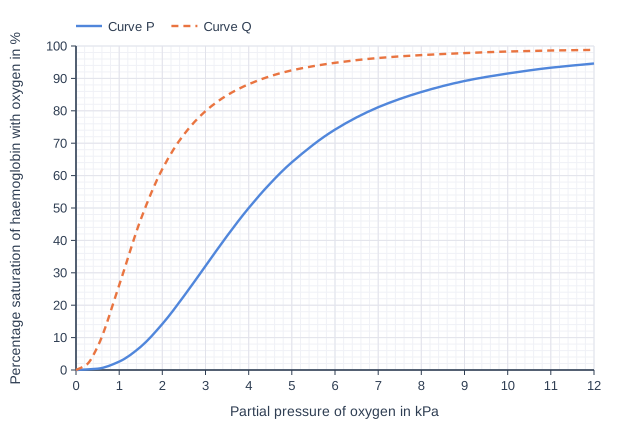
Tadpoles are the young stage of frogs. They live in water and exchange gases through gills and their skin. Adult frogs live mainly on land and breathe air with lungs.

The graph shows the oxyhaemoglobin dissociation curves for the haemoglobin of tadpoles and of adults of one species of frog.

Which curve, P or Q, is for tadpole haemoglobin? Explain your answer.

Line graph of percentage saturation of haemoglobin with oxygen in % (y-axis, 0 to 100) against partial pressure of oxygen in kPa (x-axis, 0 to 12). "Curve P" is a smooth curve through (0, 0), (0.5, 0.4), (1, 2.6), (1.5, 7.2), (2, 14.2), (2.5, 22.8), (3, 32.1), (3.5, 41.4), (4, 50), (4.5, 57.6), (5, 64.1), (6, 74.2), (7, 81.1), (8, 85.8), (9, 89.2), (10, 91.5), (11, 93.3), (12, 94.6). "Curve Q" (dashed) is a smooth curve through (0, 0), (0.25, 1.7), (0.5, 7.2), (1, 26.2), (1.5, 46.5), (2, 62), (2.5, 72.7), (3, 79.9), (3.5, 84.8), (4, 88.2), (4.5, 90.7), (5, 92.5), (6, 94.8), (7, 96.3), (8, 97.2), (9, 97.8), (10, 98.3), (11, 98.6), (12, 98.8).

Model answer

Curve Q is for tadpole haemoglobin because it is to the left of P: it has a higher affinity for oxygen (at 2 kPa it is about 62% saturated, compared with about 14% for P). Water contains less oxygen than air, so the partial pressure of oxygen at the tadpole's gills and skin is low. Haemoglobin with a high affinity can still load oxygen at these low partial pressures, so enough oxygen reaches the tissues for aerobic respiration.

Explanation

A curve to the left means a higher affinity: the haemoglobin becomes saturated at lower partial pressures of oxygen. Animals whose gas exchange surface has a low partial pressure of oxygen, such as tadpoles in water, benefit from haemoglobin that can load oxygen there. Identify the curve, then explain using the environment, and say 'loads' when you mean loading at the gas exchange surface.

Mark scheme
  1. 1 mark

    Q AND it has a higher affinity for oxygen / it is to the left / it is more saturated at the same partial pressure of oxygen

    Max 1 if the answer identifies curve P as the tadpole curve. Max 3 in total. Accept data, e.g. at 2 kPa Q is about 62% saturated and P about 14% (accept ±3%). No mark for 'Q' alone.

  2. 1 mark

    Water has a lower partial pressure / concentration of oxygen than air / oxygen diffuses slowly in water

    Accept 'less oxygen is available in water'.

  3. 1 mark

    (So tadpole haemoglobin) can load oxygen / become (highly) saturated at low partial pressures of oxygen (at the gills / skin)

    Do not accept 'unloads more oxygen'.

  4. 1 mark

    (So enough) oxygen is delivered to the tissues for aerobic respiration

    Reject 'to make energy'.

Question 4

6 marks

Describe how oxygen is loaded, transported and unloaded by haemoglobin in a mammal. Refer to the oxyhaemoglobin dissociation curve in your answer.

Model answer

In the lungs the partial pressure of oxygen is high, so haemoglobin has a high affinity for oxygen and loads it, forming oxyhaemoglobin. Binding is cooperative: when the first oxygen binds, the shape of haemoglobin changes, making it easier for more oxygen to bind, so haemoglobin becomes almost fully saturated. Oxygen is carried as oxyhaemoglobin inside red blood cells. In respiring tissues the partial pressure of oxygen is low, so haemoglobin has a lower affinity and oxygen is unloaded. Because the curve is steep at low partial pressures, a small fall in partial pressure releases a lot of oxygen. Respiring tissues also have a high carbon dioxide concentration, which lowers the affinity further (the Bohr effect), so even more oxygen is unloaded.

Explanation

Link each stage to the partial pressure of oxygen and to the affinity of haemoglobin: high partial pressure and high affinity in the lungs (loading), low partial pressure, high carbon dioxide and lower affinity in tissues (unloading). Explaining the S-shaped curve with cooperative binding and the Bohr effect earns extra marks. Avoid saying haemoglobin 'has a high affinity so it unloads easily', which contradicts itself.

Mark scheme
  1. 1 mark

    In the lungs / alveoli, the partial pressure of oxygen is high

    Max 6. Accept 'high concentration of oxygen' for 'high partial pressure'.

  2. 1 mark

    Haemoglobin has a high affinity for oxygen at high partial pressure, so oxygen associates / loads

    Do not award for 'oxygen loads / associates with haemoglobin' alone: the idea of a high affinity (at high partial pressure) is needed.

  3. 1 mark

    Forms oxyhaemoglobin / haemoglobin becomes (almost) fully saturated

    Accept 'about 97% saturated'.

  4. 1 mark

    Cooperative binding: binding of the first oxygen changes the shape of haemoglobin, making it easier for further oxygen molecules to bind

    Accept 'tertiary / quaternary structure changes'.

  5. 1 mark

    Oxygen is transported (as oxyhaemoglobin) in red blood cells

    Reject 'transported in plasma' as the main method.

  6. 1 mark

    In respiring tissues, the partial pressure of oxygen is low

  7. 1 mark

    Haemoglobin has a lower affinity (at low partial pressures), so oxygen dissociates / is unloaded

    Accept 'oxyhaemoglobin dissociates'.

  8. 1 mark

    High concentration of carbon dioxide (in respiring tissues) lowers the affinity further / Bohr effect / shifts the curve to the right, so more oxygen is unloaded

    Accept 'more oxygen unloaded where carbon dioxide is produced'.

  9. 1 mark

    The curve is steep at low partial pressures, so a small fall in partial pressure of oxygen causes a large amount of oxygen to be unloaded

Ready to try the rest? Every answer you write is marked against the mark scheme, so you can see exactly where the marks are.

Study Helper Hints first, answers after you try

Stuck on this one? Ask for a hint and I’ll point you in the right direction, without giving the answer away. Once you’ve checked your answer, I’ll show you how the marks are awarded.