
Level:
Correct: 0
Incorrect: 0
Marks: 0/0
Exam Practice
Course:
Topics:
AQA A-Level Biology (Paper 2) Smart practice A mixed round aimed at your weak spots
Unit 5
Energy transfers in and between organisms
Unit 6
Organisms respond to changes in their internal and external environments
Stimuli, both internal and external, are detected and lead to a response
Survival and response
0%
Receptors
0%
Control of heart rate
0%
Skeletal muscles are stimulated to contract by nerves and act as effectors
Skeletal muscles and muscle contraction
0%
Unit 7
Genetics, populations, evolution and ecosystems
Unit 8
The control of gene expression
Alteration of the sequence of bases in DNA can alter the structure of proteins
Gene mutations and their effects on proteins
0%
Using genome projects
0%
Differences in DNA between individuals of the same species can be exploited
DNA probes, screening and genetic counselling
0%
Genetic fingerprinting
0%
Unit 9
Comprehension
Avg
score:
–
Topics
done:
0/34

The light-independent reaction

Practise 18 exam-style questions on The light-independent reaction for AQA A-Level Biology (Paper 2). Write your answer as you would in the exam and get it marked in seconds against the mark scheme, point by point, with the Study Helper on hand if you get stuck.

  • 18 questions
  • 1–8 marks each
  • Instant marking
  • No sign-up needed
18 questions, marked as you go

Sample questions with model answers

Here are 4 of the questions in this topic, each with a model answer, an explanation of why it earns the marks and the mark scheme an examiner would use.

Question 1

2 marks

Pineapple plants open their stomata at night and close them during the day. At night they take in carbon dioxide and store it in their leaf cells as an organic acid. During the day, the acid releases carbon dioxide inside the cells, and this carbon dioxide is used in the Calvin cycle.

Explain why the carbon dioxide taken in at night cannot be used in the Calvin cycle until the day.

Model answer

The Calvin cycle needs ATP and reduced NADP to reduce GP to triose phosphate and to regenerate RuBP. These are only produced by the light-dependent reaction, which needs light, so at night there is no supply of ATP and reduced NADP and the stored carbon dioxide cannot be used until it is light.

Explanation

The light-independent reaction does not use light directly, but it depends on the ATP and reduced NADP made by the light-dependent reaction, so in practice it only runs in the light. Pineapples separate the two in time: they take in carbon dioxide at night, when stomata can be open with less water loss, and fix it in the Calvin cycle during the day. Saying 'the Calvin cycle needs light' without explaining why does not gain credit.

Mark scheme
  1. 1 mark

    The Calvin cycle / light-independent reaction needs ATP and reduced NADP

    Both ATP and reduced NADP are needed. Accept 'to reduce GP to triose phosphate and regenerate RuBP'. Reject reduced NAD.

  2. 1 mark

    ATP and reduced NADP are produced in the light-dependent reaction, which needs light / does not take place at night

    Ignore 'the Calvin cycle needs light' unless linked to the light-dependent reaction or its products.
Question 2

3 marks

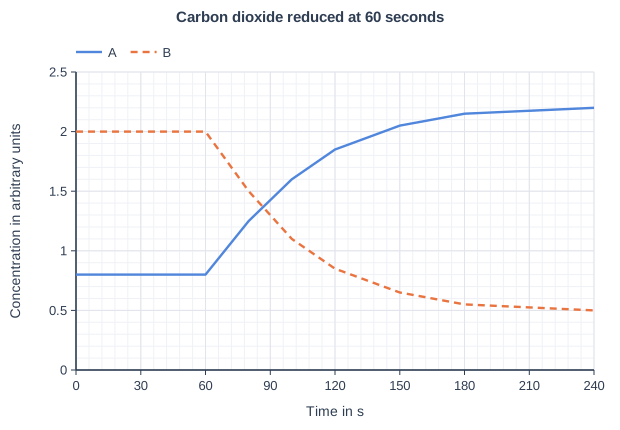
Scientists grew wheat seedlings in bright light in air containing 0.04% carbon dioxide. After 60 seconds they reduced the concentration of carbon dioxide to 0.005%, keeping the light intensity the same. They measured the concentrations of two compounds, A and B, in the leaves. One compound is RuBP and the other is GP. The graph shows their results.

Which line, A or B, shows the concentration of RuBP? Explain the changes in the concentrations of both compounds after the carbon dioxide concentration was reduced.

Carbon dioxide reduced at 60 seconds. Line graph of concentration in arbitrary units (y-axis, 0 to 2.5) against time in s (x-axis, 0 to 240). "A" joins the points (0, 0.8), (60, 0.8), (80, 1.25), (100, 1.6), (120, 1.85), (150, 2.05), (180, 2.15), (240, 2.2). "B" (dashed) joins the points (0, 2), (60, 2), (80, 1.5), (100, 1.1), (120, 0.85), (150, 0.65), (180, 0.55), (240, 0.5).

Model answer

Line A shows RuBP.

With less carbon dioxide, less RuBP combines with carbon dioxide, so less RuBP is used; but the light-dependent reaction still provides ATP, so RuBP is still regenerated from triose phosphate and its concentration rises. Less GP is formed, but GP is still reduced to triose phosphate using ATP and reduced NADP, so the concentration of GP falls.

Explanation

Each concentration depends on the balance between how fast the compound is made and how fast it is used. Reducing carbon dioxide slows only the step RuBP + CO₂ → 2 GP; the light-dependent reaction is unchanged, so GP is still reduced and RuBP is still regenerated. So RuBP (line A) builds up and GP (line B) falls - the opposite of what happens when the light is switched off. Answers must explain both the making and the using of each compound.

Mark scheme
  1. 1 mark

    A

    This mark is for the identification only; points 2 and 3 can be awarded even if the identification is wrong, if the explanations are correct for each compound.

  2. 1 mark

    Less RuBP combines with carbon dioxide / less RuBP is used, but RuBP is still regenerated (from triose phosphate using ATP), so RuBP accumulates / increases

    Both parts are needed: less used AND still regenerated. Accept 'less carbon dioxide fixed'.

  3. 1 mark

    Less GP is formed, but GP is still reduced to triose phosphate (using ATP and reduced NADP), so GP decreases

    Both parts are needed: less formed AND still used/reduced. Reject 'glucose phosphate' (or glucose 3-phosphate) for GP.

Question 3

3 marks

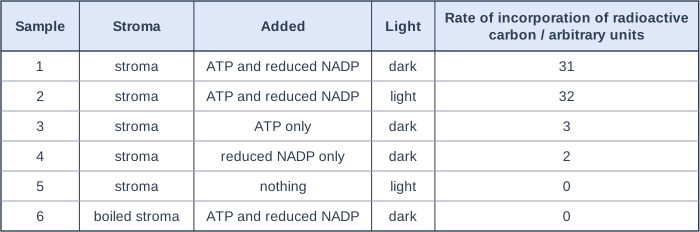
Scientists broke open chloroplasts and separated the stroma from the thylakoids. The stroma contains all the enzymes and intermediate compounds of the Calvin cycle. They added radioactive carbon dioxide to samples of stroma under different conditions and measured the rate at which radioactive carbon was incorporated into organic compounds. The table shows their results.

What can you conclude from these results about the light-independent reaction? Use the data to explain each conclusion.

Table with columns "Sample", "Stroma", "Added", "Light", "Rate of incorporation of radioactive carbon / arbitrary units". Sample: 1; Stroma: stroma; Added: ATP and reduced NADP; Light: dark; Rate of incorporation of radioactive carbon / arbitrary units: 31 | Sample: 2; Stroma: stroma; Added: ATP and reduced NADP; Light: light; Rate of incorporation of radioactive carbon / arbitrary units: 32 | Sample: 3; Stroma: stroma; Added: ATP only; Light: dark; Rate of incorporation of radioactive carbon / arbitrary units: 3 | Sample: 4; Stroma: stroma; Added: reduced NADP only; Light: dark; Rate of incorporation of radioactive carbon / arbitrary units: 2 | Sample: 5; Stroma: stroma; Added: nothing; Light: light; Rate of incorporation of radioactive carbon / arbitrary units: 0 | Sample: 6; Stroma: boiled stroma; Added: ATP and reduced NADP; Light: dark; Rate of incorporation of radioactive carbon / arbitrary units: 0.

Model answer

1. Light is not needed directly for the light-independent reaction: with ATP and reduced NADP, the rate in the dark (31) is almost the same as in the light (32).
2. Both ATP and reduced NADP are needed: with only ATP or only reduced NADP the rate is very low (3 and 2), and with neither it is 0, even in the light.
3. The reaction is catalysed by enzymes: boiled stroma, with ATP and reduced NADP, fixes no carbon dioxide.

Explanation

The light-independent reaction uses ATP and reduced NADP, not light itself; in a chloroplast it stops in the dark only because these products of the light-dependent reaction run out. Without thylakoids, the stroma in the light cannot make its own ATP and reduced NADP, so the rate is 0. Each conclusion must be backed by a comparison of the right samples.

Mark scheme
  1. 1 mark

    Light is not needed (directly) / the reaction can happen in the dark, because the rate with ATP and reduced NADP is (almost) the same in the dark (31) as in the light (32)

    Max 3. Each point needs the conclusion AND the supporting data (figures or a clear comparison of named samples).

  2. 1 mark

    Both ATP and reduced NADP are needed, because the rate is very low with only one of them (3 or 2) / is 0 with neither

    Reject reduced NAD.

  3. 1 mark

    The reaction is catalysed by enzymes (in the stroma), because boiled stroma gives no fixation / a rate of 0

    Accept 'enzymes are denatured by boiling'.

  4. 1 mark

    The enzymes of the light-independent reaction are in the stroma / thylakoids are not needed, because stroma alone with ATP and reduced NADP fixes carbon dioxide

    Ignore 'it happens in the stroma' without reference to the data.

Question 4

5 marks

Some of the triose phosphate produced in the Calvin cycle is used to make other organic substances in a plant.

Describe how triose phosphate can be used to produce named organic substances in the plant. Include any other elements or ions that the plant needs for these substances.

Model answer

Two molecules of triose phosphate are combined to form glucose. Molecules of α-glucose are joined by condensation reactions, forming glycosidic bonds, to make starch, which is stored, and β-glucose molecules are joined in the same way to make cellulose for cell walls. Glucose and fructose form sucrose, which is transported in the phloem. Triose phosphate can also be converted to glycerol, which combines with fatty acids to form triglycerides and phospholipids. Triose phosphate is used to make amino acids, but this also needs nitrogen, which the plant absorbs from the soil as nitrate ions; amino acids are joined by peptide bonds to make proteins. Nucleotides for DNA, RNA and ATP need both nitrogen and phosphate ions.

Explanation

Triose phosphate is the starting point for almost every organic substance in a plant: carbohydrates (glucose, sucrose, starch, cellulose), lipids (from glycerol and fatty acids) and, with nitrogen from nitrate, amino acids and proteins; nucleic acids also need phosphate. Name the substances and the type of reaction (condensation) where you can. A common error is to say plants store glycogen.

Mark scheme
  1. 1 mark

    Two triose phosphate (molecules) form glucose / a hexose

    Max 5. Points 1 to 9 are each worth 1 mark. Reject glycogen or glucagon for glucose. Accept TP (triose phosphate is named in the question).

  2. 1 mark

    α-glucose (molecules) joined by condensation (reactions) / glycosidic bonds to form starch (for storage)

    Accept amylose / amylopectin. Reject glycogen as the plant store.

  3. 1 mark

    β-glucose (molecules) joined by condensation / glycosidic bonds to form cellulose (for cell walls)

    Reject 'α-glucose forms cellulose'.

  4. 1 mark

    Glucose and fructose form sucrose (for transport in the phloem)

    Accept 'sucrose (a disaccharide) is made for translocation'.

  5. 1 mark

    Triose phosphate is converted to glycerol, which forms lipids / triglycerides / phospholipids with fatty acids

    Accept 'glycerol and fatty acids joined by ester bonds'.

  6. 1 mark

    Triose phosphate is used to make amino acids, which needs nitrogen / nitrate (ions) (from the soil)

    Accept ammonium ions. Nitrogen or nitrate must be named.

  7. 1 mark

    Amino acids are joined by peptide bonds / condensation to form proteins / polypeptides / enzymes

    Accept 'proteins such as rubisco'.

  8. 1 mark

    Nucleotides / DNA / RNA / ATP need nitrogen AND phosphate (ions)

    Both nitrogen (nitrate) and phosphate are needed.

  9. 1 mark

    Triose phosphate / glucose used as a respiratory substrate

    Accept 'triose phosphate is oxidised to pyruvate in respiration'.

Ready to try the rest? Every answer you write is marked against the mark scheme, so you can see exactly where the marks are.

Study Helper Hints first, answers after you try

Stuck on this one? Ask for a hint and I’ll point you in the right direction, without giving the answer away. Once you’ve checked your answer, I’ll show you how the marks are awarded.