
Level:
Correct: 0
Incorrect: 0
Marks: 0/0
Exam Practice
Course:
Topics:
AQA A-Level Biology (Paper 2) Smart practice A mixed round aimed at your weak spots
Unit 5
Energy transfers in and between organisms
Unit 6
Organisms respond to changes in their internal and external environments
Stimuli, both internal and external, are detected and lead to a response
Survival and response
0%
Receptors
0%
Control of heart rate
0%
Skeletal muscles are stimulated to contract by nerves and act as effectors
Skeletal muscles and muscle contraction
0%
Unit 7
Genetics, populations, evolution and ecosystems
Unit 8
The control of gene expression
Alteration of the sequence of bases in DNA can alter the structure of proteins
Gene mutations and their effects on proteins
0%
Using genome projects
0%
Differences in DNA between individuals of the same species can be exploited
DNA probes, screening and genetic counselling
0%
Genetic fingerprinting
0%
Unit 9
Comprehension
Avg
score:
–
Topics
done:
0/34

Gene mutations and their effects on proteins

Practise 17 exam-style questions on Gene mutations and their effects on proteins for AQA A-Level Biology (Paper 2). Write your answer as you would in the exam and get it marked in seconds against the mark scheme, point by point, with the Study Helper on hand if you get stuck.

  • 17 questions
  • 1–9 marks each
  • Instant marking
  • No sign-up needed
17 questions, marked as you go

Sample questions with model answers

Here are 4 of the questions in this topic, each with a model answer, an explanation of why it earns the marks and the mark scheme an examiner would use.

Question 1

3 marks

Acridine orange and nitrous acid are both mutagenic agents.

• Molecules of acridine orange are flat and slip between neighbouring base pairs in DNA. When this DNA is replicated, an extra nucleotide may be added to the new strand, or a nucleotide may be missed out.
• Nitrous acid changes the structure of some bases, so that each changed base pairs with a different base when the DNA is replicated.

Explain why the mutations caused by acridine orange are more likely to result in a non-functional protein than the mutations caused by nitrous acid.

Model answer

Acridine orange causes additions or deletions of a base. These cause a frame shift: every triplet after the mutation is changed, so many amino acids are different or a stop triplet appears early. The primary structure, and so the tertiary structure, of the protein is very different and it does not function.

Nitrous acid causes substitutions. A substitution changes only one triplet, so at most one amino acid changes, and because the genetic code is degenerate the new triplet may still code for the same amino acid.

Explanation

Relate the kind of mutation to how many triplets it changes. Additions and deletions shift the reading frame, so the effect spreads to every triplet downstream; substitutions affect a single triplet and may be silent because of the degenerate code. A common error is to say that a substitution causes a frame shift.

Mark scheme
  1. 1 mark

    Acridine orange causes addition / deletion (of a base / nucleotide)

    Max 2 if the answer does not describe the type or the effect of the mutations caused by nitrous acid. Max 3. Accept insertion for addition. Reject answers that say the mutagen changes amino acids in the DNA.

  2. 1 mark

    Addition / deletion causes a frame shift / changes all the triplets after / downstream of the mutation

    Accept codon for triplet.

  3. 1 mark

    (So) many amino acids are changed OR a stop triplet / codon forms early, so the primary structure and tertiary structure are very different

    Accept 'a different tertiary structure / active site / binding site'.

  4. 1 mark

    Nitrous acid causes a substitution, which changes only one triplet, so at most one amino acid is changed

    Reject 'nitrous acid causes a frame shift'.

  5. 1 mark

    (After a substitution) the triplet may still code for the same amino acid because the genetic code is degenerate
Question 2

3 marks

A channel protein in the cell-surface membrane of a type of neurone allows potassium ions to pass through. Part of the polypeptide chain of this protein crosses the phospholipid bilayer. In this part, every amino acid has a non-polar (hydrophobic) R group.

A substitution mutation changed the amino acid at one position in this part of the polypeptide from leucine, which has a non-polar R group, to lysine, which has a positively charged R group.

Suggest how this mutation could stop the channel protein allowing potassium ions to pass through the membrane.

Model answer

Replacing leucine with lysine changes the primary structure. Lysine's R group is positively charged and hydrophilic, so it cannot sit among the hydrophobic fatty acid tails in the middle of the bilayer; this part of the polypeptide may no longer cross the membrane, and different ionic and hydrogen bonds form, changing the tertiary structure. The shape of the channel changes, or the channel no longer spans the membrane, so potassium ions cannot pass. The positive charge could also repel the positively charged potassium ions.

Explanation

This question links a substitution to protein structure and to the fluid-mosaic membrane. The parts of membrane proteins that cross the bilayer have hydrophobic R groups because they are surrounded by fatty acid tails; a charged R group there disrupts folding and insertion into the membrane. A channel protein is not an enzyme, so answers about an 'active site' are wrong.

Mark scheme
  1. 1 mark

    Change in primary structure / one different amino acid, so different bonds (ionic / hydrogen) form between R groups and the tertiary structure changes

    Max 3. Accept 'the protein folds differently'.

  2. 1 mark

    The charged / polar / hydrophilic R group (of lysine) would not be in contact with / is repelled by the hydrophobic fatty acid tails (inside the bilayer)

    Accept 'charged R group cannot pass through / sit in the hydrophobic core of the membrane'.

  3. 1 mark

    So this part of the protein may not cross the membrane / the protein may not be inserted into the membrane correctly

  4. 1 mark

    So the shape of the channel / pore changes OR the channel no longer spans the membrane, so potassium ions cannot pass through

    Do not credit references to an active site (a channel protein is not an enzyme).

  5. 1 mark

    The positive charge in / near the channel repels potassium ions (which are also positive)

Question 3

4 marks

The coding sequence of a human gene is 1452 bases long. It begins with the start triplet, which codes for the first amino acid of the polypeptide, and ends with one stop triplet. A substitution of base 628 of the coding sequence changed the triplet containing this base into a stop triplet.

Calculate the number of amino acids in the polypeptide coded by the mutant allele.

Calculate this number as a percentage of the number of amino acids in the normal polypeptide. Give your answer to 3 significant figures.

Suggest why the mutant polypeptide is not functional.

Model answer

Base 628 is the first base of triplet 210 (627 ÷ 3 = 209 complete triplets before it), so triplet 210 is the stop triplet.
Mutant polypeptide = 209 amino acids
Normal polypeptide = 1452 ÷ 3 - 1 = 484 - 1 = 483 amino acids (the stop triplet codes for no amino acid)
Percentage = 209 ÷ 483 × 100 = 43.27 = 43.3%
The mutant polypeptide lacks 274 amino acids, so it cannot fold into the correct tertiary structure and parts such as the active site or binding site are missing.

Explanation

Divide the number of bases by three to find the number of triplets, and remember that the stop triplet does not code for an amino acid. A substitution that creates a stop triplet ends translation there, so the polypeptide contains only the amino acids coded by the triplets before it. Common errors are counting the stop triplet as an amino acid and giving the percentage to the wrong number of significant figures.

Mark scheme
  1. 1 mark

    209 amino acids in the mutant polypeptide (a correct answer of 209 with no working scores this mark)

    A correct answer of 209 with no working scores 1 mark (point 1); a correct percentage of 43.3 with no working scores points 2 and 3. Base 628 is the first base of triplet 210, which is now the stop triplet, so the mutant polypeptide has 209 amino acids. Do not accept 210 (the stop triplet counted as an amino acid).

  2. 1 mark

    Correct method for the percentage: 209 ÷ 483 × 100 (the normal polypeptide has 1452 ÷ 3 - 1 = 483 amino acids); or a correct answer of 43.3 with no working

    Points 2 and 3 are the percentage calculation: a correct answer of 43.3% with no working scores 2 marks. Accept for point 2 only: 43 or 43.27 (not given to 3 significant figures), or 43.4 (210 ÷ 484), 43.5 (210 ÷ 483) or 43.2 (209 ÷ 484) (incorrect numbers of amino acids).

  3. 1 mark

    43.3 (%)

    Do not award this point for 43 or 43.27 (not given to 3 significant figures); these earn point 2 only.

  4. 1 mark

    The polypeptide lacks 274 amino acids / more than half of its amino acids, so it cannot form the correct tertiary structure OR the active site / binding site is missing

    Ignore 'it is too short' with no reference to tertiary structure or a binding / active site.

Question 4

6 marks

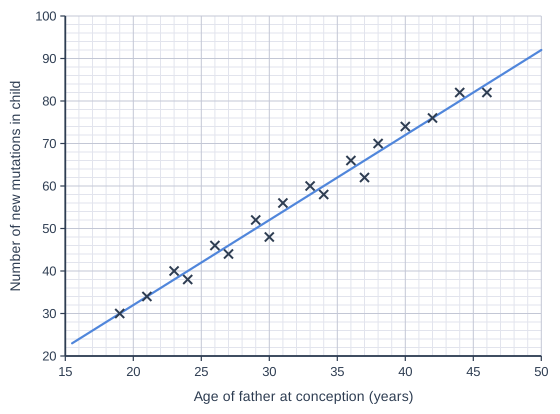
New gene mutations can arise during DNA replication in the cells that produce gametes. Scientists sequenced the genomes of 18 children and of both parents of each child. For each child, they counted the new mutations that were not present in either parent, and recorded the age of the child's father when the child was conceived. The graph shows their results with a line of best fit.

Use the line of best fit to calculate the increase in the number of new mutations for each extra year of the father's age.

In men, the cells that produce sperm divide by mitosis throughout adult life. In women, the cells that produce egg cells stop dividing by mitosis before birth. Use this information to explain the relationship shown in the graph.

A student concluded from the graph that the number of new mutations in a child depends on the age of the father and not on the age of the mother. Evaluate this conclusion.

Scatter graph on a grid of small squares. The horizontal axis is "Age of father at conception (years)", from 15 to 50, numbered every 5, with 5 small squares between numbered values (each small square is 1). The vertical axis is "Number of new mutations in child", from 20 to 100, numbered every 10, with 5 small squares between numbered values (each small square is 2). 18 points are plotted as crosses: (19, 30), (21, 34), (23, 40), (24, 38), (26, 46), (27, 44), (29, 52), (30, 48), (31, 56), (33, 60), (34, 58), (36, 66), (37, 62), (38, 70), (40, 74), (42, 76), (44, 82) and (46, 82). A straight line of best fit is drawn; it passes through (18, 28) and (48, 88).

Model answer

Gradient of the line = (88 - 28) ÷ (48 - 18) = 60 ÷ 30 = 2 new mutations per year of the father's age.

The cells that produce sperm keep dividing by mitosis throughout a man's life, so the older the father, the more times these cells have replicated their DNA. Each replication carries a chance of a spontaneous mutation, so mutations accumulate in the sperm-producing cells and more of them are passed to the child. Egg-producing cells stop dividing before birth, so the mother's age adds few extra mutations.

Evaluation: the points lie close to the line, showing a strong positive correlation with the father's age, and the information about egg-producing cells suggests that the mother's age should matter less. However, the mothers' ages are not shown; older fathers often have older partners, so the mother's age could also contribute, and the data do not show which parent each new mutation came from. Only 18 children were studied.

Explanation

Gene mutations arise spontaneously when DNA is replicated, so the more replications, the more mutations. To find a gradient, read two points well apart on the line of best fit (not on individual crosses) and divide the change in the number of mutations by the change in age. A common error is to say that sperm cells themselves divide: it is the cells that produce sperm that keep dividing by mitosis. When evaluating, notice that the graph shows only the father's age: without the mothers' ages, or knowing which parent each mutation came from, an effect of the mother's age cannot be excluded.

Mark scheme
  1. 1 mark

    Correct method: the difference in the number of mutations between two points on the line divided by the difference in age, e.g. (88 - 28) ÷ (48 - 18); or a correct answer of 2 (accept 1.8 to 2.2) with no working

    Max 6. Points 1 and 2 are the calculation: a correct answer of 2 new mutations per year (accept 1.8 to 2.2) with no working scores 2 marks. Other correct pairs of readings from the line include (20, 32), (30, 52) and (45, 82); the readings must be from the line, not from individual crosses, and at least 10 years apart. Accept for point 1 only: correct readings from the line with the subtraction or division worked out incorrectly.

  2. 1 mark

    2 (accept 1.8 to 2.2) (new mutations per year)

    Ignore units.

  3. 1 mark

    In older fathers, the sperm-producing cells have divided / replicated their DNA more times

    Points 3 to 5: max 2. Accept 'more cell divisions / more rounds of DNA replication before the sperm is made'.

  4. 1 mark

    Each replication has a chance of an error / mutation, so mutations accumulate (in the sperm-producing cells and are passed to the child)

    Accept 'mutations arise spontaneously during replication'. Do not accept 'sperm cells divide' (sperm cells do not divide).

  5. 1 mark

    The mother's egg-producing cells do not keep replicating their DNA (after birth), so the father's age has the greater effect / more new mutations come from the father

    Accept the idea that the mother's age would have less effect on the number of new mutations.

  6. 1 mark

    (Supports) strong positive correlation / the points lie close to the line of best fit OR the information about egg-producing cells explains why the mother's age would have less effect

    Points 6 to 10 are the evaluation: max 2. Only one mark for supporting points.

  7. 1 mark

    (Against) the mothers' ages are not shown / were not taken into account, and older fathers tend to have older partners, so an effect of the mother's age cannot be ruled out

    Accept 'there are no data about the mothers' ages'.

  8. 1 mark

    (Against) the data do not show which parent each new mutation came from

  9. 1 mark

    (Against) only 18 children / a small sample

  10. 1 mark

    (Against) a correlation does not show that the father's age causes the increase

    Ignore 'not repeated' unqualified.

Ready to try the rest? Every answer you write is marked against the mark scheme, so you can see exactly where the marks are.

Study Helper Hints first, answers after you try

Stuck on this one? Ask for a hint and I’ll point you in the right direction, without giving the answer away. Once you’ve checked your answer, I’ll show you how the marks are awarded.