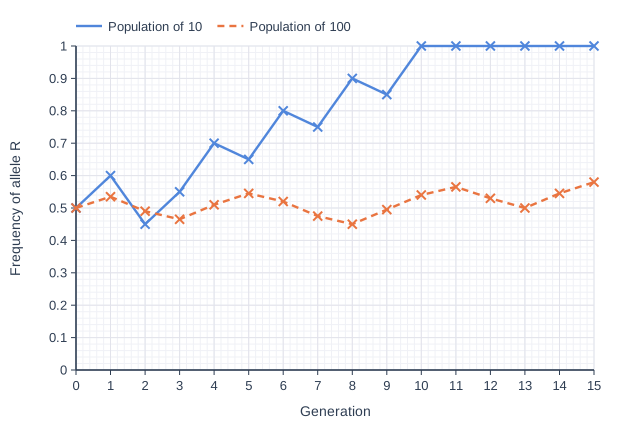
Question 1
2 marksNatural selection acts on individuals, but evolution happens in populations.
Explain this statement.
Model answer
Natural selection acts on individuals because it is individuals that survive and reproduce, or fail to: an individual with an advantageous phenotype is more likely to survive and have offspring. An individual's alleles do not change during its life, however. Evolution is a change in allele frequencies in a population's gene pool over generations, which happens because the individuals that survive pass on more copies of their alleles.
Explanation
Evolution is defined as a change in the allele frequencies in a population. Selection is the process: some individuals leave more offspring than others because of their phenotypes. The result is seen only in the population, as a change in the proportions of alleles from one generation to the next. Saying that individuals 'evolve' or 'adapt' during their lifetime is a common misconception.
Mark scheme
-
1 mark
Selection: individuals with advantageous phenotypes (alleles) are more likely to survive and reproduce / an individual's genotype does not change during its life
Max 2. Accept 'differential survival and reproduction of individuals'.
-
1 mark
Evolution is a change in the allele frequencies in a population (gene pool) over generations, which cannot happen in one individual
Accept 'evolution is measured as a change in allele frequency, which is a property of a population'. Insufficient: 'evolution is change over time'.
-
1 mark
(Advantageous) alleles passed on by surviving individuals increase in frequency in the next generation of the population