
Level:
Correct: 0
Incorrect: 0
Marks: 0/0
Exam Practice
Course:
Topics:
AQA A-Level Biology (Paper 2) Smart practice A mixed round aimed at your weak spots
Unit 5
Energy transfers in and between organisms
Unit 6
Organisms respond to changes in their internal and external environments
Stimuli, both internal and external, are detected and lead to a response
Survival and response
0%
Receptors
0%
Control of heart rate
0%
Skeletal muscles are stimulated to contract by nerves and act as effectors
Skeletal muscles and muscle contraction
0%
Unit 7
Genetics, populations, evolution and ecosystems
Unit 8
The control of gene expression
Alteration of the sequence of bases in DNA can alter the structure of proteins
Gene mutations and their effects on proteins
0%
Using genome projects
0%
Differences in DNA between individuals of the same species can be exploited
DNA probes, screening and genetic counselling
0%
Genetic fingerprinting
0%
Unit 9
Comprehension
Avg
score:
–
Topics
done:
0/34

Nutrient cycles

Practise 18 exam-style questions on Nutrient cycles for AQA A-Level Biology (Paper 2). Write your answer as you would in the exam and get it marked in seconds against the mark scheme, point by point, with the Study Helper on hand if you get stuck.

  • 18 questions
  • 1–8 marks each
  • Instant marking
  • No sign-up needed
18 questions, marked as you go

Sample questions with model answers

Here are 4 of the questions in this topic, each with a model answer, an explanation of why it earns the marks and the mark scheme an examiner would use.

Question 1

2 marks

Farmers add fertilisers containing nitrates and phosphates to fields from which crops are harvested every year. A natural woodland nearby is never fertilised, but its trees continue to grow well.

Explain why the fields need fertilisers but the woodland does not.

Model answer

When the crop is harvested, the nitrogen and phosphorus in its proteins, nucleic acids and other compounds are taken away from the field instead of being returned to the soil, so fertiliser is needed to replace the nitrates and phosphates removed. In the woodland, leaves and dead organisms fall to the ground and are decomposed by saprobionts, releasing ammonium, nitrate and phosphate ions back into the soil, so the nutrients are recycled.

Explanation

In natural ecosystems nutrients are recycled: saprobionts decompose dead material and return inorganic ions to the soil. Harvesting crops, or removing livestock, takes nitrogen and phosphorus out of the ecosystem, so farmers must replace them with natural fertilisers (manure, compost) or artificial fertilisers. It is wrong to say that trees do not need these ions.

Mark scheme
  1. 1 mark

    Harvesting removes the crop, so the nitrogen/phosphorus compounds (e.g. proteins/nucleic acids) in it are removed from the field AND are not returned to the soil

    Max 2. Accept 'the crop is not left to die and decompose in the field'. Accept 'removing livestock also removes these elements'.

  2. 1 mark

    In the woodland, dead leaves/organisms and waste are decomposed by saprobionts, releasing ammonium/nitrate/phosphate ions back into the soil

    Accept 'nutrients are recycled in the woodland'. Reject 'trees do not need nitrate or phosphate'.

  3. 1 mark

    (So in the fields) nitrate/phosphate ions in the soil are used up and must be replaced to prevent them limiting growth
Question 2

3 marks

Water draining from farmland passes through a reed bed before it enters a river. A reed bed is a shallow wetland with waterlogged mud, densely planted with reeds.

Scientists measured the concentration of nitrate ions in the water entering the reed bed as 14.5 mg dm⁻³ and in the water leaving it as 3.8 mg dm⁻³.

Calculate the percentage decrease in the concentration of nitrate ions as the water passed through the reed bed.

Explain two ways in which the reed bed removes nitrate ions from the water.

Model answer

Percentage decrease = (14.5 - 3.8) ÷ 14.5 × 100 = 73.8%

1. The mud is waterlogged, so it is anaerobic; denitrifying bacteria there convert nitrate ions into nitrogen gas, which escapes into the air.
2. The reeds absorb nitrate ions through their roots and use them to make amino acids, proteins and nucleic acids for growth.

Explanation

Reed beds are used to reduce leaching of nitrate into rivers and so reduce eutrophication. Waterlogged mud lacks oxygen, which favours denitrifying bacteria that return nitrogen to the air, and fast-growing plants take up nitrate to make nitrogen-containing compounds. Do not confuse denitrification with nitrification, which needs oxygen and produces nitrate.

Mark scheme
  1. 1 mark

    73.8 (%) (accept 73.79 or 74), from (14.5 - 3.8) ÷ 14.5 × 100; a correct answer with no working scores this mark

    Max 3. Point 1 is the calculation: a correct answer of 73.8 (accept 73.79 or 74) with no working scores 1 mark. Do not accept 26.2 (percentage remaining) or 282 (divided by 3.8). Points 2 and 3 (the two ways): 1 mark each. List rule: if more than two ways are given, each wrong or contradictory extra way cancels one correct way.

  2. 1 mark

    Denitrifying bacteria in the waterlogged/anaerobic mud convert nitrate (ions) into nitrogen gas (denitrification)

    Both the bacteria (or denitrification) and the product (nitrogen gas) are needed. Reject 'nitrifying bacteria' for this point.

  3. 1 mark

    Reeds/plants absorb nitrate (ions) through their roots AND use them to make amino acids/proteins/nucleic acids

    Accept 'algae/microorganisms absorb nitrate for growth'. Both parts are needed.

Question 3

4 marks

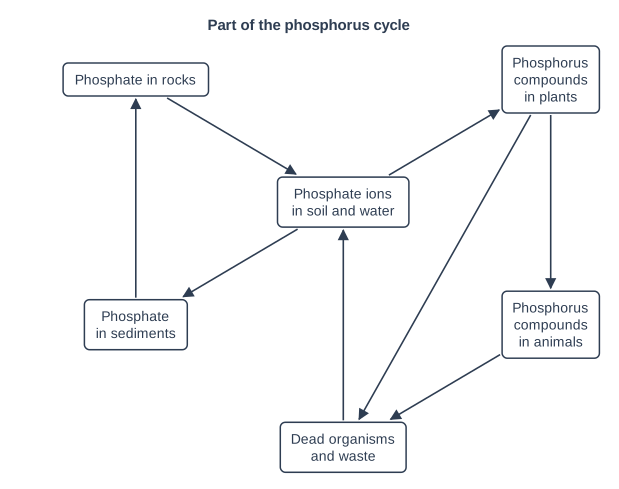
The diagram shows part of the phosphorus cycle.

Name processes A and B.

Phosphate ions that are leached from farmland and carried into the sea may take millions of years to return to the land. Use the diagram to explain why. Explain why nitrogen that is lost from farmland to the air can return to the soil much more quickly.

Part of the phosphorus cycle. Diagram of 6 boxes joined by 8 arrows. The boxes are: "Phosphate in rocks" (top row, left), "Phosphorus compounds in plants" (top row, right), "Phosphate ions in soil and water" (second row, centre), "Phosphate in sediments" (third row, left), "Phosphorus compounds in animals" (third row, right), "Dead organisms and waste" (bottom row, centre). Arrows go from "Phosphate in rocks" to "Phosphate ions in soil and water", labelled A; from "Phosphate ions in soil and water" to "Phosphorus compounds in plants", labelled "absorption by roots"; from "Phosphorus compounds in plants" to "Phosphorus compounds in animals", labelled "feeding"; from "Phosphorus compounds in plants" to "Dead organisms and waste", labelled "death"; from "Phosphorus compounds in animals" to "Dead organisms and waste", labelled "death and excretion"; from "Dead organisms and waste" to "Phosphate ions in soil and water", labelled B; from "Phosphate ions in soil and water" to "Phosphate in sediments", labelled "sedimentation"; from "Phosphate in sediments" to "Phosphate in rocks", labelled "rock formation (millions of years)".

Model answer

A is weathering of rocks.
B is decomposition by saprobionts.

Phosphate carried into the sea settles to form sediments. These sediments must be turned into rock, which takes millions of years, and the rock must then be weathered before the phosphate is available to plants again. Phosphorus has no gaseous form, so it cannot return to the land through the air. Nitrogen lost to the air as nitrogen gas is converted into ammonium compounds by nitrogen-fixing bacteria in the soil and in root nodules, so it can return to the soil within months or a few years.

Explanation

Phosphate is released from rocks by weathering, absorbed by plants and passed along food chains, and saprobionts return it to the soil by decomposition. Unlike nitrogen, phosphorus has no important gaseous form, so phosphate washed into the sea returns to the land only after sedimentation, rock formation and weathering over millions of years, whereas nitrogen gas in the air is fixed into ammonium by bacteria. Do not confuse decomposition with the nitrogen-cycle terms ammonification and nitrification.

Mark scheme
  1. 1 mark

    A: weathering (of rocks)

    Max 4. Points 1 and 2: 1 mark each. Points 3 to 5: max 2. Accept 'erosion' for A. Ignore 'dissolving'.

  2. 1 mark

    B: decomposition (by saprobionts/decomposers)

    Accept 'decay', 'saprobiotic nutrition' or 'digestion by saprobionts'. Reject 'ammonification' or 'nitrification' for B.

  3. 1 mark

    Phosphate in the sea forms sediments, which must be turned into rock (over millions of years) before weathering can release it again

    Accept 'sedimentation and rock formation are very slow'. Accept 'the rock must be exposed/uplifted before it can be weathered'.

  4. 1 mark

    Phosphorus has no (significant) gaseous form, so it cannot return to the land through the air

    Accept 'there is no store of phosphorus in the atmosphere'.

  5. 1 mark

    Nitrogen (gas) in the air is converted into ammonia/ammonium (compounds) by nitrogen-fixing bacteria (in the soil or in root nodules)

    Accept 'nitrogen fixation returns nitrogen to the soil'. Reject 'nitrogen-fixing bacteria convert nitrogen gas into nitrate'.

Question 4

5 marks

Duckweed is a small plant that floats on the surface of ponds. Each plant has a few leaf-like fronds and reproduces asexually by growing new fronds.

You are given duckweed plants, a culture solution that contains all the mineral ions needed for growth except nitrate, and a concentrated solution of sodium nitrate.

Describe how you could investigate the effect of the concentration of nitrate ions on the growth of duckweed.

Model answer

Make up at least five concentrations of nitrate, for example 0, 0.5, 1.0, 2.0 and 4.0 mmol dm⁻³, by adding different volumes of the sodium nitrate solution to the nitrate-free culture solution and making each up to the same total volume, so the other mineral ions are the same in each. The solution with no nitrate is the control. Put the same volume of each solution into three beakers, and add duckweed plants with the same total number of fronds (for example, 10) to each. Keep all the beakers at the same temperature and light intensity, in a growth room with constant lighting. After 14 days, count the fronds in each beaker, calculate the percentage increase in number of fronds, and find the mean for each concentration.

Explanation

A good plan states the independent variable and how its values are made (a range of concentrations, including a control), the dependent variable and how it is measured (number of fronds or dry mass, over a set time), the control variables (temperature, light, volume, starting number of plants, other ions) and repeats with a mean. Making each solution up to the same volume with the nitrate-free solution keeps the concentration of every other ion the same. Nitrate is needed to make amino acids, proteins, nucleic acids and chlorophyll, so growth should increase with nitrate until another factor limits it.

Mark scheme
  1. 1 mark

    Make a range of (at least five) nitrate concentrations by adding different volumes of the sodium nitrate solution to the culture solution

    Max 5. Accept 'by serial dilution of the sodium nitrate solution with the culture solution'.

  2. 1 mark

    Make each solution up to the same total volume with the (nitrate-free) culture solution, so the concentrations of the other mineral ions are the same

    Accept 'use the culture solution to dilute, so all other ions are kept constant'.

  3. 1 mark

    Include a control with no (added) nitrate

  4. 1 mark

    Put the same number of plants/fronds (of similar size) in the same volume of each solution

  5. 1 mark

    Keep light intensity AND temperature the same for all containers

    Both are needed. Accept 'same place in a growth room/incubator with constant light' for both. Ignore 'same conditions' unqualified.

  6. 1 mark

    Count the fronds (or measure dry mass) at the start and after a set time, e.g. 14 days

    Accept measuring total surface area/percentage cover of the surface.

  7. 1 mark

    Calculate the change/rate of growth, e.g. (percentage) increase in number of fronds

  8. 1 mark

    Use several (at least 3) containers at each concentration AND calculate a mean

    Both parts are needed.

Ready to try the rest? Every answer you write is marked against the mark scheme, so you can see exactly where the marks are.

Study Helper Hints first, answers after you try

Stuck on this one? Ask for a hint and I’ll point you in the right direction, without giving the answer away. Once you’ve checked your answer, I’ll show you how the marks are awarded.