Level:
Correct: 0
Incorrect: 0
Marks: 0/0
Exam Practice
Course:
Topics:
AQA A-Level Biology (Paper 2) Smart practice A mixed round aimed at your weak spots
Unit 5
Energy transfers in and between organisms
Unit 6
Organisms respond to changes in their internal and external environments
Stimuli, both internal and external, are detected and lead to a response
Survival and response
0%
Receptors
0%
Control of heart rate
0%
Skeletal muscles are stimulated to contract by nerves and act as effectors
Skeletal muscles and muscle contraction
0%
Unit 7
Genetics, populations, evolution and ecosystems
Unit 8
The control of gene expression
Alteration of the sequence of bases in DNA can alter the structure of proteins
Gene mutations and their effects on proteins
0%
Using genome projects
0%
Differences in DNA between individuals of the same species can be exploited
DNA probes, screening and genetic counselling
0%
Genetic fingerprinting
0%
Unit 9
Comprehension
Avg
score:
–
Topics
done:
0/34

Limiting factors and investigating photosynthesis

Practise 18 exam-style questions on Limiting factors and investigating photosynthesis for AQA A-Level Biology (Paper 2). Write your answer as you would in the exam and get it marked in seconds against the mark scheme, point by point, with the Study Helper on hand if you get stuck.

  • 18 questions
  • 1–8 marks each
  • Instant marking
  • No sign-up needed
18 questions, marked as you go

Sample questions with model answers

Here are 4 of the questions in this topic, each with a model answer, an explanation of why it earns the marks and the mark scheme an examiner would use.

Question 1

2 marks

In an investigation of dehydrogenase activity, leaves were blended in an ice-cold buffer solution to make a chloroplast extract.

Explain why the solution was ice-cold and why it was a buffer.

Model answer

The solution was ice-cold to reduce the activity of enzymes released from the broken cells, which could otherwise damage the chloroplasts. It was a buffer to keep the pH constant, so that the proteins and enzymes in the chloroplasts were not denatured.

Explanation

Blending releases enzymes from other parts of the cell (such as lysosomes and vacuoles) that can hydrolyse chloroplast proteins and membranes; low temperature slows these enzymes down. A buffer resists changes in pH, which would otherwise alter the tertiary structure of the chloroplast proteins. A common error is to say that cold denatures enzymes.

Mark scheme
  1. 1 mark

    (Ice-cold) reduces the activity of enzymes (released from damaged cells) that would damage / break down the chloroplasts / their proteins and membranes

    Accept 'slows down enzyme activity so the chloroplasts are not damaged'. Ignore 'keeps the chloroplasts fresh'. Reject 'so the enzymes are denatured'.

  2. 1 mark

    (Buffer) keeps the pH constant, so proteins / enzymes (in the chloroplasts) are not denatured

    Accept 'prevents changes in pH affecting the enzymes'. The link to proteins or enzymes is needed.
Question 2

3 marks

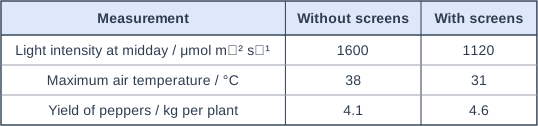
In summer, some growers put screens over their glasshouses to reduce the light intensity. The table shows data for pepper plants grown in glasshouses with and without screens in summer.

Explain why the screens increased the yield of peppers, even though they reduced the light intensity.

Table with columns "Measurement", "Without screens", "With screens". Measurement: Light intensity at midday / μmol m⁻² s⁻¹; Without screens: 1600; With screens: 1120 | Measurement: Maximum air temperature / °C; Without screens: 38; With screens: 31 | Measurement: Yield of peppers / kg per plant; Without screens: 4.1; With screens: 4.6.

Model answer

Even with screens the light intensity (1120) is high, so in summer light is not the limiting factor and reducing it has little effect on the rate of photosynthesis. Without screens the temperature reaches 38 °C, which is above the optimum, so enzymes such as rubisco are partly denatured and the rate of photosynthesis falls. With screens the temperature is 31 °C, nearer the optimum, so the rate of photosynthesis is higher and more sugars are made for growth, giving a higher yield.

Explanation

On bright summer days light is rarely limiting in a glasshouse, but the temperature can rise above the optimum for the enzymes of the light-independent reaction. Shading lowers the temperature more than it limits photosynthesis, so the overall rate, and the yield, rise. Answers must link the temperature to enzymes and explain why the lower light intensity does not matter.

Mark scheme
  1. 1 mark

    Light intensity with screens (1120) is still high enough / light is not limiting (at midday in summer)

    Max 3. Accept 'light was not the limiting factor, so reducing it by 30% had little effect'.

  2. 1 mark

    Without screens the temperature (38 °C) is above the optimum, so enzymes (e.g. rubisco) are denatured / less active

    Accept 'fewer enzyme-substrate complexes at 38 °C'. Accept 'more respiration / more stomata close at high temperature' for this point only if linked to less net photosynthesis.

  3. 1 mark

    With screens the temperature (31 °C) is nearer the optimum, so the rate of photosynthesis is higher

    Accept 'enzymes work faster at 31 °C'.

  4. 1 mark

    So more sugars / triose phosphate are made for growth / fruit (higher yield)

    Credit only with a reason linked to photosynthesis.

Question 3

4 marks

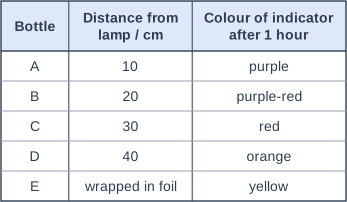
A student trapped (immobilised) a single-celled alga in small beads of alginate jelly. She put 15 beads into each of five sealed bottles of red hydrogencarbonate indicator, and placed the bottles at different distances from a lamp. Bottle E was wrapped in foil. All the bottles were at the same temperature.

Hydrogencarbonate indicator is red at the carbon dioxide concentration of air. It turns orange then yellow when the carbon dioxide concentration increases, and turns purple when it decreases. The table shows her results after 1 hour.

Explain the colour of the indicator in bottle A.

Explain why the colour of the indicator in bottle C did not change.

Suggest one advantage of using algae trapped in beads rather than algae suspended in the indicator.

Table with columns "Bottle", "Distance from lamp / cm", "Colour of indicator after 1 hour". Bottle: A; Distance from lamp / cm: 10; Colour of indicator after 1 hour: purple | Bottle: B; Distance from lamp / cm: 20; Colour of indicator after 1 hour: purple-red | Bottle: C; Distance from lamp / cm: 30; Colour of indicator after 1 hour: red | Bottle: D; Distance from lamp / cm: 40; Colour of indicator after 1 hour: orange | Bottle: E; Distance from lamp / cm: wrapped in foil; Colour of indicator after 1 hour: yellow.

Model answer

Bottle A is closest to the lamp, so the light intensity is high and the rate of photosynthesis is greater than the rate of respiration. The algae take up more carbon dioxide than they release, so the carbon dioxide concentration falls and the indicator turns purple.

In bottle C, the light intensity is at the compensation point: the rate of photosynthesis equals the rate of respiration, so carbon dioxide is taken up as fast as it is released and there is no net change in its concentration.

Using beads makes it easy to put the same number of algae into each bottle.

Explanation

The indicator shows the net change in carbon dioxide: photosynthesis removes it and respiration adds it. Near the lamp photosynthesis wins (purple); in the foil-wrapped bottle only respiration occurs (yellow); at the compensation point the two rates are equal and the colour does not change. Immobilising algae in beads makes the number of algae in each tube easy to standardise.

Mark scheme
  1. 1 mark

    (In A) the rate of photosynthesis is greater than the rate of respiration

    Accept 'photosynthesis is faster than respiration'.

  2. 1 mark

    So (more) carbon dioxide is taken up than released / carbon dioxide concentration decreases (so the indicator turns purple)

    Accept 'net uptake of carbon dioxide'.

  3. 1 mark

    (In C) the rate of photosynthesis equals the rate of respiration / the light intensity is at the compensation point, so there is no net change in carbon dioxide concentration

    Both parts are needed: rates equal AND no net change. Reject 'no photosynthesis or respiration'.

  4. 1 mark

    One of: the same number / mass of algae in each bottle / easy to transfer or count / the algae do not cloud the indicator, so the colour can be seen or measured / the algae are not damaged

    Any one advantage. List rule: if more than one advantage is given, a wrong or contradictory extra advantage cancels the correct one.

Question 4

5 marks

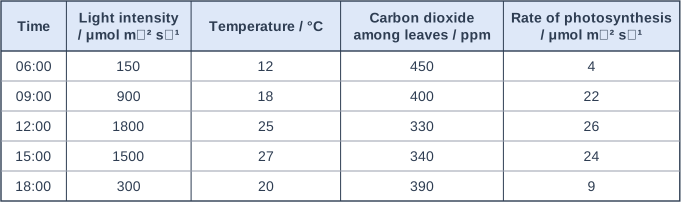
Scientists measured the rate of photosynthesis of a dense crop of sunflowers at different times on a sunny day with very little wind. They also measured the light intensity, the temperature and the carbon dioxide concentration in the air among the leaves of the crop. The table shows their results.

Use the data to explain the changes in the rate of photosynthesis during the day.

Table with columns "Time", "Light intensity / μmol m⁻² s⁻¹", "Temperature / °C", "Carbon dioxide among leaves / ppm", "Rate of photosynthesis / μmol m⁻² s⁻¹". Time: 06:00; Light intensity / μmol m⁻² s⁻¹: 150; Temperature / °C: 12; Carbon dioxide among leaves / ppm: 450; Rate of photosynthesis / μmol m⁻² s⁻¹: 4 | Time: 09:00; Light intensity / μmol m⁻² s⁻¹: 900; Temperature / °C: 18; Carbon dioxide among leaves / ppm: 400; Rate of photosynthesis / μmol m⁻² s⁻¹: 22 | Time: 12:00; Light intensity / μmol m⁻² s⁻¹: 1800; Temperature / °C: 25; Carbon dioxide among leaves / ppm: 330; Rate of photosynthesis / μmol m⁻² s⁻¹: 26 | Time: 15:00; Light intensity / μmol m⁻² s⁻¹: 1500; Temperature / °C: 27; Carbon dioxide among leaves / ppm: 340; Rate of photosynthesis / μmol m⁻² s⁻¹: 24 | Time: 18:00; Light intensity / μmol m⁻² s⁻¹: 300; Temperature / °C: 20; Carbon dioxide among leaves / ppm: 390; Rate of photosynthesis / μmol m⁻² s⁻¹: 9.

Model answer

Early in the morning, light intensity is limiting: between 06:00 and 09:00 the rate rises from 4 to 22 as light intensity rises from 150 to 900. Between 09:00 and 12:00 the light intensity doubles but the rate rises only from 22 to 26, so light is no longer the main limiting factor. At midday the carbon dioxide concentration among the leaves has fallen to 330 ppm, because the crop is taking up carbon dioxide faster than it is replaced from the air above in the still conditions, so carbon dioxide is now limiting. Temperature is not limiting: it rises from 25 to 27 °C between 12:00 and 15:00 but the rate does not increase. In the evening the light intensity falls to 300, so light becomes limiting again and the rate falls to 9. The carbon dioxide concentration was high in the early morning (450 ppm) because the crop respired overnight without photosynthesising.

Explanation

Work through the day and, at each time, ask which factor would increase the rate if it increased. Light limits in the early morning and evening; at midday on a still day, a dense crop uses carbon dioxide faster than it is replaced, so carbon dioxide becomes limiting even in bright light. Support each point with figures from the table. A common error is to describe the changes in rate without naming the limiting factor at each time.

Mark scheme
  1. 1 mark

    Between 06:00 and 09:00 the rate increases (from 4 to 22) as light intensity increases, so light (intensity) is limiting in the early morning

    Max 3 if the answer does not use any figures from the table. Max 5. Points 1 to 7 are each worth 1 mark.

  2. 1 mark

    Between 09:00 and 12:00 light intensity doubles (900 to 1800) but the rate increases only a little (22 to 26), so light is no longer limiting

    Accept 'light is not limiting at midday'.

  3. 1 mark

    At midday the carbon dioxide concentration among the leaves is lowest (330 ppm), so carbon dioxide (concentration) is limiting

    Accept 'carbon dioxide is the limiting factor in the afternoon too (340 at 15:00)'.

  4. 1 mark

    Carbon dioxide concentration falls because the crop takes up carbon dioxide (in photosynthesis) faster than it is replaced, as there is little wind / little mixing of air

    Accept 'carbon dioxide used faster than it diffuses in from the air above the crop'.

  5. 1 mark

    Temperature is unlikely to be limiting at midday / in the afternoon, as the rate does not rise between 12:00 and 15:00 even though temperature rises (25 to 27 °C)

    Accept 'low temperature (12 °C) may also limit the rate at 06:00'.

  6. 1 mark

    In the evening (18:00) light intensity falls (to 300), so the rate falls / light is limiting again

  7. 1 mark

    Carbon dioxide concentration is high early in the day (450 ppm) because the crop respired overnight without photosynthesis

    Accept 'carbon dioxide rises again in the evening as photosynthesis slows but respiration continues'.

Ready to try the rest? Every answer you write is marked against the mark scheme, so you can see exactly where the marks are.

Study Helper Hints first, answers after you try

Stuck on this one? Ask for a hint and I’ll point you in the right direction, without giving the answer away. Once you’ve checked your answer, I’ll show you how the marks are awarded.