
Level:
Correct: 0
Incorrect: 0
Marks: 0/0
Exam Practice
Course:
Topics:
AQA A-Level Biology (Paper 2) Smart practice A mixed round aimed at your weak spots
Unit 5
Energy transfers in and between organisms
Unit 6
Organisms respond to changes in their internal and external environments
Stimuli, both internal and external, are detected and lead to a response
Survival and response
0%
Receptors
0%
Control of heart rate
0%
Skeletal muscles are stimulated to contract by nerves and act as effectors
Skeletal muscles and muscle contraction
0%
Unit 7
Genetics, populations, evolution and ecosystems
Unit 8
The control of gene expression
Alteration of the sequence of bases in DNA can alter the structure of proteins
Gene mutations and their effects on proteins
0%
Using genome projects
0%
Differences in DNA between individuals of the same species can be exploited
DNA probes, screening and genetic counselling
0%
Genetic fingerprinting
0%
Unit 9
Comprehension
Avg
score:
–
Topics
done:
0/34

Succession and conservation

Practise 17 exam-style questions on Succession and conservation for AQA A-Level Biology (Paper 2). Write your answer as you would in the exam and get it marked in seconds against the mark scheme, point by point, with the Study Helper on hand if you get stuck.

  • 17 questions
  • 1–8 marks each
  • Instant marking
  • No sign-up needed
17 questions, marked as you go

Sample questions with model answers

Here are 4 of the questions in this topic, each with a model answer, an explanation of why it earns the marks and the mark scheme an examiner would use.

Question 1

2 marks

On an island nature reserve, feral goats grazed the vegetation for over a hundred years and kept it as short grassland. Ten years after all the goats were removed, much of the grassland had been replaced by scrub (shrubs and young trees).

Explain why.

Model answer

The goats ate and trampled the seedlings of shrubs and trees, so these species could not become established and succession was stopped at the grassland stage. When the goats were removed, succession continued: shrubs and young trees grew taller than the grasses, shaded them and outcompeted them for light, and the community moved towards a climax of woodland.

Explanation

Grazing is a way of managing (deflecting) succession: grazing animals remove tree and shrub seedlings, so a grassland is kept as grassland. When grazing stops, succession resumes, because taller woody species outcompete grasses for light. This is why conservation of grasslands and heathlands often depends on grazing.

Mark scheme
  1. 1 mark

    The goats ate/trampled the seedlings of shrubs and trees, which prevented/stopped succession

    Accept 'grazing deflected succession / kept a plagioclimax'.

  2. 1 mark

    Without grazing, succession continued: shrubs/trees grew taller and shaded/outcompeted the grasses (towards a climax community)

    Accept 'shrubs outcompete grasses for light'. 'The plants could grow' alone is insufficient.
Question 2

3 marks

Coppicing is a traditional way of managing woodland. Hazel trees are cut down to near ground level every 7 to 10 years, and new shoots grow from each stump. The wood is used for fencing and firewood. The woodland is divided into areas, and a different area is cut each year.

Explain how coppicing provides a sustainable supply of wood and also conserves biodiversity.

Model answer

The hazel trees are not killed when they are cut: new shoots grow from the stumps, so the same trees provide wood again and again, and because a different area is cut each year there is always wood ready to harvest. Cutting lets light reach the woodland floor, so flowering plants grow, and the areas at different stages of regrowth provide a range of habitats and niches, so many more species can live in the wood than in an unmanaged, shaded wood.

Explanation

Coppicing is an example of reconciling human needs with conservation: it provides a renewable supply of wood while managing succession. Cutting in rotation creates a patchwork of open, young and older areas, each with different light conditions and species. A resource is used sustainably when it is harvested no faster than it is replaced.

Mark scheme
  1. 1 mark

    The trees are not killed / regrow from the stumps, so wood can be harvested again and again (without replanting)

    Max 3. Accept 'the rate of harvesting does not exceed the rate of regrowth'.

  2. 1 mark

    Cutting in rotation means there is always an area ready to cut / a continuous supply of wood

  3. 1 mark

    Cutting lets light reach the woodland floor, so ground plants/flowers grow (and support insects)

  4. 1 mark

    Areas at different stages of regrowth provide a range of habitats/niches, so more species can live in the woodland

    Accept 'increases biodiversity because of a variety of habitats'.

  5. 1 mark

    Coppicing stops succession to dense, shaded/closed-canopy woodland (managing succession)

Question 3

4 marks

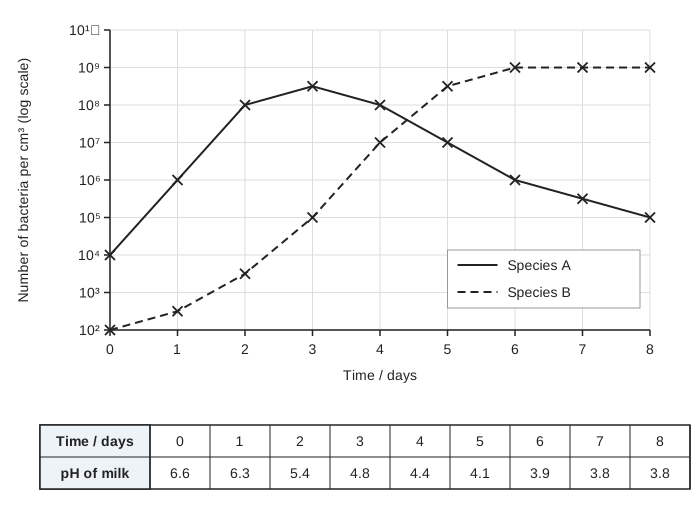
Raw milk contains several species of bacteria. Scientists left a sample of raw milk at 25 °C for 8 days. Every day, they measured the pH of the milk and estimated the number of bacteria of two species, A and B, per cm³. Both species ferment lactose (milk sugar) to produce lactic acid.

The figure shows their results. The vertical axis of the graph has a logarithmic scale.

Use the graph to calculate how many times greater the population of species B was on day 6 than on day 0.

Explain why the scientists used a logarithmic scale.

The changes in the populations of bacteria in milk have been described as a type of succession. Use the information to explain why.

A line graph of the number of bacteria per cm³ against time from day 0 to day 8. The vertical axis is a logarithmic scale with gridlines labelled 10², 10³, 10⁴ and so on up to 10¹⁰. Species A (solid line) is at 10⁴ on day 0, 10⁶ on day 1, 10⁸ on day 2, halfway between 10⁸ and 10⁹ on day 3, then falls to 10⁸ on day 4, 10⁷ on day 5, 10⁶ on day 6, halfway between 10⁵ and 10⁶ on day 7 and 10⁵ on day 8. Species B (dashed line) is at 10² on day 0, halfway between 10² and 10³ on day 1, halfway between 10³ and 10⁴ on day 2, 10⁵ on day 3, 10⁷ on day 4, halfway between 10⁸ and 10⁹ on day 5, and 10⁹ on days 6, 7 and 8. A table under the graph gives the pH of the milk on days 0 to 8: 6.6, 6.3, 5.4, 4.8, 4.4, 4.1, 3.9, 3.8, 3.8.

Model answer

On day 6, species B = 10⁹ per cm³; on day 0, species B = 10² per cm³
10⁹ ÷ 10² = 10⁷, so the population was 10 000 000 times greater.

A logarithmic scale was used because the numbers of bacteria range from 10² to about 10⁹ per cm³; on a linear scale the small values would not be visible.

Species A produces lactic acid, which lowers the pH of the milk from 6.6 to about 4.4 by day 4. This makes the milk less suitable for species A, and its population falls after day 3. Species B is adapted to the lower pH, so the changed environment is more suitable for B, which then replaces A as the dominant species. This is like succession, in which one species changes the environment, making it less suitable for itself and more suitable for species with different adaptations.

Explanation

On a logarithmic scale each gridline is ten times the one below, so the ratio between two values is 10 raised to the difference in their powers: 10⁹ ÷ 10² = 10⁷. Log scales are used when values span several orders of magnitude, as microbial populations often do. The milk shows the key idea of succession on a small scale: a species changes its abiotic environment (here, pH) so that it becomes less suitable for itself and more suitable for another species.

Mark scheme
  1. 1 mark

    10⁷ / 10 000 000 (times), from 10⁹ ÷ 10²; a correct answer with no working scores this mark

    Max 4. Point 1 is the calculation: a correct answer of 10⁷ (accept 1 × 10⁷ or 10 million) with no working scores 1 mark. Do not accept 7 (the difference in powers of ten), 4.5 (9 ÷ 2) or 999 999 900 (difference, not ratio).

  2. 1 mark

    The numbers cover a very large range (from 10² to about 10⁹ / several orders of magnitude), so both small and large numbers can be shown/read on the same graph

    Accept 'a linear scale could not show the small numbers clearly'.

  3. 1 mark

    Species A lowers the pH (by producing lactic acid), making the milk less suitable for itself, so its population falls (after day 3)

    Accept 'species A changes its environment so that it becomes less suitable for A'.

  4. 1 mark

    Species B is adapted to/tolerates a lower pH, so the changed conditions are more suitable for B, which replaces/outcompetes A (as in succession)

    Accept 'B grows best at low pH'.

Question 4

5 marks

A landslide exposed a large area of bare rock on a hillside. Over the next few hundred years, lichens colonised the rock first, followed by mosses, then grasses and ferns, then shrubs and finally trees.

Describe and explain how the organisms are likely to have changed the abiotic conditions on the hillside, allowing each new group of plants to colonise.

Model answer

The lichens slowly weather the surface of the rock and trap dust and rock particles. When lichens and later mosses die, saprobionts decompose them, adding organic matter, so a thin soil forms in which mosses and then grasses and ferns can grow. Each stage adds more organic matter and traps more particles, so the soil becomes deeper; it holds more water, and decomposition releases mineral ions such as nitrate and phosphate into it. Deeper soil allows shrubs and trees, with larger roots, to anchor themselves and reach water. Taller plants also shade and shelter the ground, so it loses less water by evaporation and has smaller changes in temperature. At each stage, conditions become less hostile and more suitable for species with different adaptations, which can then colonise.

Explanation

In primary succession the organisms themselves change the abiotic environment. Weathering and the decomposition of dead pioneers form a soil, which becomes deeper and holds more water and mineral ions at each stage, making conditions less hostile for species that need soil. Link each change in the abiotic conditions to the organisms that cause it and to the new species that can then colonise; 'more habitable' with no reason earns no credit.

Mark scheme
  1. 1 mark

    Lichens (pioneer species) weather/break down the surface of the rock / trap dust and rock particles

    Max 5. Accept 'secrete acids that break down the rock'. Ignore 'lichens can survive on bare rock' (an adaptation, not a change in conditions).

  2. 1 mark

    When lichens (and mosses) die, they are decomposed (by saprobionts), adding organic matter/humus

    Accept saprophytes, saprotrophs or decomposers.

  3. 1 mark

    So a (thin) soil forms (from organic matter and rock particles), in which mosses/plants can grow

    Weathering alone, without organic matter or soil, is insufficient for point 3.

  4. 1 mark

    Each stage adds more organic matter (and traps more particles), so the soil becomes deeper

  5. 1 mark

    The soil holds/retains more water

    Accept 'the soil dries out less'.

  6. 1 mark

    Decomposition releases mineral ions (e.g. nitrate, phosphate) into the soil

    Accept 'the soil contains more nutrients/minerals'.

  7. 1 mark

    Deeper soil allows plants with larger/deeper roots, such as shrubs and trees, to be anchored / to reach water

  8. 1 mark

    Taller plants provide shade/shelter, so the ground loses less water by evaporation / is less exposed to wind / has smaller changes in temperature

    Ignore 'shelter' unqualified.

  9. 1 mark

    Conditions become less hostile / more suitable for species with different adaptations (so these species can colonise)

    Accept 'less harsh' or 'more favourable'. Ignore 'more hospitable' or 'more habitable'.

Ready to try the rest? Every answer you write is marked against the mark scheme, so you can see exactly where the marks are.

Study Helper Hints first, answers after you try

Stuck on this one? Ask for a hint and I’ll point you in the right direction, without giving the answer away. Once you’ve checked your answer, I’ll show you how the marks are awarded.