
Level:
Correct: 0
Incorrect: 0
Marks: 0/0
Exam Practice
Course:
Topics:
AQA A-Level Biology (Paper 2) Smart practice A mixed round aimed at your weak spots
Unit 5
Energy transfers in and between organisms
Unit 6
Organisms respond to changes in their internal and external environments
Stimuli, both internal and external, are detected and lead to a response
Survival and response
0%
Receptors
0%
Control of heart rate
0%
Skeletal muscles are stimulated to contract by nerves and act as effectors
Skeletal muscles and muscle contraction
0%
Unit 7
Genetics, populations, evolution and ecosystems
Unit 8
The control of gene expression
Alteration of the sequence of bases in DNA can alter the structure of proteins
Gene mutations and their effects on proteins
0%
Using genome projects
0%
Differences in DNA between individuals of the same species can be exploited
DNA probes, screening and genetic counselling
0%
Genetic fingerprinting
0%
Unit 9
Comprehension
Avg
score:
–
Topics
done:
0/34

Nerve impulses

Practise 20 exam-style questions on Nerve impulses for AQA A-Level Biology (Paper 2). Write your answer as you would in the exam and get it marked in seconds against the mark scheme, point by point, with the Study Helper on hand if you get stuck.

  • 20 questions
  • 1–8 marks each
  • Instant marking
  • No sign-up needed
20 questions, marked as you go

Sample questions with model answers

Here are 4 of the questions in this topic, each with a model answer, an explanation of why it earns the marks and the mark scheme an examiner would use.

Question 1

2 marks

The absolute refractory period of a type of neurone is 1.25 ms. During this time no new action potential can be produced, however strong the stimulus.

Calculate the maximum frequency of impulses that this neurone could conduct. Give your answer in hertz (Hz).

Model answer

1.25 ms = 1.25 × 10⁻³ s
Maximum frequency = 1 ÷ (1.25 × 10⁻³ s) = 800 impulses per second
Maximum frequency = 800 Hz

Explanation

A new impulse can start only when the previous refractory period has ended, so the shortest possible time between impulses is 1.25 ms. The number of impulses in one second is 1 ÷ time between impulses, with the time in seconds: 1 ÷ 0.00125 = 800 Hz (1 Hz = one impulse per second). Forgetting to convert milliseconds to seconds gives 0.8, which is the number of impulses per millisecond.

Mark scheme
  1. 1 mark

    Correct method: 1 ÷ 0.00125 / 1 ÷ (1.25 × 10⁻³) / 1000 ÷ 1.25; or a correct final answer of 800 with no working

    A correct answer of 800 (Hz) with no working scores 2 marks. Accept 800 impulses per second, 800 action potentials per second or 800 s⁻¹ for 2 marks. Accept for 1 mark: 0.8 (refractory period not converted to seconds; this is the number of impulses per millisecond).

  2. 1 mark

    800 (Hz)

    Do not accept 0.8, 1250 or 8 × 10⁻⁴ for this mark.
Question 2

4 marks

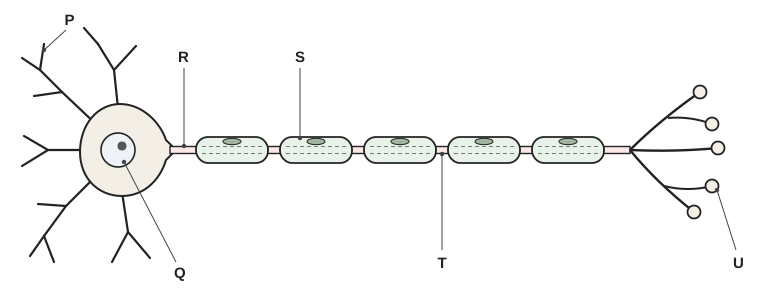
The figure shows a myelinated motor neurone.

Name the structure labelled S.

As an impulse passes along the myelinated region of the axon, the axon membrane is depolarised only at certain points. Give the letter that labels one of these points.

Explain why the axon membrane is not depolarised where it is covered by S.

A drawing of a neurone. On the left, a rounded cell body containing a round structure with a dark dot inside it is surrounded by short branching fibres. A long thin fibre runs to the right from the cell body. Most of its length is covered by five rounded segments, each with a small oval on top, separated by four narrow gaps where the thin fibre is exposed. At the right-hand end the fibre divides into five branches, each ending in a small round swelling. Labels: P points to one of the branching fibres at the top left of the cell body; Q points to the round structure inside the cell body; R points to the thin fibre just after it leaves the cell body, before the first segment; S points to the second segment from the left; T points to the thin fibre in the gap between the third and fourth segments; U points to one of the round swellings at the right-hand end.

Model answer

S is the myelin sheath (formed by a Schwann cell).

T (a node of Ranvier).

The myelin sheath is an electrical insulator and is impermeable to ions. So sodium ions cannot diffuse into the axon through the membrane under the myelin, and the membrane there cannot be depolarised. Depolarisation only happens at the nodes of Ranvier, where the axon membrane is exposed.

Explanation

S is one of the Schwann cells whose membranes wrap round the axon to form the myelin sheath, and T is a node of Ranvier, a gap in the sheath. Myelin is an electrical insulator: sodium ions cannot diffuse in through the membrane it covers, so action potentials occur only at the nodes and depolarisation passes from node to node (saltatory conduction). Do not describe myelin as a thermal insulator. P labels a dendrite, Q the nucleus, R the axon before the myelin begins, and U an axon terminal (synaptic knob).

Mark scheme
  1. 1 mark

    S: myelin sheath / Schwann cell

    Accept myelin. Accept phonetic spellings of Schwann (e.g. shwann, schwan) but reject 'swan'. Reject node (of Ranvier), axon, dendrite or nucleus.

  2. 1 mark

    T

    Accept 'T, node of Ranvier'. Do not award the mark if any other letter is given as well as T (e.g. 'R and T').

  3. 1 mark

    Myelin (sheath) is an (electrical) insulator / is impermeable to (sodium and potassium) ions

    Reject thermal insulation. Accept 'ions cannot pass through the myelin'. Insufficient: 'it covers / protects the axon'.

  4. 1 mark

    So sodium ions cannot diffuse into the axon there (and no action potential / depolarisation occurs) / there are no (voltage-gated) sodium ion channels exposed under the myelin

    Accept Na⁺ for sodium ions. Accept 'sodium ion channels cannot open there'. Insufficient: 'ions cannot move' with no reference to sodium ions or to entry into the axon. Reject 'messages' or 'signals' for depolarisation or action potentials.

Question 3

4 marks

An impulse passes along a non-myelinated axon, away from the cell body. An action potential at one point on the axon membrane leads to an action potential in the region of membrane next to it.

Explain how. Explain why the action potential does not travel back towards the cell body.

Model answer

Where the action potential is, sodium ions have diffused into the axon. These sodium ions diffuse sideways along the inside of the axon, setting up local currents. This slightly depolarises the membrane next to it. When this membrane reaches the threshold, its voltage-gated sodium ion channels open, sodium ions diffuse in and an action potential is produced there.

The membrane behind the action potential is in its refractory period: its sodium ion channels cannot open, so it cannot be depolarised again and the action potential cannot travel backwards.

Explanation

In a non-myelinated axon the action potential moves as a wave of depolarisation: sodium ions entering at one point diffuse along the axon and bring the next region to threshold. The region just behind is refractory, so the wave only moves forwards. Mention the ions and the threshold: 'the impulse moves along' does not explain how.

Mark scheme
  1. 1 mark

    Sodium ions (that entered at the action potential) diffuse sideways / along (the inside of) the axon / set up local currents

    Accept Na⁺ for sodium ions. Accept 'positive ions move along the axon to the next region'.

  2. 1 mark

    The membrane next to it is (slightly) depolarised / becomes less negative

    Reject 'messages' or 'signals'.

  3. 1 mark

    Threshold is reached, so voltage-gated sodium ion channels open (and sodium ions diffuse in)

    Both threshold and the opening of sodium ion channels are needed. Accept 'reaches -55 mV' for threshold.

  4. 1 mark

    The membrane behind (towards the cell body) is in its refractory period / its sodium ion channels cannot open

    Accept 'membrane behind is repolarising / hyperpolarised so cannot be depolarised'. Insufficient: 'refractory period' with no idea of where (behind the action potential).

Question 4

6 marks

Squid have giant axons that are not myelinated. One giant axon has a diameter of 0.5 mm and conducts impulses at 25 m s⁻¹. A myelinated axon in a mammal has a diameter of only 10 μm but conducts impulses at 60 m s⁻¹.

Use your knowledge of how axon diameter and myelination affect the speed of conduction to explain these figures.

Suggest two advantages to a mammal of having myelinated axons rather than giant non-myelinated axons.

Model answer

The giant axon conducts quickly for a non-myelinated axon because its large diameter gives little resistance to the flow of ions along the inside of the axon (and less leakage of ions out of it), so local currents depolarise the membrane further ahead.

The mammal's axon is myelinated. Myelin is an electrical insulator, so depolarisation can only happen at the nodes of Ranvier. Local currents pass from one node to the next (saltatory conduction), so far fewer depolarisations are needed along each millimetre than in a non-myelinated axon, where the whole length must be depolarised. This increases the speed so much that the myelinated axon is faster even though it is 50 times narrower.

Advantages: myelinated axons are fifty times narrower, so many more can be packed into a nerve, allowing a large number of neurones without taking up much space. Also, sodium ions enter only at the nodes, so fewer ions must be pumped back out after each impulse and less ATP is used.

Explanation

Squid rely on diameter, and mammals on myelination, to conduct impulses quickly. A wide axon lets ions flow along it with less resistance; myelin restricts depolarisation to the nodes, so the impulse passes from node to node. Myelination has the bigger effect: the mammal's axon is faster although it is 50 times narrower, which saves space, and limiting ion movement to the nodes saves ATP. Do not call myelin a thermal insulator, and say 'depolarisation' or 'action potential', not 'the impulse jumps'.

Mark scheme
  1. 1 mark

    Large diameter (of the giant axon): less resistance to the flow of ions / local currents inside the axon OR less leakage of ions (out of the axon)

    Max 6. Points 1 to 6: max 4. Points 7 to 9: max 2. Accept 'ions can move along the axon more easily'. Ignore 'more surface area' on its own.

  2. 1 mark

    Myelin is an (electrical) insulator / is impermeable to ions

    Reject thermal insulation.

  3. 1 mark

    Depolarisation / action potentials only occur at the nodes of Ranvier

    Accept 'sodium ions can only enter at the nodes'.

  4. 1 mark

    Saltatory conduction / local currents pass from node to node / the action potential jumps from node to node

    Insufficient: 'the impulse jumps from node to node' on its own, without depolarisation, action potential or saltatory. Reject 'messages' or 'signals'.

  5. 1 mark

    Fewer depolarisations are needed along a given length of axon (than in a non-myelinated axon, where the whole length is depolarised)

    Accept 'depolarisation does not have to occur along the whole length of the axon'.

  6. 1 mark

    (So) myelination increases the speed more than a (50 times) larger diameter does / myelination more than makes up for the narrow diameter

    Accept 'the mammal's axon is faster even though it is 50 times narrower, because saltatory conduction is faster than depolarising the whole membrane'.

  7. 1 mark

    Myelinated axons are much thinner, so many more fit into a nerve / take up less space / allow a larger number of neurones

    List rule for points 7 to 9: if more than two advantages are given, each wrong extra answer cancels one correct one.

  8. 1 mark

    Fewer sodium ions enter per impulse (only at nodes), so less ATP / energy is needed to restore the resting potential (with the sodium-potassium pump)

    Accept 'less active transport needed, so more energy-efficient'. Ignore references to energy unless linked to ATP or active transport.

  9. 1 mark

    Faster conduction (60 compared with 25 m s⁻¹), so faster responses (to stimuli)

    The idea of faster responses (e.g. faster reflexes) is needed for this mark: a comparison of the two speeds on its own is not an advantage.

Ready to try the rest? Every answer you write is marked against the mark scheme, so you can see exactly where the marks are.

Study Helper Hints first, answers after you try

Stuck on this one? Ask for a hint and I’ll point you in the right direction, without giving the answer away. Once you’ve checked your answer, I’ll show you how the marks are awarded.