Level:
Correct: 0
Incorrect: 0
Marks: 0/0
Exam Practice
Course:
Topics:
AQA A-Level Biology (Paper 2) Smart practice A mixed round aimed at your weak spots
Unit 5
Energy transfers in and between organisms
Unit 6
Organisms respond to changes in their internal and external environments
Stimuli, both internal and external, are detected and lead to a response
Survival and response
0%
Receptors
0%
Control of heart rate
0%
Skeletal muscles are stimulated to contract by nerves and act as effectors
Skeletal muscles and muscle contraction
0%
Unit 7
Genetics, populations, evolution and ecosystems
Unit 8
The control of gene expression
Alteration of the sequence of bases in DNA can alter the structure of proteins
Gene mutations and their effects on proteins
0%
Using genome projects
0%
Differences in DNA between individuals of the same species can be exploited
DNA probes, screening and genetic counselling
0%
Genetic fingerprinting
0%
Unit 9
Comprehension
Avg
score:
–
Topics
done:
0/34

Genetic fingerprinting

Practise 17 exam-style questions on Genetic fingerprinting for AQA A-Level Biology (Paper 2). Write your answer as you would in the exam and get it marked in seconds against the mark scheme, point by point, with the Study Helper on hand if you get stuck.

  • 17 questions
  • 1–8 marks each
  • Instant marking
  • No sign-up needed
17 questions, marked as you go

Sample questions with model answers

Here are 4 of the questions in this topic, each with a model answer, an explanation of why it earns the marks and the mark scheme an examiner would use.

Question 1

2 marks

Forensic scientists often obtain only a very small amount of DNA from a crime scene, for example from a few skin cells on a weapon.

Explain why PCR is used before a genetic fingerprint is produced from such a sample, and explain why investigators at the scene wear gloves, masks and disposable suits.

Model answer

A few cells contain too little DNA to produce a fingerprint, so PCR is used to make millions of copies of the DNA, enough to give visible bands.

PCR would copy any DNA present, including DNA from investigators' skin cells, hair or saliva. Gloves, masks and suits stop this DNA contaminating the sample, which could give a false fingerprint or a mixture of DNA.

Explanation

PCR's ability to amplify tiny amounts of DNA is what makes forensic DNA analysis possible from traces such as skin cells or hair roots. The same sensitivity makes contamination a serious risk, so samples must be collected and handled carefully. Link each part of the answer to the property of PCR that explains it.

Mark scheme
  1. 1 mark

    PCR makes many copies of the DNA / VNTRs, so there is enough DNA to analyse / to give visible bands

    Insufficient: 'to amplify it' with no idea of why.

  2. 1 mark

    Any DNA from the investigators (e.g. skin cells or saliva) would also be amplified, contaminating the sample / giving a false or mixed fingerprint

    Accept 'so that the DNA analysed is only from the crime scene'.
Question 2

3 marks

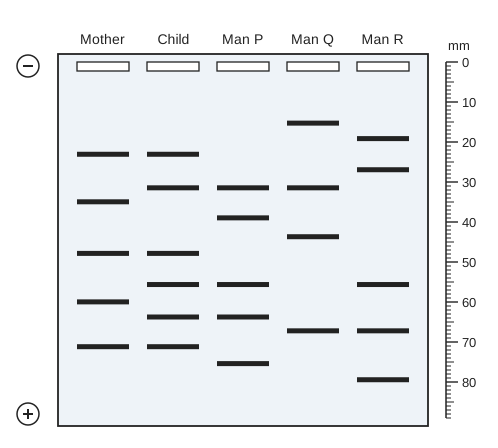
The figure shows the genetic fingerprints of a mother, her child and three men, P, Q and R. One of the men is the child's father.

Which man is most likely to be the child's father? Use the figure to explain your answer.

Genetic fingerprints in five lanes labelled Mother, Child, Man P, Man Q and Man R. The wells are at the top, next to the negative electrode, and the positive electrode is at the bottom. A millimetre scale beside the gel starts at the wells. Distances of the bands from the wells: Mother: 23, 35, 48, 60 and 71 mm; Child: 23, 31, 48, 56, 64 and 71 mm; Man P: 31, 39, 56, 64 and 75 mm; Man Q: 15, 31, 44 and 67 mm; Man R: 19, 27, 56, 67 and 79 mm.

Model answer

Man P is most likely to be the father. A child inherits one allele of each VNTR from each parent, so every band in the child's fingerprint must come from either the mother or the father. The child's bands at 23, 48 and 71 mm match the mother's. The other three bands, at 31, 56 and 64 mm, must have come from the father, and man P has all three. Man Q has only the band at 31 mm, and man R has only the band at 56 mm, so neither can be the father.

Explanation

In a paternity test, first cross off the child's bands that match the mother; the remaining bands must come from the father, so the father must have every one of them. A man who lacks even one of these bands can be excluded. A man is not excluded simply because he has extra bands: the child inherits only half of each parent's VNTR alleles.

Mark scheme
  1. 1 mark

    Man P

    Max 3.

  2. 1 mark

    Each band in the child's fingerprint comes from the mother or from the father / the child inherits one allele of each VNTR from each parent

  3. 1 mark

    The bands in the child's fingerprint that are not in the mother's (at about 31, 56 and 64 mm) are all present in man P's fingerprint

    Accept positions within 2 mm, or the bands described in words.

  4. 1 mark

    Men Q and R each have only one of these bands (Q lacks the bands at 56 and 64 mm; R lacks those at 31 and 64 mm)

    Accept 'Q and R do not have all of the child's non-maternal bands'.

Question 3

3 marks

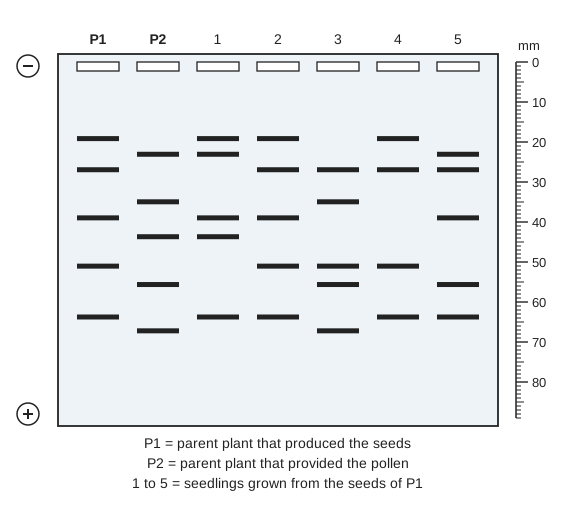
A plant breeder crossed two varieties of tomato. She transferred pollen from plant P2 to the flowers of plant P1, then grew seedlings from the seeds that P1 produced. Some seeds may have been produced by self-pollination of P1. The figure shows the genetic fingerprints of the two parent plants and five seedlings.

Give the numbers of the seedlings that are hybrids produced by the cross. Explain your answer.

Genetic fingerprints in seven lanes labelled P1, P2, 1, 2, 3, 4 and 5. A key says P1 is the parent plant that produced the seeds, P2 is the parent plant that provided the pollen, and 1 to 5 are seedlings grown from the seeds of P1. The wells are at the top, next to the negative electrode, and the positive electrode is at the bottom. A millimetre scale beside the gel starts at the wells. Distances of the bands from the wells: P1: 19, 27, 39, 51 and 64 mm; P2: 23, 35, 44, 56 and 67 mm; 1: 19, 23, 39, 44 and 64 mm; 2: 19, 27, 39, 51 and 64 mm; 3: 27, 35, 51, 56 and 67 mm; 4: 19, 27, 51 and 64 mm; 5: 23, 27, 39, 56 and 64 mm.

Model answer

Seedlings 1, 3 and 5 are hybrids. Every band in a seedling must have come from one of its parents. Seedlings 1, 3 and 5 each have bands that are in P2's fingerprint but not in P1's (for example, seedling 1 has P2's bands at 23 and 44 mm), so they inherited DNA from the pollen of P2. Seedlings 2 and 4 have only bands that are in P1's fingerprint, so they were produced when P1 pollinated itself.

Explanation

Plant breeders use genetic fingerprinting to check that offspring really come from the intended cross, without waiting for the plants to grow and show their characteristics. A seedling with any band found only in the pollen parent must be a hybrid. A seedling from self-pollination can lack some of P1's bands (if P1 is heterozygous), but it never has bands that P1 lacks.

Mark scheme
  1. 1 mark

    Seedlings 1, 3 and 5

    Max 3. All three, and no others, are needed for this mark.

  2. 1 mark

    These seedlings have bands that are present in P2 but not in P1, so they inherited DNA from P2 (the pollen parent)

    Accept a correct example, e.g. 'seedling 1 has P2's bands at 23 and 44 mm'.

  3. 1 mark

    Seedlings 2 and 4 have only bands found in P1, so they were produced by self-pollination of P1

  4. 1 mark

    Every band in a seedling must come from one of its two parents

Question 4

5 marks

Explain why genetic fingerprinting can almost always distinguish between two people, but cannot distinguish between identical twins.

Model answer

The genome contains many variable number tandem repeats (VNTRs): non-coding base sequences repeated many times one after another. The number of repeats at each VNTR varies between people, so the fragments containing them differ in length. Many different VNTRs are analysed, and each has many possible lengths. Each person inherits a combination of VNTR alleles, one of each from each parent, so the probability that two people have the same VNTRs at every locus is extremely low.

Identical twins develop from the same zygote, which divided by mitosis to form two embryos, so they have identical DNA and identical VNTRs, giving identical fingerprints.

Explanation

The power of genetic fingerprinting comes from combining many variable loci: even if two people match at one VNTR, they are very unlikely to match at all of them. Identical twins are the exception, because mitosis produces genetically identical cells. A common error is to say that VNTRs are genes or code for proteins; they are in non-coding DNA.

Mark scheme
  1. 1 mark

    The genome contains many VNTRs / variable number tandem repeats (base sequences repeated one after another in non-coding DNA)

    Max 4 if the answer does not explain why identical twins have the same fingerprint. Max 5.

  2. 1 mark

    The number of repeats (at each VNTR) varies between people, so the DNA fragments differ in length

    Accept 'VNTRs differ in length between people'.

  3. 1 mark

    Many different VNTRs (loci) are analysed (in one fingerprint)

  4. 1 mark

    Each VNTR has many different possible lengths / numbers of repeats (alleles) in the population

  5. 1 mark

    Each person inherits a different combination of VNTR alleles, one allele of each VNTR from each parent

    Accept references to independent segregation or crossing over in meiosis producing different combinations.

  6. 1 mark

    So the probability of two (unrelated) people having the same VNTRs at every locus is very low

  7. 1 mark

    Identical twins develop from the same zygote / fertilised egg, which divided by mitosis, so they have identical DNA / VNTRs

    Reject meiosis. Insufficient: 'twins have the same DNA' with no explanation.

Ready to try the rest? Every answer you write is marked against the mark scheme, so you can see exactly where the marks are.

Study Helper Hints first, answers after you try

Stuck on this one? Ask for a hint and I’ll point you in the right direction, without giving the answer away. Once you’ve checked your answer, I’ll show you how the marks are awarded.