
Level:
Correct: 0
Incorrect: 0
Marks: 0/0
Exam Practice
Course:
Topics:
AQA A-Level Biology (Paper 2) Smart practice A mixed round aimed at your weak spots
Unit 5
Energy transfers in and between organisms
Unit 6
Organisms respond to changes in their internal and external environments
Stimuli, both internal and external, are detected and lead to a response
Survival and response
0%
Receptors
0%
Control of heart rate
0%
Skeletal muscles are stimulated to contract by nerves and act as effectors
Skeletal muscles and muscle contraction
0%
Unit 7
Genetics, populations, evolution and ecosystems
Unit 8
The control of gene expression
Alteration of the sequence of bases in DNA can alter the structure of proteins
Gene mutations and their effects on proteins
0%
Using genome projects
0%
Differences in DNA between individuals of the same species can be exploited
DNA probes, screening and genetic counselling
0%
Genetic fingerprinting
0%
Unit 9
Comprehension
Avg
score:
–
Topics
done:
0/34

Skeletal muscles and muscle contraction

Practise 19 exam-style questions on Skeletal muscles and muscle contraction for AQA A-Level Biology (Paper 2). Write your answer as you would in the exam and get it marked in seconds against the mark scheme, point by point, with the Study Helper on hand if you get stuck.

  • 19 questions
  • 1–8 marks each
  • Instant marking
  • No sign-up needed
19 questions, marked as you go

Sample questions with model answers

Here are 4 of the questions in this topic, each with a model answer, an explanation of why it earns the marks and the mark scheme an examiner would use.

Question 1

2 marks

In each myosin filament, the myosin heads in one half of the filament point in the opposite direction to the myosin heads in the other half.

Suggest why this arrangement is important for the contraction of a sarcomere.

Model answer

Because the heads in the two halves point in opposite directions, the actin filaments attached to each Z line are pulled in opposite directions, towards the centre of the sarcomere. This pulls the two Z lines towards each other, so the sarcomere shortens, rather than all the actin being moved in one direction.

Explanation

Each myosin head pulls the actin filament it is attached to towards the centre of the thick filament. If all the heads pointed the same way, actin filaments on both sides would be moved in the same direction and the sarcomere would not shorten. The opposite arrangement means each half-sarcomere shortens, so the whole myofibril shortens.

Mark scheme
  1. 1 mark

    The actin filaments on each side are pulled in opposite directions / towards the centre (M line)

    Accept 'both sets of actin filaments move towards the middle'.

  2. 1 mark

    So both Z lines are pulled towards the centre / the sarcomere shortens (instead of the filaments moving in the same direction)

Question 2

4 marks

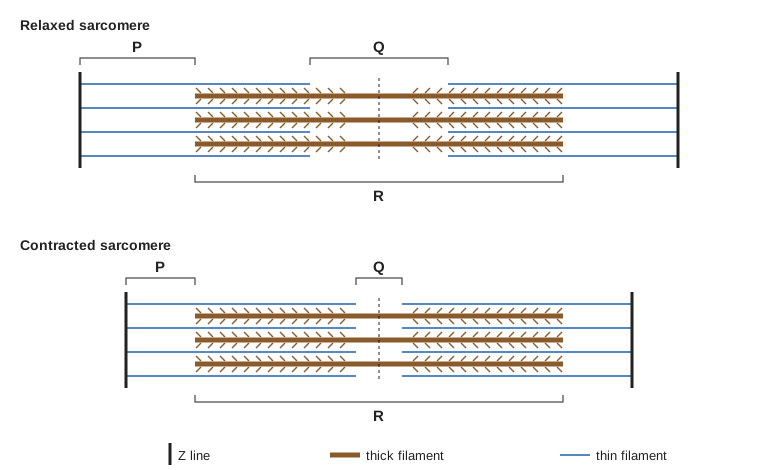
The diagram shows a sarcomere from a skeletal muscle when the muscle was relaxed and when it was contracted. The diagrams are drawn to the same scale.

Name the bands or zone labelled P, Q and R.

Explain why R has the same length in both sarcomeres.

Two diagrams of a sarcomere drawn to the same scale, one labelled 'Relaxed sarcomere' and one labelled 'Contracted sarcomere'. Each has a thick vertical Z line at each end. Thin filaments (thin blue lines) extend inwards from each Z line, and thick filaments (thick brown lines with short projecting heads) lie in the middle, overlapping the ends of the thin filaments; a dashed vertical line marks the centre. In each diagram, bracket P spans from the left Z line to the left end of the thick filaments; bracket Q spans the gap between the ends of the thin filaments from the two sides; bracket R, below, spans the full length of the thick filaments. The contracted sarcomere is shorter: P and Q are shorter than in the relaxed sarcomere and R is the same length. A key shows the Z line, thick filament and thin filament.

Model answer

P is the I band, Q is the H zone and R is the A band.

The A band is the length of the myosin (thick) filaments. During contraction the actin and myosin filaments slide past each other, but neither changes in length, so the A band stays the same length while the I band and H zone get shorter.

Explanation

The I band contains only thin (actin) filaments, the H zone only thick (myosin) filaments, and the A band is the whole length of the thick filaments, including where they overlap with thin filaments. During contraction the filaments slide past each other, so the overlap increases: the I band and H zone shorten, but the A band does not. Mixing up the H zone and the I band is a common error.

Mark scheme
  1. 1 mark

    P: I band

    Accept 'light band' or 'isotropic band'. Reject 'H band'.

  2. 1 mark

    Q: H zone

    Accept 'H band'.

  3. 1 mark

    R: A band

    Accept 'dark band' or 'anisotropic band'.

  4. 1 mark

    R is the length of the myosin / thick filaments, which do not change length (they slide past the actin filaments)

    Accept 'neither actin nor myosin filaments shorten; they slide'. 'The filaments slide' alone is insufficient: the link between the A band and the myosin filaments is needed.

Question 3

4 marks

Astronauts on a space station are weightless, so their leg muscles do not have to support the weight of the body. Scientists took a small sample of the soleus muscle from the calf of each of six astronauts, before and after they had spent six months on a space station. They found the percentage of slow fibres in each sample.

The table shows their results. Mean ± 2 standard deviations includes over 95% of the data.

The scientists concluded that weightlessness causes slow fibres in the soleus muscle to be replaced by fast fibres.

Evaluate this conclusion.

Table with columns "Sample", "Mean percentage of slow fibres", "Standard deviation". Sample: Before six months on the space station; Mean percentage of slow fibres: 66; Standard deviation: 8 | Sample: After six months on the space station; Mean percentage of slow fibres: 57; Standard deviation: 10.

Model answer

The mean percentage of slow fibres fell from 66% to 57%, which supports the conclusion. However, the ranges of mean ± 2 standard deviations overlap (50 to 82% and 37 to 77%), so the difference may be due to chance. Only six astronauts were studied, and there was no control group of people on Earth sampled six months apart, so the change could have been caused by other factors, such as diet or the different exercise the astronauts did. The data also show only that the proportion of slow fibres fell: they do not show that slow fibres were converted into fast fibres, because slow fibres might simply have been lost.

Explanation

An evaluation should say what supports the conclusion and what limits it. Overlapping ± 2 SD ranges suggest that a difference between means may be due to chance; talk about the difference, never 'the results', being due to chance. A study of a few people with no control group cannot separate the effect of weightlessness from other changes in their lives, and a change in a percentage does not show what happened to individual fibres.

Mark scheme
  1. 1 mark

    The mean percentage of slow fibres decreased (from 66% to 57%), which supports the conclusion

    Max 4. Accept 'the percentage of fast fibres increased' as the supporting point.

  2. 1 mark

    The mean ± 2 SD ranges overlap (50 to 82 and 37 to 77), so the difference (in means) may be due to chance / may not be significant

    Accept the overlap described without the ranges. Reject 'the results are due to chance'.

  3. 1 mark

    Only six astronauts / small sample

  4. 1 mark

    No control group (e.g. people on Earth sampled six months apart), so the change may be due to other factors, such as diet, exercise or confinement

  5. 1 mark

    The data show only that the proportion of slow fibres fell, not that slow fibres were converted into fast fibres (slow fibres may have been lost / fast fibres may have increased in number)

  6. 1 mark

    A small sample of muscle may not be representative of the whole soleus muscle / only one muscle was studied

Question 4

6 marks

Some students investigated the effect of repeated contraction on muscle fatigue. A volunteer squeezed a spring hand-grip as many times as possible in each of six 20-second periods, one immediately after another, using the same hand.

The table shows the results.

Calculate the percentage decrease in the number of squeezes between period 1 and period 6. Give your answer to 3 significant figures.

Suggest two reasons why the number of squeezes decreased.

The students concluded that repeated contraction causes muscle fatigue in all people. Evaluate this conclusion.

Table with columns "20-second period", "1", "2", "3", "4", "5", "6". 20-second period: Number of squeezes; 1: 38; 2: 35; 3: 31; 4: 27; 5: 24; 6: 21.

Model answer

Percentage decrease = (38 - 21) ÷ 38 × 100 = 17 ÷ 38 × 100 = 44.7%

The phosphocreatine in the muscle was used up, so ATP could not be regenerated fast enough. Oxygen could not reach the muscle fast enough for aerobic respiration, so more anaerobic respiration took place, producing lactate, which lowers the pH in the muscle.

The number of squeezes fell in every period, which supports the conclusion for this volunteer. However, only one person was tested, so the result cannot be applied to all people, and the fall might be caused by the volunteer losing motivation rather than by fatigue of the muscles.

Explanation

Percentage change = change ÷ original value × 100, so divide by the first value, 38. Repeated contraction uses up phosphocreatine and increases reliance on anaerobic respiration, both of which reduce the rate at which ATP can be supplied. A conclusion about all people cannot be drawn from a single volunteer, and counting squeezes does not separate fatigue of the muscle from loss of effort.

Mark scheme
  1. 1 mark

    Correct method, e.g. (38 - 21) ÷ 38 × 100; or a correct final answer of 44.7 with no working

    Max 6. Points 1 and 2 are the calculation: a correct answer of 44.7% with no working scores 2 marks. Accept for 1 mark: 81.0 (divided by 21 instead of 38) OR 45 or 44.74 (not to 3 significant figures) OR 0.447 (not multiplied by 100).

  2. 1 mark

    44.7 (%)

  3. 1 mark

    Phosphocreatine is used up, so ATP is not regenerated fast enough

    Points 3 to 5: 1 mark each, max 2. List rule: if more than two reasons are given, each wrong or contradictory extra reason cancels one correct reason.

  4. 1 mark

    Anaerobic respiration produces lactate / lactic acid, which lowers the pH (and affects enzymes)

    Accept 'build-up of lactate'.

  5. 1 mark

    Not enough oxygen reaches the muscle for aerobic respiration (so less ATP is produced)

    Reject 'no oxygen'. Reject the idea of energy being produced.

  6. 1 mark

    (Supports) The number of squeezes fell in every period / fell by about 45%

    Points 6 to 11: max 2. Allow ECF from the calculated percentage.

  7. 1 mark

    Only one volunteer (was tested), so the results cannot be applied to all people / other people may respond differently

  8. 1 mark

    Only one hand / one group of muscles was tested

  9. 1 mark

    The fall could be due to the volunteer's motivation / effort / boredom rather than muscle fatigue

  10. 1 mark

    The force of each squeeze was not measured / squeezes may not have been complete or equal

  11. 1 mark

    No repeats / the investigation was done only once, so it is not known whether the results are repeatable

    Ignore 'repeat the experiment' with no reason.

Ready to try the rest? Every answer you write is marked against the mark scheme, so you can see exactly where the marks are.

Study Helper Hints first, answers after you try

Stuck on this one? Ask for a hint and I’ll point you in the right direction, without giving the answer away. Once you’ve checked your answer, I’ll show you how the marks are awarded.
