
Level:
Correct: 0
Incorrect: 0
Marks: 0/0
Exam Practice
Course:
Topics:
AQA A-Level Biology (Paper 2) Smart practice A mixed round aimed at your weak spots
Unit 5
Energy transfers in and between organisms
Unit 6
Organisms respond to changes in their internal and external environments
Stimuli, both internal and external, are detected and lead to a response
Survival and response
0%
Receptors
0%
Control of heart rate
0%
Skeletal muscles are stimulated to contract by nerves and act as effectors
Skeletal muscles and muscle contraction
0%
Unit 7
Genetics, populations, evolution and ecosystems
Unit 8
The control of gene expression
Alteration of the sequence of bases in DNA can alter the structure of proteins
Gene mutations and their effects on proteins
0%
Using genome projects
0%
Differences in DNA between individuals of the same species can be exploited
DNA probes, screening and genetic counselling
0%
Genetic fingerprinting
0%
Unit 9
Comprehension
Avg
score:
–
Topics
done:
0/34

Populations and the Hardy-Weinberg principle

Practise 18 exam-style questions on Populations and the Hardy-Weinberg principle for AQA A-Level Biology (Paper 2). Write your answer as you would in the exam and get it marked in seconds against the mark scheme, point by point, with the Study Helper on hand if you get stuck.

  • 18 questions
  • 1–8 marks each
  • Instant marking
  • No sign-up needed
18 questions, marked as you go

Sample questions with model answers

Here are 4 of the questions in this topic, each with a model answer, an explanation of why it earns the marks and the mark scheme an examiner would use.

Question 1

2 marks

A species of flightless ground beetle lives in two woods, X and Y. The woods are 3 km apart and are separated by a motorway and large fields of crops. The beetles cannot cross the motorway or the fields.

Biologists describe the beetles in wood X and the beetles in wood Y as two populations of the same species.

Explain why.

Model answer

The beetles in the two woods belong to the same species because, if they were brought together, they could interbreed to produce fertile offspring. However, a population is a group of organisms of the same species living in a particular area at a particular time, which interbreed. The beetles cannot cross the motorway or the fields, so beetles in wood X never interbreed with beetles in wood Y: each wood has its own population with its own gene pool.

Explanation

A species can exist as one or more populations. Being the same species depends on the potential to interbreed and produce fertile offspring; being one population depends on actually living in the same place at the same time, so that members can interbreed. Here the barrier stops gene flow, so the two woods have separate gene pools whose allele frequencies can change independently. Saying only that the beetles 'look the same' does not show they are one species.

Mark scheme
  1. 1 mark

    (They are the same species because) beetles from X and Y could (potentially) interbreed to produce fertile offspring (if they met)

    Max 2. Accept 'can potentially interbreed' as the idea of the same species. Insufficient: 'they are the same type of beetle' or 'they look the same'.

  2. 1 mark

    A population is a group of (organisms of) the same species living in a particular area/space at a particular time (that can interbreed)

    Accept 'the beetles in each wood live in a particular space at a particular time'. Accept a correct definition of a population applied to either wood.

  3. 1 mark

    Beetles in X and Y do not (actually) interbreed / there is no gene flow between them / each wood has a separate gene pool (because they cannot cross the motorway or fields)

    Accept 'they are reproductively separated by the motorway and fields'. Ignore 'they are isolated' unless linked to not interbreeding, gene flow or gene pools.
Question 2

2 marks

In a population of a species of deer, a recessive allele causes a white coat. Deer with at least one copy of the dominant allele have a brown coat. The frequency of the recessive allele in the population is 0.14.

Use the Hardy-Weinberg equation to calculate the percentage of deer in this population that are expected to have a brown coat.

Model answer

q = 0.14, so q² (white deer) = 0.14² = 0.0196
Brown deer = 1 - q² = 1 - 0.0196 = 0.9804
Percentage with a brown coat = 98.04% (98%)
(Check: p = 0.86, p² + 2pq = 0.7396 + 0.2408 = 0.9804)

Explanation

Brown deer include both the homozygous dominant (p²) and the heterozygous (2pq) deer, so the brown frequency is p² + 2pq, which equals 1 - q². The quickest route is to square the recessive allele frequency and subtract it from 1. Giving only p² (73.96%) forgets that heterozygotes show the dominant phenotype.

Mark scheme
  1. 1 mark

    Correct method: 1 - q² = 1 - 0.14² / p² + 2pq = 0.86² + 2 × 0.86 × 0.14; or a correct final answer of 98.04% (accept 98 or 98.0) with no working

    A correct answer of 98.04% (accept 98 or 98.0) with no working scores 2 marks. Accept for 1 mark: 0.9804 (correct, not converted to a percentage) OR evidence of q² = 0.0196 (1.96% white). Do not award a mark for 73.96% (p² only: the heterozygotes are also brown) or 24.08% (2pq only).

  2. 1 mark

    98.04 (%) (accept 98 or 98.0)

Question 3

4 marks

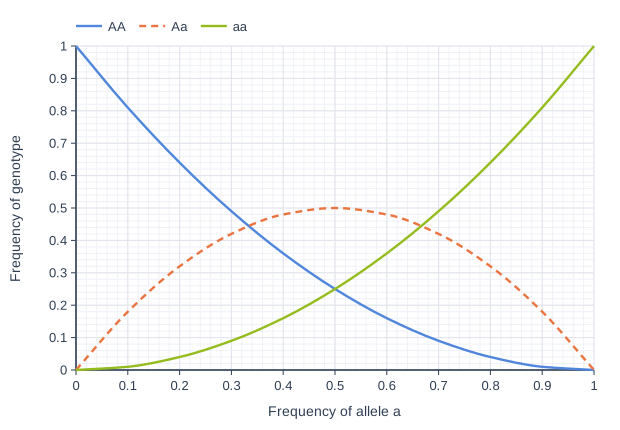
The graph shows the frequencies of the three genotypes of a gene with two alleles, A and a, predicted by the Hardy-Weinberg principle, for different frequencies of allele a.

In one population, 45.5% of the individuals are heterozygous for this gene.

Use the graph to give the two possible frequencies of allele a in this population.

Suggest what other information about this population would allow you to decide which of these two frequencies is correct. Explain your answer.

Line graph of frequency of genotype (y-axis, 0 to 1) against frequency of allele a (x-axis, 0 to 1). "AA" is a smooth curve through (0, 1), (0.1, 0.81), (0.2, 0.64), (0.3, 0.49), (0.4, 0.36), (0.5, 0.25), (0.6, 0.16), (0.7, 0.09), (0.8, 0.04), (0.9, 0.01), (1, 0). "Aa" (dashed) is a smooth curve through (0, 0), (0.1, 0.18), (0.2, 0.32), (0.3, 0.42), (0.4, 0.48), (0.5, 0.5), (0.6, 0.48), (0.7, 0.42), (0.8, 0.32), (0.9, 0.18), (1, 0). "aa" is a smooth curve through (0, 0), (0.1, 0.01), (0.2, 0.04), (0.3, 0.09), (0.4, 0.16), (0.5, 0.25), (0.6, 0.36), (0.7, 0.49), (0.8, 0.64), (0.9, 0.81), (1, 1).

Model answer

Reading across from 0.455 on the heterozygote (Aa) curve, it meets the curve twice: at a frequency of allele a of 0.35 and at 0.65.

To decide between them, find the frequency of individuals with the recessive phenotype (genotype aa). If the frequency of allele a is 0.35, about 12% of individuals would be aa (and 42% AA); if it is 0.65, about 42% would be aa (and 12% AA). So whichever homozygote is more common shows which allele is more common.

Explanation

The heterozygote curve (2pq) is symmetrical about a frequency of 0.5, so every heterozygote frequency below 0.5 corresponds to two allele frequencies, q and 1 - q. The heterozygote frequency alone cannot tell you which allele is the more common one. The homozygote frequencies do: q² and p² are very different unless q is close to 0.5.

Mark scheme
  1. 1 mark

    0.35 (accept 0.33 to 0.37)

    The two frequencies may be given in either order.

  2. 1 mark

    0.65 (accept 0.63 to 0.67)

  3. 1 mark

    The frequency/percentage of individuals with the recessive phenotype / homozygous aa (or of homozygous AA)

    Accept 'the frequency of individuals showing the recessive characteristic' or the frequency of individuals with the dominant phenotype. Accept 'whether AA or aa individuals are more common'. Do not accept 'whether the dominant or the recessive phenotype is more common': the dominant phenotype (AA + Aa) is the more common at both allele frequencies (about 88% or 58%). Ignore 'the number of heterozygotes' (already given).

  4. 1 mark

    aa would be about 0.12 (12%) if the frequency of a is 0.35 but about 0.42 (42%) if it is 0.65 / the homozygote of the more common allele is the more common homozygote

    Accept values read from the graph within ±0.03. Accept 'if aa is less common than AA, the frequency of a is 0.35'. Accept 'the dominant phenotype would be about 88% of individuals if the frequency of a is 0.35 but about 58% if it is 0.65'.

Question 4

5 marks

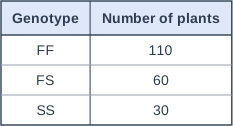
An enzyme in a species of wild grass exists in two forms. The two forms are coded for by two codominant alleles, F and S, of a single gene. Scientists used gel electrophoresis to find the genotype of 200 plants from one population. The table shows their results.

Use the numbers of each genotype to calculate the frequency of allele S in this sample.

Use the Hardy-Weinberg equation and your allele frequencies to calculate the number of heterozygous (FS) plants expected in a sample of 200.

Suggest two reasons why the observed number of heterozygous plants is different from the expected number.

Table with columns "Genotype", "Number of plants". Genotype: FF; Number of plants: 110 | Genotype: FS; Number of plants: 60 | Genotype: SS; Number of plants: 30.

Model answer

Copies of S = (2 × 30) + 60 = 120; total copies of the gene = 2 × 200 = 400
Frequency of S (q) = 120 ÷ 400 = 0.3, so frequency of F (p) = 0.7

Expected heterozygotes = 2pq × 200 = 2 × 0.7 × 0.3 × 200 = 84
Observed = 60, so there are fewer heterozygotes than expected.

Possible reasons: the grass may self-pollinate or mate mostly with close neighbours (non-random mating/inbreeding), which increases the proportion of homozygotes; or there may be selection against heterozygous plants.

Explanation

With codominant alleles every genotype can be identified, so allele frequencies are found by counting: each homozygote has two copies of an allele and each heterozygote one. The Hardy-Weinberg equation then predicts the genotype frequencies expected under its conditions (2pq for heterozygotes). A shortage of heterozygotes is typical of inbreeding or self-pollination, selection against heterozygotes, or a sample drawn from two populations that do not interbreed. Using √(SS frequency) to find q is an error when the genotypes can be counted.

Mark scheme
  1. 1 mark

    Correct method: (2 × 30 + 60) ÷ (2 × 200) / 120 ÷ 400; or a correct final answer of 0.3 with no working

    Max 5. Points 1 and 2: a correct answer of 0.3 for the frequency of S with no working scores 2 marks. Accept for 1 mark: 0.7 (frequency of F given instead of S). Do not award a mark for 0.39 (√(30 ÷ 200)): the alleles can be counted directly, so the Hardy-Weinberg equation should not be used here.

  2. 1 mark

    0.3 / 0.30

  3. 1 mark

    84 (2 × 0.7 × 0.3 × 200)

    ECF: 2 × their p × their q × 200, where p = 1 - q. Accept 84 with no working.

  4. 1 mark

    (Self-pollination/self-fertilisation/inbreeding/non-random mating) increases the proportion of homozygotes

    Points 4 to 8: max 2. List rule: if more than two reasons are given, each wrong or contradictory extra reason cancels one correct reason. Accept 'plants mate with close relatives/neighbours'.

  5. 1 mark

    Selection against heterozygotes / homozygotes have a selective advantage (survive or reproduce better)

    Accept 'heterozygous plants are less likely to survive to be sampled'.

  6. 1 mark

    The sample contains plants from two (or more) separate populations / sub-populations (with different allele frequencies)

    Accept 'the plants are not one interbreeding population'.

  7. 1 mark

    Migration / gene flow (of pollen or seeds) from another population (with different allele frequencies)

    Accept immigration or emigration.

  8. 1 mark

    The sample is not random / not representative of the population (e.g. plants collected from only one part of the population)

    Insufficient: 'small sample' with no reference to the sample not being representative. Ignore 'small population' or 'genetic drift' (these do not explain a shortage of heterozygotes in one generation), 'mutation' unless qualified, and 'human error'.

Ready to try the rest? Every answer you write is marked against the mark scheme, so you can see exactly where the marks are.

Study Helper Hints first, answers after you try

Stuck on this one? Ask for a hint and I’ll point you in the right direction, without giving the answer away. Once you’ve checked your answer, I’ll show you how the marks are awarded.