
Level:
Correct: 0
Incorrect: 0
Marks: 0/0
Exam Practice
Course:
Topics:
AQA A-Level Biology (Paper 2) Smart practice A mixed round aimed at your weak spots
Unit 5
Energy transfers in and between organisms
Unit 6
Organisms respond to changes in their internal and external environments
Stimuli, both internal and external, are detected and lead to a response
Survival and response
0%
Receptors
0%
Control of heart rate
0%
Skeletal muscles are stimulated to contract by nerves and act as effectors
Skeletal muscles and muscle contraction
0%
Unit 7
Genetics, populations, evolution and ecosystems
Unit 8
The control of gene expression
Alteration of the sequence of bases in DNA can alter the structure of proteins
Gene mutations and their effects on proteins
0%
Using genome projects
0%
Differences in DNA between individuals of the same species can be exploited
DNA probes, screening and genetic counselling
0%
Genetic fingerprinting
0%
Unit 9
Comprehension
Avg
score:
–
Topics
done:
0/34

The light-dependent reaction

Practise 18 exam-style questions on The light-dependent reaction for AQA A-Level Biology (Paper 2). Write your answer as you would in the exam and get it marked in seconds against the mark scheme, point by point, with the Study Helper on hand if you get stuck.

  • 18 questions
  • 1–8 marks each
  • Instant marking
  • No sign-up needed
18 questions, marked as you go

Sample questions with model answers

Here are 4 of the questions in this topic, each with a model answer, an explanation of why it earns the marks and the mark scheme an examiner would use.

Question 1

2 marks

Scientists investigated the source of the oxygen released in photosynthesis. They used the heavy isotope of oxygen, ¹⁸O, which can be detected and measured.

In two experiments, they supplied a single-celled alga with water and carbon dioxide containing different percentages of ¹⁸O. They then measured the percentage of ¹⁸O in the oxygen released by the alga. The table shows their results.

What can you conclude from these results? Explain your answer.
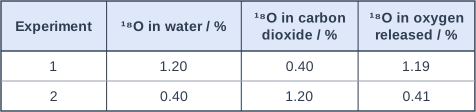
Table with columns "Experiment", "¹⁸O in water / %", "¹⁸O in carbon dioxide / %", "¹⁸O in oxygen released / %". Experiment: 1; ¹⁸O in water / %: 1.20; ¹⁸O in carbon dioxide / %: 0.40; ¹⁸O in oxygen released / %: 1.19 | Experiment: 2; ¹⁸O in water / %: 0.40; ¹⁸O in carbon dioxide / %: 1.20; ¹⁸O in oxygen released / %: 0.41.

Model answer

The oxygen released comes from the water, not from the carbon dioxide. In both experiments the percentage of ¹⁸O in the oxygen released (1.19% and 0.41%) is almost the same as in the water (1.20% and 0.40%), and it does not match the percentage in the carbon dioxide (0.40% and 1.20%). This is because the oxygen is produced by photolysis of water.

Explanation

If the oxygen came from carbon dioxide, its ¹⁸O content would follow the carbon dioxide; instead it matches the water in both experiments, so the oxygen comes from water split by photolysis. Swapping which substance was enriched in the second experiment is what makes the conclusion convincing. Support the conclusion with figures from the table.

Mark scheme
  1. 1 mark

    The oxygen released comes from water (and not from carbon dioxide)

    Accept 'the oxygen is produced by photolysis of water'. Reject 'oxygen comes from carbon dioxide'.

  2. 1 mark

    The percentage of ¹⁸O in the oxygen released is (almost) the same as in the water (1.19 and 1.20, 0.41 and 0.40) in both experiments

    Accept 'the percentage in the oxygen changes when the percentage in the water changes'. Accept 'it is not the same as in the carbon dioxide (0.40 and 1.20)'. Data or a clear comparison with the water are needed.

Question 2

3 marks

Scientists illuminated suspensions of thylakoids isolated from chloroplasts, with and without compound U. Both suspensions contained an electron acceptor, ADP and phosphate. The table shows their results.

The scientists suggested that compound U stops ATP production by making the thylakoid membrane permeable to protons, and not by inhibiting ATP synthase or the electron transfer chain.

Explain how the data support this suggestion.

Table with columns "Measurement", "Without compound U", "With compound U". Measurement: Rate of oxygen production / μmol mg⁻¹ chlorophyll h⁻¹; Without compound U: 48; With compound U: 61 | Measurement: Rate of ATP production / μmol mg⁻¹ chlorophyll h⁻¹; Without compound U: 52; With compound U: 2 | Measurement: Difference in pH across the thylakoid membrane; Without compound U: 2.8; With compound U: 0.1.

Model answer

With compound U, the pH difference across the thylakoid membrane falls from 2.8 to 0.1, so there is almost no proton gradient - protons must be leaking back across the membrane rather than passing through ATP synthase. If U inhibited ATP synthase, protons could not flow back out, so the pH difference would stay large or even increase. Oxygen production does not fall but rises from 48 to 61, so electron transfer along the chain (and photolysis) is still happening; U does not inhibit the electron transfer chain.

Explanation

ATP synthase can only make ATP when protons diffuse through it down a gradient. A compound that lets protons cross the membrane anywhere destroys the gradient (pH difference near zero) while electrons still flow and oxygen is still released. An ATP synthase inhibitor would have the opposite effect on the gradient, and an electron transfer inhibitor would stop oxygen production. Use the figures from the table to support each point.

Mark scheme
  1. 1 mark

    The pH difference across the membrane (almost) disappears / falls from 2.8 to 0.1, so there is no proton gradient / protons leak back across the membrane (not through ATP synthase)

    Max 2 if the answer does not quote any figures from the table. Accept 'no difference in proton concentration between the inside and outside of the thylakoids'. Ignore 'ATP production falls from 52 to 2' on its own (it is the effect to be explained).

  2. 1 mark

    If ATP synthase were inhibited, protons would not flow back out, so the proton gradient / pH difference would be maintained / would increase

    Accept 'an ATP synthase inhibitor would not abolish the pH difference'.

  3. 1 mark

    Oxygen production continues / increases (from 48 to 61), so electron transfer (and photolysis) is not inhibited

    Accept 'electrons are still passing along the chain to the acceptor'. Ignore 'photosynthesis continues'.

Question 3

4 marks

In a chloroplast in bright light, the pH of the thylakoid space is 5.1 and the pH of the stroma is 7.9.

pH = -log₁₀[H⁺], where [H⁺] is the concentration of hydrogen ions (protons).

Calculate how many times greater the concentration of protons is in the thylakoid space than in the stroma. Give your answer to 2 significant figures.

Describe two ways in which the concentration of protons in the thylakoid space becomes higher than in the stroma.

Model answer

[H⁺] in thylakoid space = 10 to the power -5.1 = 7.94 × 10⁻⁶ mol dm⁻³
[H⁺] in stroma = 10 to the power -7.9 = 1.26 × 10⁻⁸ mol dm⁻³
Ratio = 7.94 × 10⁻⁶ ÷ 1.26 × 10⁻⁸ = 10 to the power (7.9 - 5.1) = 10 to the power 2.8 = 630.96
Answer = 630 times (2 significant figures)

1. Photolysis of water takes place in the thylakoid space and releases protons there.
2. The electron carriers in the thylakoid membrane use energy from the electrons to pump protons from the stroma into the thylakoid space.

Explanation

pH is a logarithmic scale, so a difference of 2.8 pH units is a difference of 10 to the power 2.8 (about 630 times) in proton concentration - dividing one pH by the other is a common error. The high proton concentration in the thylakoid space comes from photolysis inside the thylakoid and from proton pumping by the electron transfer chain; using protons to reduce NADP in the stroma also helps. This proton gradient is the store of energy that drives ATP synthesis by ATP synthase.

Mark scheme
  1. 1 mark

    Correct method, e.g. 7.94 × 10⁻⁶ ÷ 1.26 × 10⁻⁸, or 10 to the power (7.9 - 5.1) = 10 to the power 2.8; or a correct final answer of 630 with no working

    Max 4. Points 1 and 2 are the calculation: a correct answer of 630 (or 6.3 × 10²) with no working scores 2 marks. Accept for 1 mark: an answer of 631 or 630.96 or 630.957 (not given to 2 significant figures) OR an answer of 610 or 608 (concentrations rounded to 2 significant figures before dividing) OR evidence of the two concentrations 7.9 × 10⁻⁶ and 1.3 × 10⁻⁸ (mol dm⁻³) OR 0.0016 / 1.6 × 10⁻³ (ratio inverted). Do not award a mark for 2.8 (the pH difference) or 1.5 (7.9 ÷ 5.1).

  2. 1 mark

    630 / 6.3 × 10²

    Do not award this mark for 631 or 630.96 (not 2 significant figures), 610 (rounded too early) or 600 (1 significant figure).

  3. 1 mark

    (Photolysis) water is split in the thylakoid space, releasing protons / H⁺

    Points 3 to 5: 1 mark each, max 2 from these points. List rule: if more than two ways are given, each wrong or contradictory extra answer cancels one correct answer. Accept 'photolysis releases protons inside the thylakoid'.

  4. 1 mark

    Protons are pumped/moved (from the stroma) into the thylakoid space by the electron carriers / using energy from electrons in the electron transfer chain

    Accept 'active transport of protons into the thylakoid space' only if linked to electron transfer/carriers. Reject 'protons pumped by ATP synthase'.

  5. 1 mark

    Protons are removed from the stroma when NADP is reduced

    Accept 'protons in the stroma are used to form reduced NADP'. Reject reduced NAD.

Question 4

5 marks

Scientists found a mutant strain of a single-celled alga in which the ATP synthase in the thylakoid membranes does not work: its proton channel is blocked, so protons cannot pass through it.

The mutant alga was kept in the light with carbon dioxide as its only source of carbon.

Explain how this mutation would affect the light-dependent reaction and the growth of the alga.

Model answer

Protons are still pumped into the thylakoid space by the electron carriers, but they cannot diffuse back through ATP synthase, so they accumulate there and the pH of the thylakoid space falls further. No ATP is produced in the light-dependent reaction. Without ATP, GP cannot be reduced to triose phosphate and RuBP cannot be regenerated, so the light-independent reaction stops. Reduced NADP is then not used, so NADP is not regenerated; with no electron acceptor, electron transfer, photoionisation and photolysis stop as well. As no triose phosphate is made, the alga cannot make glucose, proteins, lipids or other organic substances, so it has no respiratory substrate or materials for growth, and it does not grow.

Explanation

The light-dependent and light-independent reactions depend on each other: the light-independent reaction uses ATP and reduced NADP, and returns ADP and NADP to the thylakoids. Blocking ATP synthase stops ATP production directly and causes protons to build up; then, because GP is not reduced, reduced NADP is not used and the electron transfer chain loses its final acceptor. With carbon dioxide as its only carbon source, the alga cannot make organic substances, so it cannot grow. A common error is to stop after 'no ATP' without following the effects into the light-independent reaction and growth.

Mark scheme
  1. 1 mark

    Protons accumulate / build up in the thylakoid space (as they cannot diffuse back into the stroma)

    Max 5. Accept H⁺ or hydrogen ions for protons.

  2. 1 mark

    The pH of the thylakoid space falls (further) / the proton gradient becomes steeper

    Accept 'more acidic'.

  3. 1 mark

    No ATP is produced in the light-dependent reaction / by chemiosmosis / by photophosphorylation

    Accept 'no ATP made in the chloroplasts / thylakoids'. Ignore 'less energy'.

  4. 1 mark

    (Without ATP) GP cannot be reduced to triose phosphate (in the light-independent reaction)

    Reject 'glucose phosphate' for GP. Accept TP only if triose phosphate is also written in full in the answer.

  5. 1 mark

    (Without ATP) RuBP cannot be regenerated (from triose phosphate)

    Accept 'ribulose bisphosphate is not regenerated'.

  6. 1 mark

    Reduced NADP is not used / oxidised, so NADP is not regenerated / runs out

    Reject reduced NAD.

  7. 1 mark

    (So) no electron acceptor for the chain / electron transfer stops / photoionisation stops / photolysis and oxygen production stop

    Accept 'the light-dependent reaction soon stops completely'.

  8. 1 mark

    No / less triose phosphate / glucose / organic substances are made, so no / less growth (no respiratory substrate or new biomass)

    Accept 'cannot make proteins/lipids/carbohydrates for new cells'. Ignore 'the alga dies' without a reason.

Ready to try the rest? Every answer you write is marked against the mark scheme, so you can see exactly where the marks are.

Study Helper Hints first, answers after you try

Stuck on this one? Ask for a hint and I’ll point you in the right direction, without giving the answer away. Once you’ve checked your answer, I’ll show you how the marks are awarded.