
Level:
Correct: 0
Incorrect: 0
Marks: 0/0
Exam Practice
Course:
Topics:
AQA A-Level Biology (Paper 2) Smart practice A mixed round aimed at your weak spots
Unit 5
Energy transfers in and between organisms
Unit 6
Organisms respond to changes in their internal and external environments
Stimuli, both internal and external, are detected and lead to a response
Survival and response
0%
Receptors
0%
Control of heart rate
0%
Skeletal muscles are stimulated to contract by nerves and act as effectors
Skeletal muscles and muscle contraction
0%
Unit 7
Genetics, populations, evolution and ecosystems
Unit 8
The control of gene expression
Alteration of the sequence of bases in DNA can alter the structure of proteins
Gene mutations and their effects on proteins
0%
Using genome projects
0%
Differences in DNA between individuals of the same species can be exploited
DNA probes, screening and genetic counselling
0%
Genetic fingerprinting
0%
Unit 9
Comprehension
Avg
score:
–
Topics
done:
0/34

Synaptic transmission

Practise 20 exam-style questions on Synaptic transmission for AQA A-Level Biology (Paper 2). Write your answer as you would in the exam and get it marked in seconds against the mark scheme, point by point, with the Study Helper on hand if you get stuck.

  • 20 questions
  • 1–8 marks each
  • Instant marking
  • No sign-up needed
20 questions, marked as you go

Sample questions with model answers

Here are 4 of the questions in this topic, each with a model answer, an explanation of why it earns the marks and the mark scheme an examiner would use.

Question 1

2 marks

Give two differences between transmission across a neuromuscular junction and transmission across a cholinergic synapse between two neurones.

Model answer

1. A neuromuscular junction is always excitatory, but a synapse between neurones can be excitatory or inhibitory.
2. At a neuromuscular junction one impulse always produces an action potential in the muscle fibre, but at a synapse a new action potential may not be produced unless there is summation.

Explanation

The steps of transmission are the same at both junctions. The differences are about what is connected and the outcome: a neuromuscular junction connects a motor neurone to a muscle fibre, is always excitatory and always triggers an action potential in the sarcolemma, whereas a synapse between neurones may be inhibitory and may need summation. Each difference must describe both junctions.

Mark scheme
  1. 1 mark

    Neuromuscular junction is always excitatory; a synapse can be excitatory or inhibitory

    Max 2. List rule: if more than two differences are given, each wrong or contradictory extra answer cancels one correct answer. Each point needs both sides, or a clear comparative (e.g. 'only the neuromuscular junction is always excitatory').

  2. 1 mark

    Neuromuscular junction links a (motor) neurone to a muscle fibre / effector; a synapse links two neurones

    Accept 'postsynaptic cell is a muscle fibre rather than a neurone'.

  3. 1 mark

    At a neuromuscular junction an action potential is always produced in the muscle fibre; at a synapse a new action potential may not be produced / summation may be needed

    Accept 'one impulse is always enough at a neuromuscular junction but not at a synapse'.

  4. 1 mark

    Neuromuscular junction involves only motor neurones; synapses can involve sensory, relay or motor neurones

  5. 1 mark

    At a neuromuscular junction the receptors are on the sarcolemma / (folded) muscle membrane; at a synapse they are on the membrane of the postsynaptic neurone

    Accept 'the postsynaptic membrane at a neuromuscular junction is folded / has more receptors'.

  6. 1 mark

    At a neuromuscular junction the action potential spreads along the sarcolemma (and T-tubules) causing contraction; at a synapse it passes along the postsynaptic neurone

    Ignore details of muscle contraction.
Question 2

3 marks

At cholinergic synapses, the choline produced by the hydrolysis of acetylcholine is taken back into the presynaptic knob by a carrier protein. Substance H inhibits this carrier protein.

Scientists treated a synapse with substance H and stimulated the presynaptic neurone repeatedly at a high frequency. At first, impulses were transmitted across the synapse normally, but after a few seconds transmission stopped.

Explain these results.

Model answer

At first, the vesicles in the presynaptic knob already contain acetylcholine, so it is released and transmission is normal. However, substance H stops choline being taken back into the knob, so acetylcholine cannot be resynthesised. With repeated high-frequency impulses, the stored acetylcholine is used up. Then too little acetylcholine is released to bind to the receptors, the postsynaptic membrane does not reach threshold, and transmission stops.

Explanation

Acetylcholine is recycled: choline from its hydrolysis is taken back into the presynaptic knob and recombined with ethanoic acid. If recycling is blocked, the synapse keeps working only until its stored acetylcholine runs out, which happens quickly at high frequencies. Explain both parts of the result: why transmission was normal at first and why it then stopped.

Mark scheme
  1. 1 mark

    At first, the vesicles already contain acetylcholine, so it is released as normal

    Max 3. Accept ACh or other abbreviations for acetylcholine.

  2. 1 mark

    Choline is not taken back into the presynaptic knob, so acetylcholine cannot be resynthesised

    Accept 'choline and ethanoic acid cannot be recombined because there is no choline in the knob'.

  3. 1 mark

    The vesicles / stores of acetylcholine are used up by the repeated impulses

    Accept 'acetylcholine runs out'.

  4. 1 mark

    So no / too little acetylcholine is released to bind to receptors, so the postsynaptic membrane does not reach threshold

    Accept 'no depolarisation / no action potential in the postsynaptic neurone'. Reject 'messages' or 'signals'.

Question 3

4 marks

After acetylcholine has bound to receptors on the postsynaptic membrane, it is hydrolysed by acetylcholinesterase.

Explain why it is important that acetylcholine is hydrolysed.

Describe what happens to the products of the hydrolysis.

Model answer

If acetylcholine were not hydrolysed, it would stay bound to the receptors and the sodium ion channels would stay open, so the postsynaptic membrane would be continuously depolarised. Hydrolysis frees the receptors so that the membrane repolarises and the next impulse produces a separate response.

Acetylcholine is hydrolysed into choline and ethanoic acid. These diffuse back across the cleft and are taken into the presynaptic knob, where they are recombined into acetylcholine using ATP and stored in vesicles.

Explanation

Removing the neurotransmitter quickly is what keeps synaptic transmission under control: each impulse gives one short response. Acetylcholinesterase on the postsynaptic membrane splits acetylcholine into choline and ethanoic acid, which are recycled in the presynaptic knob, saving the cell from making new acetylcholine from scratch. Answer both parts: why hydrolysis matters and what happens to the products.

Mark scheme
  1. 1 mark

    Otherwise acetylcholine would stay bound / sodium ion channels would stay open, causing continuous depolarisation / continuous action potentials

    Max 4. Max 2 from points 1 and 2. Max 2 from points 3 to 5. Accept ACh or other abbreviations for acetylcholine. Accept 'continuous contraction' at a neuromuscular junction.

  2. 1 mark

    (Hydrolysis) frees the receptors (and lets the membrane repolarise), so the next impulse produces a separate response / impulses are discrete

    Accept 'allows the postsynaptic neurone to respond to the next impulse'.

  3. 1 mark

    Products are choline and ethanoic acid

    Accept acetate / acetyl / acetic acid for ethanoic acid. Reject glucose or amino acids.

  4. 1 mark

    They diffuse back across the cleft / are taken back into the presynaptic knob

    Accept 'reabsorbed by the presynaptic neurone'.

  5. 1 mark

    They are recombined into acetylcholine (using ATP) AND stored in vesicles

    Both parts are needed. Accept 'resynthesised into acetylcholine and packaged into vesicles'.

Question 4

5 marks

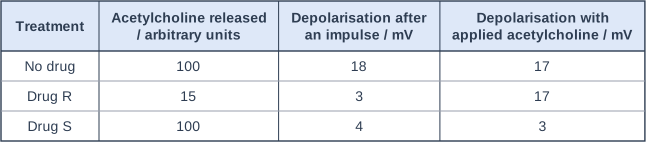
Scientists investigated two drugs, R and S, at cholinergic synapses between neurones. For each treatment they measured:
- the amount of acetylcholine released when an impulse arrived at the presynaptic knob
- the depolarisation of the postsynaptic membrane after an impulse arrived
- the depolarisation of the postsynaptic membrane when acetylcholine was applied directly to it.

The table shows their results.

Use the table to suggest where drug R and drug S act. Explain your answers.

Suggest one way in which drug R could act.

Table with columns "Treatment", "Acetylcholine released / arbitrary units", "Depolarisation after an impulse / mV", "Depolarisation with applied acetylcholine / mV". Treatment: No drug; Acetylcholine released / arbitrary units: 100; Depolarisation after an impulse / mV: 18; Depolarisation with applied acetylcholine / mV: 17 | Treatment: Drug R; Acetylcholine released / arbitrary units: 15; Depolarisation after an impulse / mV: 3; Depolarisation with applied acetylcholine / mV: 17 | Treatment: Drug S; Acetylcholine released / arbitrary units: 100; Depolarisation after an impulse / mV: 4; Depolarisation with applied acetylcholine / mV: 3.

Model answer

Drug R acts on the presynaptic neurone. It reduces the acetylcholine released from 100 to 15 arbitrary units, but the postsynaptic membrane still responds normally (17 mV) when acetylcholine is applied directly, so the receptors are not affected.

Drug S acts on the postsynaptic membrane, probably on the receptors. The acetylcholine released is unchanged (100), but the response to directly applied acetylcholine falls from 17 to 3 mV.

Drug R could block the calcium ion channels in the presynaptic membrane, so fewer calcium ions enter and fewer vesicles fuse with the membrane.

Explanation

Applying acetylcholine directly to the postsynaptic membrane bypasses the presynaptic neurone, so it tests whether the receptors and postsynaptic membrane still work. A drug that cuts release but leaves this response normal acts presynaptically; a drug that leaves release normal but cuts this response acts postsynaptically. Quote the figures that support each conclusion.

Mark scheme
  1. 1 mark

    Drug R acts on the presynaptic neurone / knob

    Accept 'R affects the release of acetylcholine'.

  2. 1 mark

    R reduces the acetylcholine released (from 100 to 15) but the response to directly applied acetylcholine is unchanged (17 mV), so the postsynaptic membrane / receptors are not affected

    Both parts of the evidence are needed for this mark.

  3. 1 mark

    Drug S acts on the postsynaptic membrane / receptors

    Accept 'S blocks the receptors'.

  4. 1 mark

    S does not change the acetylcholine released (100) but reduces the response to directly applied acetylcholine (from 17 to 3 mV)

    Both parts of the evidence are needed for this mark.

  5. 1 mark

    R blocks calcium ion channels / reduces calcium ion entry into the knob OR prevents vesicles moving to / fusing with the presynaptic membrane OR reduces the synthesis of acetylcholine / the uptake of choline

    One suggestion is enough. List rule: if more than one way is given, a wrong suggestion cancels a correct one. Reject 'R inhibits acetylcholinesterase'.

Ready to try the rest? Every answer you write is marked against the mark scheme, so you can see exactly where the marks are.

Study Helper Hints first, answers after you try

Stuck on this one? Ask for a hint and I’ll point you in the right direction, without giving the answer away. Once you’ve checked your answer, I’ll show you how the marks are awarded.