
Level:
Correct: 0
Incorrect: 0
Marks: 0/0
Exam Practice
Course:
Topics:
AQA A-Level Biology (Paper 2) Smart practice A mixed round aimed at your weak spots
Unit 5
Energy transfers in and between organisms
Unit 6
Organisms respond to changes in their internal and external environments
Stimuli, both internal and external, are detected and lead to a response
Survival and response
0%
Receptors
0%
Control of heart rate
0%
Skeletal muscles are stimulated to contract by nerves and act as effectors
Skeletal muscles and muscle contraction
0%
Unit 7
Genetics, populations, evolution and ecosystems
Unit 8
The control of gene expression
Alteration of the sequence of bases in DNA can alter the structure of proteins
Gene mutations and their effects on proteins
0%
Using genome projects
0%
Differences in DNA between individuals of the same species can be exploited
DNA probes, screening and genetic counselling
0%
Genetic fingerprinting
0%
Unit 9
Comprehension
Avg
score:
–
Topics
done:
0/34

Principles of homeostasis and negative feedback

Practise 18 exam-style questions on Principles of homeostasis and negative feedback for AQA A-Level Biology (Paper 2). Write your answer as you would in the exam and get it marked in seconds against the mark scheme, point by point, with the Study Helper on hand if you get stuck.

  • 18 questions
  • 1–8 marks each
  • Instant marking
  • No sign-up needed
18 questions, marked as you go

Sample questions with model answers

Here are 4 of the questions in this topic, each with a model answer, an explanation of why it earns the marks and the mark scheme an examiner would use.

Question 1

2 marks

Mammals keep the concentration of glucose in their blood within narrow limits.

Give two reasons why it is important to maintain a stable blood glucose concentration.

Model answer

1. Glucose is the main respiratory substrate, so cells (especially brain cells) need a steady supply to release energy and make ATP in respiration.
2. Glucose affects the water potential of the blood: a high concentration lowers the water potential of the blood, so water leaves cells by osmosis; a low concentration raises it, so water enters cells by osmosis.

Explanation

These are the two reasons the specification gives. If blood glucose falls, cells that rely on glucose, such as neurones, cannot make enough ATP. If it rises, the water potential of the blood falls and water leaves cells by osmosis. Use the term water potential, not 'concentration of the blood', and remember it is water that moves by osmosis, not glucose.

Mark scheme
  1. 1 mark

    Glucose is the (main) respiratory substrate, so a low concentration means cells cannot respire enough / release enough energy / make enough ATP

    Max 2. List rule: if more than two reasons are given, each wrong or contradictory extra answer cancels one correct answer. A high and a low glucose effect on water potential count as one reason (point 2). Accept 'brain cells / neurones depend on glucose for respiration'. Accept 'releases energy'; reject 'glucose produces / makes energy'. Insufficient: 'glucose is needed for energy' with no reference to respiration or ATP. Reject glycogen or glucagon for glucose.

  2. 1 mark

    Glucose (concentration) affects the water potential of the blood, so a change causes water to move into or out of cells by osmosis

    Accept either direction, e.g. 'a high glucose concentration lowers the water potential of the blood / makes it more negative, so water leaves cells by osmosis' or 'a low glucose concentration raises the water potential of the blood, so water enters cells by osmosis (and they may swell or burst)'. Accept Ψ for water potential. Reject 'water moves by diffusion' or 'glucose moves by osmosis'. Insufficient: 'it affects the concentration of the blood'.
Question 2

3 marks

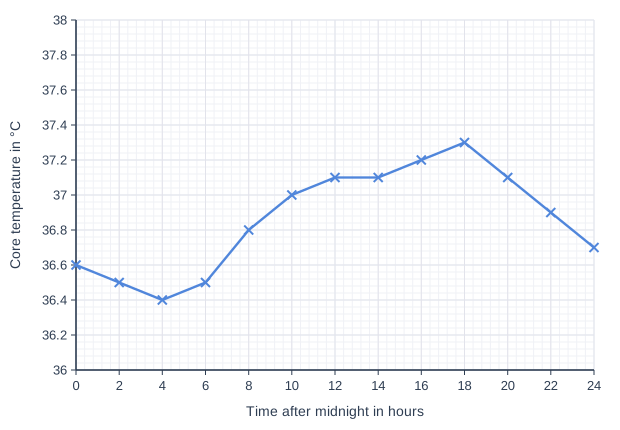
A student wore a sensor that recorded her core temperature every 2 hours for 24 hours, starting at midnight. The graph shows her results.

Explain how these results show that her core temperature is controlled by negative feedback.

The student concluded that her core temperature is always lowest at 4 am. Suggest one reason why this conclusion may not be valid.

Line graph of core temperature in °C (y-axis, 36 to 38) against time after midnight in hours (x-axis, 0 to 24). The line joins the points (0, 36.6), (2, 36.5), (4, 36.4), (6, 36.5), (8, 36.8), (10, 37), (12, 37.1), (14, 37.1), (16, 37.2), (18, 37.3), (20, 37.1), (22, 36.9), (24, 36.7).

Model answer

Her core temperature stayed within narrow limits, between 36.4 and 37.3 °C, a range of only 0.9 °C. It fluctuated around a set point of about 37 °C: each rise was followed by a fall and each fall by a rise, so changes were reversed.

The results come from only one day, so her temperature may not be lowest at 4 am on other days.

Explanation

Negative feedback does not keep a factor perfectly constant: a change has to occur before receptors detect it, so the factor fluctuates around the set point within restricted limits. A conclusion with 'always' needs repeated results, here on several days. Other valid reasons are that readings 2 hours apart may miss the true minimum, and that differences of 0.1 °C may be within the uncertainty of the sensor; give only one reason when one is asked for.

Mark scheme
  1. 1 mark

    Core temperature varies only within narrow / restricted limits, e.g. between 36.4 and 37.3 °C / a range of 0.9 °C

    Max 3. Points 1 and 2 answer the first task; points 3, 4 and 5 answer the second, max 1 from points 3 to 5. Accept a range of 0.9 °C or limits quoted from the graph.

  2. 1 mark

    Temperature fluctuates around a set point / mean (of about 37 °C): each rise is followed by a fall and each fall by a rise / changes are reversed

    Accept 'it never stays constant because a change must happen before it is detected and corrected'.

  3. 1 mark

    Results are from only one day / one set of readings / not repeated on other days

    List rule: if more than one reason is given, a wrong or contradictory extra reason cancels the correct one. Ignore 'only one person' (the conclusion is about this student only).

  4. 1 mark

    Readings were taken only every 2 hours, so the lowest temperature may have occurred between readings / at another time (e.g. 3 am or 5 am)

  5. 1 mark

    The differences between readings are very small (0.1 °C), so they may be within the uncertainty / resolution of the sensor

    Accept 'the sensor may not be accurate enough to detect such small differences'.

Question 3

3 marks

Homeostasis in mammals involves physiological control systems that use negative feedback. Many of these systems have separate mechanisms: one that corrects a rise in a factor and another that corrects a fall.

What is meant by homeostasis? Explain why having separate mechanisms gives a greater degree of control than having only one mechanism.

Model answer

Homeostasis is the maintenance of a stable internal environment: physiological control systems keep factors such as core temperature, blood pH and blood glucose concentration within restricted limits. With separate mechanisms, a change in either direction is actively reversed, because one mechanism is switched on to correct a rise and the other to correct a fall. With only one mechanism, a change in one direction could be corrected only by switching that mechanism off, which is slower. Separate mechanisms therefore return the factor to its set point faster and keep it within narrower limits.

Explanation

Homeostasis keeps the internal environment within restricted limits, not perfectly constant. Separate mechanisms involving negative feedback, such as insulin lowering and glucagon raising blood glucose, mean that a departure in either direction can be actively corrected rather than just allowed to drift back. Saying only that separate mechanisms 'give more control' repeats the question and earns no credit.

Mark scheme
  1. 1 mark

    (Homeostasis is) the maintenance of a stable internal environment / keeping conditions inside the body within restricted limits

    Max 3. Accept 'keeping factors such as core temperature, blood pH or blood glucose concentration within narrow limits / near a set point'. Insufficient: 'keeping the body the same' or 'keeping conditions constant' with no reference to the internal environment.

  2. 1 mark

    With separate mechanisms, a change in either direction can be actively reversed / each mechanism can be switched on to correct a change in its own direction

    Accept 'one mechanism (e.g. one hormone) raises the factor and another lowers it'.

  3. 1 mark

    With only one mechanism, a change in one direction can be corrected only by switching that mechanism off / reducing its effect, which is slower

    Accept the idea that a single mechanism can only increase or decrease its own effect.

  4. 1 mark

    So the factor returns to the set point / normal level faster / fluctuates less / is kept within narrower limits

    Insufficient: 'it gives more control' (this repeats the question).

Question 4

6 marks

The thyroid gland secretes the hormone thyroxine, which increases the metabolic rate of body cells. Each thyroxine molecule contains iodine, which the body obtains from the diet.

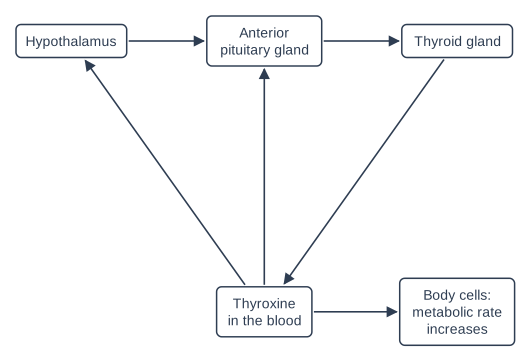
The diagram shows how the secretion of thyroxine is controlled. TRH and TSH are hormones. TSH stimulates the thyroid gland to secrete thyroxine, and it also stimulates the cells of the thyroid gland to divide.

Use the information to explain how the concentration of thyroxine in the blood is kept stable. Explain why a person whose diet contains too little iodine has a high concentration of TSH in the blood and an enlarged thyroid gland.

Diagram of 5 boxes joined by 6 arrows. The boxes are: "Hypothalamus" (top row, left), "Anterior pituitary gland" (top row, centre), "Thyroid gland" (top row, right), "Thyroxine in the blood" (bottom row, centre), "Body cells: metabolic rate increases" (bottom row, right). Arrows go from "Hypothalamus" to "Anterior pituitary gland", labelled "TRH"; from "Anterior pituitary gland" to "Thyroid gland", labelled "TSH"; from "Thyroid gland" to "Thyroxine in the blood", labelled "thyroxine"; from "Thyroxine in the blood" to "Body cells: metabolic rate increases", labelled "stimulates"; from "Thyroxine in the blood" to "Anterior pituitary gland", labelled "inhibits"; from "Thyroxine in the blood" to "Hypothalamus", labelled "inhibits".

Model answer

If the thyroxine concentration in the blood rises, thyroxine inhibits the hypothalamus and the anterior pituitary gland, so less TRH and less TSH are secreted. With less TSH, the thyroid secretes less thyroxine, so the concentration falls back to normal. If the thyroxine concentration falls, there is less inhibition, so more TRH and TSH are secreted and the thyroid secretes more thyroxine. This negative feedback keeps the concentration stable.

Without enough iodine, the thyroid cannot make enough thyroxine, so the thyroxine concentration stays low. There is then little inhibition of the hypothalamus and anterior pituitary, so TRH and TSH secretion stays high. The high concentration of TSH keeps stimulating the cells of the thyroid gland to divide, so the gland enlarges.

Explanation

This is negative feedback by a hormone acting on the glands that control its own secretion: a rise in thyroxine reduces TRH and TSH, and a fall increases them. Iodine deficiency breaks the loop, because the thyroid cannot respond by making more thyroxine, so the signal to make more (TSH) never switches off. Use the information given: it states that TSH also stimulates thyroid cells to divide, which explains the enlargement.

Mark scheme
  1. 1 mark

    A rise in the (blood) thyroxine concentration inhibits the hypothalamus / anterior pituitary, so less TRH / TSH is secreted

    Max 4 if the answer does not refer to iodine. Max 6.

  2. 1 mark

    Less TSH, so the thyroid secretes less thyroxine and its concentration falls back to normal

    Accept 'negative feedback returns the thyroxine concentration to normal' only with the idea of less TSH.

  3. 1 mark

    A fall in thyroxine concentration reduces the inhibition, so more TRH / TSH (and so more thyroxine) is secreted

  4. 1 mark

    With too little iodine, the thyroid cannot make (enough) thyroxine

  5. 1 mark

    So the thyroxine concentration stays low and there is little / no inhibition of the hypothalamus and anterior pituitary

  6. 1 mark

    So (TRH and) TSH secretion stays high / keeps increasing

  7. 1 mark

    TSH (continuously) stimulates the thyroid cells to divide, so the thyroid gland enlarges

    Reject 'TSH makes the thyroid produce more thyroxine' as the reason for enlargement unless cell division is also given.

Ready to try the rest? Every answer you write is marked against the mark scheme, so you can see exactly where the marks are.

Study Helper Hints first, answers after you try

Stuck on this one? Ask for a hint and I’ll point you in the right direction, without giving the answer away. Once you’ve checked your answer, I’ll show you how the marks are awarded.