
Level:
Correct: 0
Incorrect: 0
Marks: 0/0
Exam Practice
Course:
Topics:
AQA A-Level Biology (Paper 2) Smart practice A mixed round aimed at your weak spots
Unit 5
Energy transfers in and between organisms
Unit 6
Organisms respond to changes in their internal and external environments
Stimuli, both internal and external, are detected and lead to a response
Survival and response
0%
Receptors
0%
Control of heart rate
0%
Skeletal muscles are stimulated to contract by nerves and act as effectors
Skeletal muscles and muscle contraction
0%
Unit 7
Genetics, populations, evolution and ecosystems
Unit 8
The control of gene expression
Alteration of the sequence of bases in DNA can alter the structure of proteins
Gene mutations and their effects on proteins
0%
Using genome projects
0%
Differences in DNA between individuals of the same species can be exploited
DNA probes, screening and genetic counselling
0%
Genetic fingerprinting
0%
Unit 9
Comprehension
Avg
score:
–
Topics
done:
0/34

Regulation of transcription and translation

Practise 18 exam-style questions on Regulation of transcription and translation for AQA A-Level Biology (Paper 2). Write your answer as you would in the exam and get it marked in seconds against the mark scheme, point by point, with the Study Helper on hand if you get stuck.

  • 18 questions
  • 1–9 marks each
  • Instant marking
  • No sign-up needed
18 questions, marked as you go

Sample questions with model answers

Here are 4 of the questions in this topic, each with a model answer, an explanation of why it earns the marks and the mark scheme an examiner would use.

Question 1

2 marks

Transcription factor R is found in the cytoplasm of liver cells. When the cells are exposed to a particular hormone, R moves into the nucleus and transcription of gene G stops.

Suggest how transcription factor R stops the transcription of gene G.

Model answer

Transcription factor R binds to the promoter, a specific base sequence of DNA at the start of gene G. This prevents RNA polymerase (or the transcription factors that activate it) from binding, so gene G is not transcribed.

Explanation

Transcription factors can inhibit as well as stimulate transcription. An inhibitory factor binds to the DNA near its target gene and stops RNA polymerase binding or being activated. A common error is to say the factor stops translation: transcription factors act on DNA in the nucleus, so they affect transcription.

Mark scheme
  1. 1 mark

    R binds to the promoter / a specific base sequence of DNA near / at the start of gene G

    Max 2. Accept 'R has a shape complementary to a base sequence near gene G'.

  2. 1 mark

    (So) RNA polymerase cannot bind (to the promoter) / cannot begin transcription

    Accept 'blocks RNA polymerase'. Reject 'DNA polymerase' and 'stops translation'.

  3. 1 mark

    R prevents other transcription factors (that stimulate transcription) from binding to the promoter
Question 2

4 marks

Transcription factor T is found in the cytoplasm of a type of mammalian cell. When the cells are heated, T moves into the nucleus and stimulates transcription of a target gene.

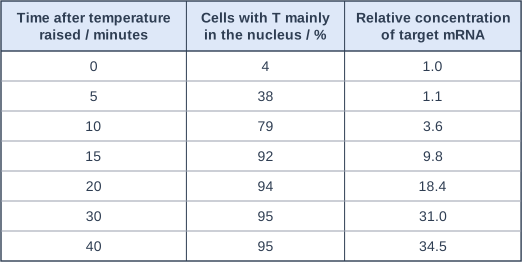
Scientists attached a fluorescent protein to T, so they could see where T was in each cell using a microscope. They raised the temperature of cultured cells from 37 °C to 42 °C at time 0. At intervals, they examined 200 cells and recorded the percentage of cells in which most of the fluorescence was in the nucleus. They also measured the concentration of mRNA transcribed from the target gene. The table shows their results.

Describe and explain the relationship between the location of T and the concentration of the target mRNA.

Suggest why the scientists examined 200 cells each time.

Table with columns "Time after temperature raised / minutes", "Cells with T mainly in the nucleus / %", "Relative concentration of target mRNA". Time after temperature raised / minutes: 0; Cells with T mainly in the nucleus / %: 4; Relative concentration of target mRNA: 1.0 | Time after temperature raised / minutes: 5; Cells with T mainly in the nucleus / %: 38; Relative concentration of target mRNA: 1.1 | Time after temperature raised / minutes: 10; Cells with T mainly in the nucleus / %: 79; Relative concentration of target mRNA: 3.6 | Time after temperature raised / minutes: 15; Cells with T mainly in the nucleus / %: 92; Relative concentration of target mRNA: 9.8 | Time after temperature raised / minutes: 20; Cells with T mainly in the nucleus / %: 94; Relative concentration of target mRNA: 18.4 | Time after temperature raised / minutes: 30; Cells with T mainly in the nucleus / %: 95; Relative concentration of target mRNA: 31.0 | Time after temperature raised / minutes: 40; Cells with T mainly in the nucleus / %: 95; Relative concentration of target mRNA: 34.5.

Model answer

The percentage of cells with T in the nucleus rises quickly, from 4% to 79% within 10 minutes, and levels off at about 95% after 20 minutes. The mRNA concentration hardly changes in the first 5 minutes, then rises steeply after 10 minutes and is still rising at 40 minutes. T must move into the nucleus before it can bind to the promoter of the target gene and stimulate RNA polymerase to transcribe it, so the mRNA increases only after T has entered the nucleus; transcription takes time and mRNA accumulates while T remains in the nucleus.

Examining 200 cells each time gives a percentage that is representative of the whole culture and reduces the effect of variation between individual cells.

Explanation

The data show the sequence of events: a transcription factor moves from the cytoplasm into the nucleus, binds to DNA and then transcription increases. A description should use values from both columns and point out the time lag; the explanation links the lag to the factor's need to reach the DNA. Large samples make percentages more reliable.

Mark scheme
  1. 1 mark

    T moves into the nucleus first and the mRNA concentration increases after a delay / lag, e.g. at 5 minutes T is mainly in the nucleus in 38% of cells but the mRNA concentration has hardly changed (1.1), and most of the increase in mRNA happens after 10 minutes

    Max 4. Points 1 to 4: max 3. Accept other correct use of the data, e.g. the percentage of cells with T in the nucleus levels off at 15 minutes, but the mRNA concentration keeps rising until 40 minutes.

  2. 1 mark

    T must enter the nucleus to bind to the promoter / DNA of the target gene

    Accept 'T cannot reach the DNA while it is in the cytoplasm'.

  3. 1 mark

    T stimulates RNA polymerase / transcription, so mRNA is produced

    Reject 'DNA polymerase' or 'translation'.

  4. 1 mark

    Transcription takes time / mRNA accumulates while T stays in the nucleus, so the mRNA concentration keeps rising after T levels off

  5. 1 mark

    So that the percentage is representative of the culture / to reduce the effect of variation between cells / anomalous cells

    Accept 'a large sample gives a more reliable / repeatable percentage'. Ignore 'to make it fair' or 'more accurate' unqualified.

Question 3

5 marks

Oestrogen is a steroid hormone. Describe how oestrogen stimulates the transcription of a target gene in a cell.

Model answer

Oestrogen is a lipid-soluble steroid, so it diffuses through the phospholipid bilayer of the cell-surface membrane into the cytoplasm. There it binds to a complementary site on a receptor, which is part of a transcription factor. Binding changes the shape of the transcription factor, so its DNA-binding site can now bind to DNA. The oestrogen-receptor complex moves into the nucleus through a nuclear pore and binds to the promoter of the target gene. This stimulates RNA polymerase to bind and transcribe the gene, producing mRNA.

Explanation

Transcription factors move from the cytoplasm into the nucleus and bind to specific base sequences near their target genes, stimulating or inhibiting transcription. Oestrogen activates such a factor: because it is lipid-soluble it can enter the cell, unlike protein hormones that bind to cell-surface receptors. Common errors are saying oestrogen binds to a receptor on the cell-surface membrane, or that oestrogen itself binds to the DNA.

Mark scheme
  1. 1 mark

    Oestrogen is lipid-soluble

    Max 5. Accept 'oestrogen is a lipid / steroid, so it can pass through the membrane'.

  2. 1 mark

    (So it) diffuses through the phospholipid bilayer (of the cell-surface membrane)

    Reject 'by active transport' or 'through a channel / carrier protein'.

  3. 1 mark

    (In the cytoplasm) oestrogen binds to a receptor (which is part of a transcription factor)

    Reject 'binds to a receptor on the cell-surface membrane'. Accept 'binds to a complementary site on the transcription factor'.

  4. 1 mark

    Binding changes the shape of the receptor / transcription factor (so it can bind to DNA) OR releases an inhibitor molecule from the transcription factor

  5. 1 mark

    The oestrogen-receptor complex / transcription factor moves into the nucleus (through a nuclear pore)

  6. 1 mark

    The transcription factor binds to the promoter / a specific base sequence (of DNA) near the target gene

    Accept 'binds to DNA' for this point only if the target gene is mentioned.

  7. 1 mark

    This stimulates / allows RNA polymerase to bind / transcription of the target gene (to form mRNA)

    Do not accept 'switches the gene on' alone. Reject 'DNA polymerase'.

Question 4

6 marks

Describe how the expression of a gene in a eukaryotic cell can be inhibited by changes affecting its transcription and by RNA interference.

Model answer

Transcription can be inhibited when a transcription factor moves into the nucleus and binds to the promoter of the gene, preventing RNA polymerase from binding; it is also prevented if an activating transcription factor does not enter the nucleus. Epigenetic changes can inhibit transcription: increased methylation of cytosine bases in the DNA prevents transcription factors binding and RNA polymerase being activated, and decreased acetylation of histones makes the DNA wind more tightly round them, so the chromatin is condensed and transcription factors and RNA polymerase cannot reach the gene.

In RNA interference, one strand of an siRNA or miRNA combines with proteins and binds to mRNA with a complementary base sequence. The mRNA is cut up or its translation by ribosomes is blocked, so the polypeptide is not made even though the gene is still being transcribed.

Explanation

Gene expression can be controlled at transcription (transcription factors, DNA methylation, histone acetylation) and after transcription (RNAi). Good answers name the molecule affected at each step and give the consequence, e.g. methylated DNA prevents transcription factors binding. The commonest errors are 'acetylation of DNA', 'methylation of histones' and saying RNAi acts on DNA.

Mark scheme
  1. 1 mark

    A transcription factor (moves into the nucleus and) binds to the promoter / DNA of the gene and prevents RNA polymerase binding

    Max 6. Accept 'an activating transcription factor does not enter the nucleus / is not available, so RNA polymerase is not stimulated'.

  2. 1 mark

    Increased methylation of the DNA / of cytosine bases (in the promoter)

    Reject 'methylation of histones' for this point.

  3. 1 mark

    Methylation prevents transcription factors binding / prevents RNA polymerase being activated

  4. 1 mark

    Decreased acetylation of histones

    Reject 'acetylation of DNA'.

  5. 1 mark

    (So) DNA is wound more tightly round histones / chromatin is more condensed, so transcription factors / RNA polymerase cannot reach the DNA

  6. 1 mark

    RNAi: (one strand of) siRNA / miRNA combines with a protein / enzyme (complex)

  7. 1 mark

    The siRNA / miRNA binds to mRNA with a complementary base sequence

    Reject 'binds to DNA / the gene'.

  8. 1 mark

    The mRNA is cut / hydrolysed / broken down OR translation (by ribosomes) is prevented

  9. 1 mark

    So the polypeptide is not made, even though the gene is transcribed

Ready to try the rest? Every answer you write is marked against the mark scheme, so you can see exactly where the marks are.

Study Helper Hints first, answers after you try

Stuck on this one? Ask for a hint and I’ll point you in the right direction, without giving the answer away. Once you’ve checked your answer, I’ll show you how the marks are awarded.