
Level:
Correct: 0
Incorrect: 0
Marks: 0/0
Exam Practice
Course:
Topics:
AQA A-Level Biology (Paper 2) Smart practice A mixed round aimed at your weak spots
Unit 5
Energy transfers in and between organisms
Unit 6
Organisms respond to changes in their internal and external environments
Stimuli, both internal and external, are detected and lead to a response
Survival and response
0%
Receptors
0%
Control of heart rate
0%
Skeletal muscles are stimulated to contract by nerves and act as effectors
Skeletal muscles and muscle contraction
0%
Unit 7
Genetics, populations, evolution and ecosystems
Unit 8
The control of gene expression
Alteration of the sequence of bases in DNA can alter the structure of proteins
Gene mutations and their effects on proteins
0%
Using genome projects
0%
Differences in DNA between individuals of the same species can be exploited
DNA probes, screening and genetic counselling
0%
Genetic fingerprinting
0%
Unit 9
Comprehension
Avg
score:
–
Topics
done:
0/34

Producing and amplifying DNA fragments

Practise 19 exam-style questions on Producing and amplifying DNA fragments for AQA A-Level Biology (Paper 2). Write your answer as you would in the exam and get it marked in seconds against the mark scheme, point by point, with the Study Helper on hand if you get stuck.

  • 19 questions
  • 1–8 marks each
  • Instant marking
  • No sign-up needed
19 questions, marked as you go

Sample questions with model answers

Here are 4 of the questions in this topic, each with a model answer, an explanation of why it earns the marks and the mark scheme an examiner would use.

Question 1

2 marks

Thaumatin is a protein that tastes about 2000 times sweeter than sucrose. It is made by a shrub that grows in West Africa. Scientists transferred the thaumatin gene from this shrub into tomato plants. The transgenic tomato plants produced thaumatin with exactly the same amino acid sequence as the shrub's thaumatin, and their fruits tasted sweeter.

Explain why tomato plant cells were able to produce thaumatin with the same amino acid sequence as the shrub's thaumatin.

Model answer

The genetic code is universal, so each DNA triplet in the shrub's gene codes for the same amino acid in tomato as it does in the shrub. Transcription and translation are also universal: tomato RNA polymerase transcribes the gene into mRNA, and tomato ribosomes and tRNA molecules translate this mRNA, giving the same sequence of amino acids.

Explanation

Recombinant DNA technology works because all organisms use the same genetic code and the same mechanisms of transcription and translation, so a gene transferred into another species can be expressed in the recipient (transgenic) organism. A full answer makes both points: the code (which triplet means which amino acid) and the cell machinery that reads it. 'They have the same DNA' is wrong: the shrub and the tomato have different genomes.

Mark scheme
  1. 1 mark

    The genetic code is universal / the same triplets (codons) code for the same amino acids in the shrub and in tomato

    Accept 'the genetic code is the same in all organisms'. Insufficient: 'they have the same DNA', 'DNA is universal' or 'the gene is the same' (the two species have different genomes). Ignore references to the code being degenerate or non-overlapping.

  2. 1 mark

    Transcription and translation (mechanisms) are universal OR tomato cells transcribe the gene and translate the mRNA in the same way as the shrub's cells (e.g. tomato RNA polymerase, ribosomes and tRNA can read it)

    Accept 'protein synthesis is the same in all organisms' for this point. Ignore references to promoters.
Question 2

3 marks

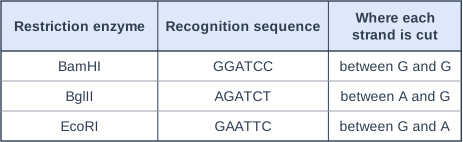
The table shows the recognition sequences of three restriction enzymes and where each enzyme cuts each strand of DNA. All three recognition sequences are palindromic.

Scientists cut out a gene using BglII. They found that the gene fragment could be joined to a plasmid cut with BamHI, but not to a plasmid cut with EcoRI.

Use the information in the table to explain these results.

Table with columns "Restriction enzyme", "Recognition sequence", "Where each strand is cut". Restriction enzyme: BamHI; Recognition sequence: GGATCC; Where each strand is cut: between G and G | Restriction enzyme: BglII; Recognition sequence: AGATCT; Where each strand is cut: between A and G | Restriction enzyme: EcoRI; Recognition sequence: GAATTC; Where each strand is cut: between G and A.

Model answer

BglII cuts A/GATCT and BamHI cuts G/GATCC, so both leave sticky ends with the same four unpaired bases, GATC. The sticky ends of the gene fragment and of the BamHI-cut plasmid are therefore complementary and can form hydrogen bonds between their bases.

EcoRI cuts G/AATTC, leaving unpaired bases AATT. These are not complementary to GATC, so the gene fragment cannot pair with this plasmid.

Explanation

The unpaired bases left by a staggered cut are the bases between the two cut positions, here the middle four bases of each recognition sequence: GATC for both BamHI and BglII, but AATT for EcoRI. Fragments can only be joined if their sticky ends are complementary, so two different enzymes can produce compatible ends. 'Both make sticky ends' is not enough, because EcoRI makes sticky ends too.

Mark scheme
  1. 1 mark

    BglII and BamHI produce the same sticky ends / both leave the unpaired bases GATC

    Accept CTAG for GATC (the same sticky end read on the other strand). Insufficient: 'both produce sticky ends' (EcoRI does too).

  2. 1 mark

    So the sticky ends of the gene fragment and the plasmid are complementary / can form base pairs / hydrogen bonds

    Ignore references to DNA ligase.

  3. 1 mark

    EcoRI produces different sticky ends, AATT, which are not complementary to GATC (the BglII sticky ends)

    Accept TTAA for AATT. Insufficient: 'EcoRI has a different recognition sequence' with no reference to the sticky ends.

Question 3

3 marks

PCR normally uses two different primers. A student set up a PCR but added only one of the two primers. All the other reagents were correct. The reaction mixture contained 1000 molecules of double-stranded target DNA.

After 20 cycles, the student found that only about 20 000 new single strands of the target DNA had been made, far fewer than expected.

Explain why.

Model answer

The primer is complementary to a sequence on only one of the two strands of the target DNA, so in each cycle only that strand of each original molecule is copied. The new strands are complementary to the template strand, so they have the same base sequence as the primer; the primer cannot bind to them and they are never copied. The number therefore increases by only about 1000 new strands per cycle (1000 × 20 = 20 000 after 20 cycles) instead of doubling in every cycle.

Explanation

The two strands of DNA are complementary, not identical, so a primer that binds to one strand cannot bind to the other. With two primers, every new strand can be a template in the next cycle, so the number of molecules doubles in each cycle. With one primer only the original strands act as templates, so the increase is linear rather than exponential.

Mark scheme
  1. 1 mark

    The primer is complementary to (the end of) only one of the two strands / binds to only one strand

    Max 3.

  2. 1 mark

    So only one strand of each original molecule is copied in each cycle

    Accept 'only the original template strands are copied'.

  3. 1 mark

    The new strands are not complementary to the primer / have the same base sequence as the primer, so the primer cannot bind to them and they are not copied

    Accept 'the new strands cannot act as templates'.

  4. 1 mark

    So the number increases by only about 1000 strands per cycle (1000 × 20 = 20 000) instead of doubling each cycle

    Accept 'linear increase, not exponential' or 'one new strand per original molecule per cycle'.

Question 4

6 marks

Scientists wanted to produce many copies of the gene for an enzyme found in the leaves of a plant. They extracted mRNA for the enzyme from leaf cells.

Describe how the scientists could use this mRNA to produce many copies of double-stranded DNA of the gene.

Model answer

Reverse transcriptase is added to the mRNA with free DNA nucleotides. It makes a single strand of cDNA that is complementary to the mRNA (for example, thymine pairs with adenine in the mRNA). The mRNA is then removed, and DNA polymerase makes a complementary second strand, giving double-stranded cDNA.

The cDNA is amplified by PCR. It is mixed with two primers, free DNA nucleotides and a thermostable DNA polymerase (Taq polymerase). The mixture is heated to 95 °C to break the hydrogen bonds and separate the strands. It is cooled to about 55 °C so that the primers bind to complementary sequences at the ends of each strand. It is then heated to 72 °C, when DNA polymerase joins nucleotides to the primers, forming new complementary strands. This cycle is repeated many times, and the number of DNA molecules doubles in each cycle.

Explanation

The answer has two stages: making cDNA (reverse transcriptase makes a DNA copy of the RNA, then DNA polymerase makes it double-stranded) and amplifying it by PCR. For PCR, give each temperature with its purpose: separating strands, primers binding, and DNA polymerase building new strands. Common errors are naming RNA polymerase or 'polymerase' alone, missing out the nucleotides, and saying that DNA polymerase forms hydrogen bonds.

Mark scheme
  1. 1 mark

    Reverse transcriptase (and DNA nucleotides) used to make (single-stranded) cDNA from the mRNA

    Max 6. Reject 'reverse transcriptase makes mRNA from DNA'.

  2. 1 mark

    cDNA is complementary to the mRNA (by base pairing, e.g. adenine in mRNA with thymine)

  3. 1 mark

    DNA polymerase makes the second (complementary) strand, giving double-stranded cDNA

    Accept 'the mRNA is removed / hydrolysed and DNA polymerase copies the cDNA'.

  4. 1 mark

    (PCR mixture contains the cDNA and) primers, (DNA) nucleotides and (thermostable / Taq) DNA polymerase

    All three needed for this point. Accept Taq polymerase for DNA polymerase.

  5. 1 mark

    Heat to 95 °C to break hydrogen bonds / separate the strands

    Accept a temperature from 90 to 95 °C.

  6. 1 mark

    Cool to about 55 °C so that primers bind / anneal (to complementary bases at the ends of each strand)

    Accept a temperature from 40 to 65 °C.

  7. 1 mark

    Heat to 72 °C so that DNA polymerase joins (complementary) nucleotides to form new strands

    Accept a temperature from 70 to 75 °C. Accept 'forms phosphodiester bonds'. Reject 'DNA polymerase forms hydrogen bonds between bases'.

  8. 1 mark

    The cycle is repeated (many times) and the number of DNA molecules doubles in each cycle

    Accept 'copies increase exponentially / 2ⁿ'.

Ready to try the rest? Every answer you write is marked against the mark scheme, so you can see exactly where the marks are.

Study Helper Hints first, answers after you try

Stuck on this one? Ask for a hint and I’ll point you in the right direction, without giving the answer away. Once you’ve checked your answer, I’ll show you how the marks are awarded.