
Level:
Correct: 0
Incorrect: 0
Marks: 0/0
Exam Practice
Course:
Topics:
AQA A-Level Biology (Paper 2) Smart practice A mixed round aimed at your weak spots
Unit 5
Energy transfers in and between organisms
Unit 6
Organisms respond to changes in their internal and external environments
Stimuli, both internal and external, are detected and lead to a response
Survival and response
0%
Receptors
0%
Control of heart rate
0%
Skeletal muscles are stimulated to contract by nerves and act as effectors
Skeletal muscles and muscle contraction
0%
Unit 7
Genetics, populations, evolution and ecosystems
Unit 8
The control of gene expression
Alteration of the sequence of bases in DNA can alter the structure of proteins
Gene mutations and their effects on proteins
0%
Using genome projects
0%
Differences in DNA between individuals of the same species can be exploited
DNA probes, screening and genetic counselling
0%
Genetic fingerprinting
0%
Unit 9
Comprehension
Avg
score:
–
Topics
done:
0/34

Control of blood water potential

Practise 18 exam-style questions on Control of blood water potential for AQA A-Level Biology (Paper 2). Write your answer as you would in the exam and get it marked in seconds against the mark scheme, point by point, with the Study Helper on hand if you get stuck.

  • 18 questions
  • 1–8 marks each
  • Instant marking
  • No sign-up needed
18 questions, marked as you go

Sample questions with model answers

Here are 4 of the questions in this topic, each with a model answer, an explanation of why it earns the marks and the mark scheme an examiner would use.

Question 1

2 marks

Explain why the control of the water potential of the blood by ADH is an example of negative feedback.

Model answer

If the water potential of the blood falls, more ADH is secreted, so more water is reabsorbed in the kidneys and the water potential rises back to normal. If the water potential rises, less ADH is secreted, so less water is reabsorbed and more is lost in the urine, and the water potential falls back to normal. In each case the response reverses the change.

Explanation

Negative feedback means that a change causes a response that restores the original level. ADH secretion rises when the blood becomes too concentrated and falls when it becomes too dilute, so the water potential of the blood is kept within narrow limits. Describe both directions to show the idea fully.

Mark scheme
  1. 1 mark

    A fall in the water potential of the blood causes more ADH to be secreted, so more water is reabsorbed and the water potential rises back to normal

    Each point needs the change, the response and the return to normal. Accept the symbol Ψ for water potential, and 'more negative' / 'less negative' for lower / higher water potential.

  2. 1 mark

    A rise in the water potential of the blood causes less ADH to be secreted, so less water is reabsorbed and the water potential falls back to normal

    Accept 'the response reverses the change in water potential' for one mark if neither direction is described in full.
Question 2

3 marks

The walls of the ascending limb of the loop of Henle are normally impermeable to water.

Suggest and explain how the concentration of the urine would be affected if the walls of the ascending limb were permeable to water.

Model answer

Water would leave the ascending limb by osmosis along with the sodium ions pumped out of it, so the tissue fluid of the medulla would be diluted: its sodium ion concentration would not rise as much and its water potential would not be lowered as much. The water potential gradient between the collecting duct and the medulla would be smaller, so less water would leave the collecting duct by osmosis, and the urine would be more dilute.

Explanation

The impermeability of the ascending limb is essential: it lets sodium ions leave without water, so the medulla becomes concentrated. Without it, the medulla could not have a low water potential, and the collecting duct could not reabsorb much water. Predictions like this test whether you understand why each part of the nephron has its particular properties.

Mark scheme
  1. 1 mark

    Water would leave the ascending limb by osmosis (following the sodium ions pumped out)

    Max 3.

  2. 1 mark

    So the sodium ion concentration of the tissue fluid in the medulla would not rise as much / the water potential of the medulla would not be lowered as much / the gradient would not be maintained

    Accept the symbol Ψ for water potential, and 'more negative' / 'less negative' for lower / higher water potential.

  3. 1 mark

    So less water would leave the collecting duct by osmosis

    Reject 'more water would be reabsorbed'.

  4. 1 mark

    So the urine would be less concentrated / more dilute (and a larger volume would be produced)

    The effect on urine concentration is needed for this mark.

Question 3

5 marks

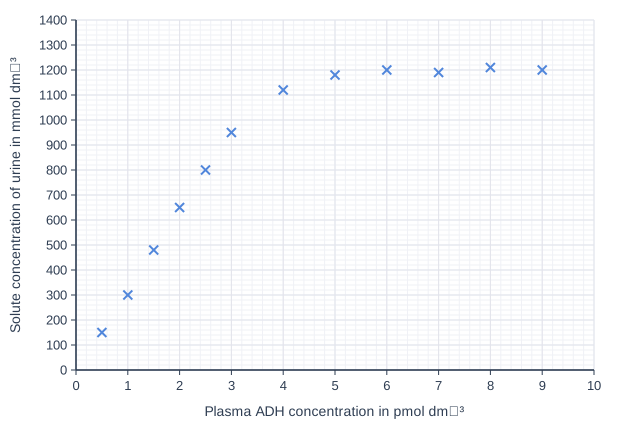
Scientists measured the concentration of ADH in the blood plasma and the solute concentration of the urine of volunteers who had drunk different volumes of water. The graph shows their results.

The scientists concluded that the solute concentration of the urine is directly proportional to the plasma ADH concentration. Use the graph to evaluate this conclusion.

Explain why the solute concentration of the urine increases as the ADH concentration increases, and suggest why it does not rise above about 1200 mmol dm⁻³.

Line graph of solute concentration of urine in mmol dm⁻³ (y-axis, 0 to 1400) against Plasma ADH concentration in pmol dm⁻³ (x-axis, 0 to 10). The line is shown as plotted points only (no line), at (0.5, 150), (1, 300), (1.5, 480), (2, 650), (2.5, 800), (3, 950), (4, 1120), (5, 1180), (6, 1200), (7, 1190), (8, 1210), (9, 1200).

Model answer

The conclusion is only partly supported. Up to about 3 pmol dm⁻³ the solute concentration of the urine rises roughly in proportion to the ADH concentration: about 300 mmol dm⁻³ for each 1 pmol dm⁻³ (300 at 1 and 950 at 3 pmol dm⁻³). Above about 5 pmol dm⁻³, however, it levels off at about 1200 mmol dm⁻³ (1180 at 5 and 1200 at 9 pmol dm⁻³), so it is not directly proportional over the whole range.

More ADH causes more aquaporins to be inserted into the membranes of the collecting duct cells, so they become more permeable to water and more water leaves the collecting duct by osmosis into the medulla, leaving a smaller volume of more concentrated urine. The urine cannot become more concentrated than the tissue fluid deep in the medulla, because once their water potentials are equal there is no water potential gradient and no more water leaves by osmosis.

Explanation

To evaluate 'directly proportional', check whether the values rise by the same amount for each step in ADH and whether this holds over the whole range: here it holds only at low ADH concentrations. ADH controls how permeable the collecting duct is, but the loop of Henle sets how far water can move: water leaves the collecting duct only while the medulla has a lower water potential than the urine, so the maximum concentration of urine depends on the sodium ion gradient in the medulla.

Mark scheme
  1. 1 mark

    Supports: up to about 3 pmol dm⁻³ the urine concentration rises roughly in proportion to the ADH concentration, e.g. 300 mmol dm⁻³ at 1 and 950 at 3 pmol dm⁻³ / about 300 mmol dm⁻³ for each 1 pmol dm⁻³

    Max 4 if the answer does not use any values from the graph. Max 5. Points 1 and 2 evaluate the conclusion; points 3 to 6 explain the pattern, max 3 from points 3 to 6. Accept readings within ±20 mmol dm⁻³. Accept 'linear' for 'in proportion' only if values are used.

  2. 1 mark

    Against: above about 4 to 5 pmol dm⁻³ the urine concentration levels off at about 1200 mmol dm⁻³, so it is not proportional over the whole range

    Accept values showing the plateau, e.g. 1180 at 5 and 1200 at 9 pmol dm⁻³.

  3. 1 mark

    More ADH causes more aquaporins / water channel proteins to be inserted into the membranes of collecting duct (and distal convoluted tubule) cells, making them more permeable to water

    Accept 'ADH binds to receptors and vesicles containing aquaporins fuse with the membrane'. Ignore the abbreviations PCT and DCT here (naming the part is not the mark).

  4. 1 mark

    So more water leaves the collecting duct by osmosis (into the medulla / blood), leaving a smaller volume of more concentrated urine

    Reject 'water is actively transported'. Reject 'more solutes are added to the urine'.

  5. 1 mark

    Urine cannot become more concentrated than the tissue fluid deep in the medulla: once their water potentials are equal there is no gradient, so no more water leaves by osmosis

    Accept 'the maximum concentration is set by the sodium ion gradient produced by the loop of Henle'. Accept the symbol Ψ for water potential, and 'more negative' / 'less negative' for lower / higher water potential.

  6. 1 mark

    At high ADH concentrations the collecting duct cells already have the maximum number of aquaporins / are fully permeable to water

    Accept 'all the ADH receptors are occupied'.

Question 4

7 marks

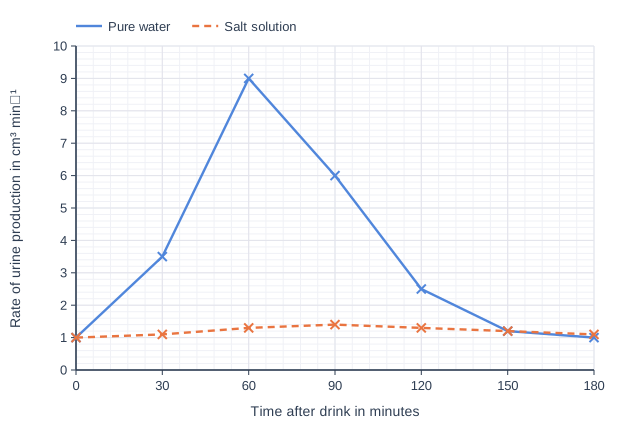
Volunteers drank 1 dm³ of either pure water or a salt solution with the same water potential as blood plasma. The graph shows their mean rate of urine production after each drink.

Explain the difference between the effects of the two drinks on the rate of urine production.

A company that sells the salt solution says that these results show that its drink 'rehydrates you better than water'. Evaluate this claim.

Line graph of rate of urine production in cm³ min⁻¹ (y-axis, 0 to 10) against time after drink in minutes (x-axis, 0 to 180). "Pure water" joins the points (0, 1), (30, 3.5), (60, 9), (90, 6), (120, 2.5), (150, 1.2), (180, 1). "Salt solution" (dashed) joins the points (0, 1), (30, 1.1), (60, 1.3), (90, 1.4), (120, 1.3), (150, 1.2), (180, 1.1).

Model answer

After drinking water, the rate of urine production rose to a peak of 9.0 cm³ min⁻¹ at 60 minutes and returned to about 1.0 cm³ min⁻¹ by 180 minutes, but after the salt solution it stayed between 1.0 and 1.4 cm³ min⁻¹. The water was absorbed into the blood and raised its water potential, which was detected by osmoreceptors in the hypothalamus. Less ADH was released from the posterior pituitary, so fewer aquaporins were inserted into the membranes of collecting duct cells, less water was reabsorbed by osmosis, and a large volume of dilute urine was produced. The salt solution had the same water potential as the blood, so ADH secretion did not change.

The results support the claim in that much less of the salt solution was lost as urine. However, the volunteers were not dehydrated, so rehydration after sweating was not tested; there is no information about the number of volunteers or the variation in results, and only 3 hours were measured. The company may also be biased.

Explanation

Drinking water raises the water potential of the blood, so less ADH is released and the excess water is excreted: this is negative feedback. A drink with the same water potential as plasma does not trigger this response. When evaluating a claim, check whether the experiment actually tested what is claimed, how reliable the data are, and who is making the claim.

Mark scheme
  1. 1 mark

    After water, the rate rose to a peak of 9.0 cm³ min⁻¹ at 60 minutes and returned to about 1.0 by 180 minutes, whereas after the salt solution it stayed between 1.0 and 1.4 cm³ min⁻¹

    Max 7. Points 1 to 6: max 4. Points 7 to 12: max 3. Accept readings within ±0.2 cm³ min⁻¹.

  2. 1 mark

    Water is absorbed into the blood and raises its water potential (makes it less negative), which is detected by osmoreceptors in the hypothalamus

    Accept the symbol Ψ for water potential, and 'more negative' / 'less negative' for lower / higher water potential. Both the change in water potential and the hypothalamus (or osmoreceptors) are needed.

  3. 1 mark

    Less ADH is released from the posterior pituitary

    Accept 'secreted' for released. Insufficient: 'pituitary' without 'posterior'.

  4. 1 mark

    So fewer aquaporins / channel proteins are inserted into the membranes of cells of the collecting duct (and distal convoluted tubule), so they are less permeable to water

    Ignore the abbreviations PCT and DCT here (naming the part is not the mark).

  5. 1 mark

    So less water is reabsorbed by osmosis, giving a large volume of dilute urine

  6. 1 mark

    The salt solution does not change the water potential of the blood, so ADH secretion and urine production stay the same

    Accept 'osmoreceptors are not stimulated'.

  7. 1 mark

    Supports the claim: after the salt solution much less urine was produced, so more of the drink stayed in the body

  8. 1 mark

    The volunteers were not dehydrated, so the test does not show rehydration after water loss (e.g. sweating) / when dehydrated, more of a water drink might be retained

    Accept 'rehydration was not measured'.

  9. 1 mark

    No information on the number of volunteers / repeats / variation in the results (e.g. standard deviations), so we cannot tell whether the difference is significant

    Any one of these ideas about the reliability of the data scores this mark.

  10. 1 mark

    Urine was measured for only 3 hours, so longer-term effects are not known

  11. 1 mark

    The company may be biased because it sells the drink

  12. 1 mark

    The salt solution adds extra salt (sodium ions) to the diet, which may be harmful

Ready to try the rest? Every answer you write is marked against the mark scheme, so you can see exactly where the marks are.

Study Helper Hints first, answers after you try

Stuck on this one? Ask for a hint and I’ll point you in the right direction, without giving the answer away. Once you’ve checked your answer, I’ll show you how the marks are awarded.