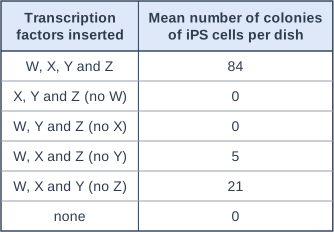
Scientists used viruses to insert genes for four different transcription factors, W, X, Y and Z, into mouse skin cells (fibroblasts) in different combinations. Each dish contained 2.0 × 10⁵ fibroblasts. After three weeks, they counted the colonies of induced pluripotent stem cells (iPS cells) in each dish. Each colony grew from one fibroblast that had been reprogrammed. The table shows the mean number of colonies per dish.
Calculate the percentage of fibroblasts that were reprogrammed when all four transcription factors were inserted. Give your answer in standard form.
What can you conclude about the importance of each transcription factor in producing iPS cells?
Transcription factor Z also stimulates cell division and is found at high concentrations in some tumours. Suggest one advantage and one disadvantage of producing iPS cells for treating patients without transcription factor Z.
Explain why the scientists included dishes in which no genes were inserted.
Model answer
Percentage = 84 ÷ (2.0 × 10⁵) × 100 = 0.042% = 4.2 × 10⁻² %
W and X are essential: no colonies formed without either of them. Y is not essential but is needed for efficient reprogramming: only 5 colonies formed without it. Z is not essential but increases the number of iPS cells about four times (21 colonies without Z, 84 with all four). All four factors together gave the most iPS cells.
Without Z: the advantage is a lower risk that the iPS cells, or cells made from them, divide uncontrollably and form a tumour; the disadvantage is that only about a quarter as many iPS cells are produced, so reprogramming is less efficient.
The dishes with no inserted genes are a control: they show that fibroblasts do not form iPS colonies on their own, so the colonies were caused by the transcription factors.
Explanation
iPS cells are made from adult somatic cells using particular protein transcription factors, which switch on the genes needed for pluripotency. Reading the table factor by factor (what happens when each one is left out) shows which are essential and which only increase efficiency. In the calculation, divide by the number of fibroblasts and multiply by 100 to get a percentage. Factors that stimulate cell division raise the risk of tumours, which is one reason why pluripotent cells must be used with care in treatment.