Practise 30 questions on Volume, cubes and cuboids for 11+ Maths. Tap your answer and find out straight away if you are right, with the Study Helper on hand if you get stuck.
30 questions
1–2 marks each
Instant marking
No sign-up needed
20 questions, marked as you go
Sample questions with model answers
Here are 4 of the questions in this topic, each with a model answer, an explanation of why it earns the marks and the mark scheme.
Question 1
1 mark
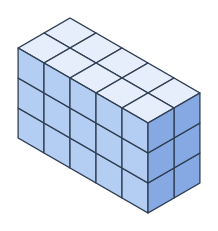
Jamal builds this cuboid from cubes, with no gaps inside it.
How many cubes does he use?
Model answer
The cuboid is 5 cubes long, 2 cubes wide and 3 cubes high. \(5 \times 2 \times 3 = 30\)
Answer: 30
Explanation
Each layer is 5 cubes long and 2 cubes wide, so it has 10 cubes, and there are 3 layers: 10 × 3 = 30 cubes. Some cubes are hidden at the back, but they are still there. A common mistake is to count only the cubes you can see.
Mark scheme
1 mark
30
Only 30. 10: counts only the top layer. 15: counts only the cubes on the front face. 22: counts only the cubes that can be seen. 31: adds the cubes on the three faces that can be seen (15 + 10 + 6), so counts the cubes along the edges more than once.
Question 2
1 mark
A cube has edges of 5 cm.
What is the total surface area of the cube?
Model answer
Each face is a square: \(5 \times 5 = 25\) cm² A cube has 6 faces: \(6 \times 25 = 150\) cm²
Answer: 150 cm²
Explanation
The surface area is the total area of all the faces. A cube has 6 identical square faces, each 5 × 5 = 25 cm², so the surface area is 6 × 25 = 150 cm². A common mistake is to work out the volume, 125 cm³, which measures the space inside, not the outside.
Mark scheme
1 mark
150 cm²
Only 150 cm². 25 cm²: gives the area of one face only. 60 cm²: adds the lengths of the 12 edges. 100 cm²: counts only 4 faces. 125 cm²: works out the volume (5 × 5 × 5) instead of the surface area.
Question 3
1 mark
A glass vase is a cuboid 10 cm long, 10 cm wide and 25 cm tall. Water is poured in until it is 12 cm deep. 1 cm³ holds 1 ml.
How much water is in the vase?
Model answer
The water is a cuboid 10 cm by 10 cm by 12 cm. \(10 \times 10 \times 12 = 1{,}200\) cm³ \(= 1{,}200\) ml
Answer: 1,200 ml
Explanation
Only the part with water in it counts: a cuboid 10 cm by 10 cm by 12 cm deep. Its volume is 100 × 12 = 1,200 cm³, which holds 1,200 ml. A common mistake is to use the full height of the vase, 25 cm.
Mark scheme
1 mark
1,200 ml
Only 1,200 ml. 120 ml: multiplies only one 10 by 12. 1,300 ml: works out the empty space above the water (25 − 12 = 13 cm). 2,500 ml: works out how much the full vase holds. 12,000 ml: multiplies by 10 too many times.
Question 4
2 marks
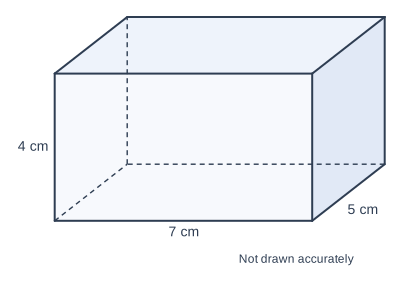
The diagram shows a closed box shaped like a cuboid.
What is the volume of the box? What is its total surface area?
The volume is length × width × height: 140 cm³. For the surface area, a cuboid has three pairs of matching faces: top and bottom (35 cm² each), front and back (28 cm² each) and the two ends (20 cm² each). Adding all six gives 166 cm². A common mistake is to add only one face from each pair.
Mark scheme
1 mark
140 cm³
Do not accept 16 (the lengths added) or 35 (the base only).
1 mark
166 cm²
Do not accept 83 (only three faces, one of each pair) or 140 (the volume).
Ready to try the rest? Tap your answers and see straight away how you did.
Ctrl + Enter to check
Study HelperHints first, answers after you try
Stuck on this one? Ask for a hint and I’ll point you in the right direction, without giving the answer away. Once you’ve checked your answer, I’ll show you how the marks are awarded.