Level:
Correct: 0
Incorrect: 0
Marks: 0/0
Practice
Course:
Topics:
11+ Maths Smart practice A mixed round aimed at your weak spots
Unit 1
Number and place value
Unit 2
Calculation
Unit 3
Factors, multiples and primes
Unit 4
Fractions, decimals and percentages
Unit 5
Ratio and proportion
Unit 6
Algebra
Unit 7
Measures, time and money
Unit 8
Shape and angles
Unit 9
Area, perimeter and volume
Unit 10
Position and direction
Unit 11
Statistics
Unit 12
Probability
Unit 13
Problem solving
Avg
score:
–
Topics
done:
0/71

Angles in quadrilaterals and polygons

Practise 30 questions on Angles in quadrilaterals and polygons for 11+ Maths. Tap your answer and find out straight away if you are right, with the Study Helper on hand if you get stuck.

  • 30 questions
  • 1–2 marks each
  • Instant marking
  • No sign-up needed
20 questions, marked as you go

Sample questions with model answers

Here are 4 of the questions in this topic, each with a model answer, an explanation of why it earns the marks and the mark scheme.

Question 1

1 mark

The diagram shows a kite ABCD. The angles at B and D are equal.

What is the size of angle \(x\)?
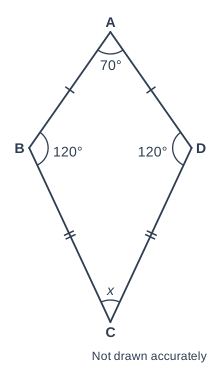
Geometry diagram, marked "Not drawn accurately". Kite ABCD. Angle DAB is marked 70°. Angle ABC is marked 120°. Angle CDA is marked 120°. Angle BCD is marked x. AB and AD are each marked with one short dash (equal lengths). CB and CD are each marked with two short dashes (equal lengths).

Model answer

The angles of a quadrilateral add up to \(360^\circ\).
\(70 + 120 + 120 = 310\)
\(x = 360 - 310 = 50\)

Answer: \(50^\circ\)

Explanation

A kite is a quadrilateral, so its angles add up to 360 degrees. The angles at B and D are both 120 degrees, so with the 70 degree angle they make 310 degrees, leaving 50 degrees for x. A common mistake is to count the 120 degree angle only once.

Mark scheme
  1. 1 mark

    \(50^\circ\)

    Only \(50^\circ\). \(70^\circ\): thinks x is equal to the angle at A. \(120^\circ\): thinks all the angles of a kite except one are equal. \(170^\circ\): uses only one of the 120° angles. \(310^\circ\): adds the three angles and stops.
Question 2

1 mark

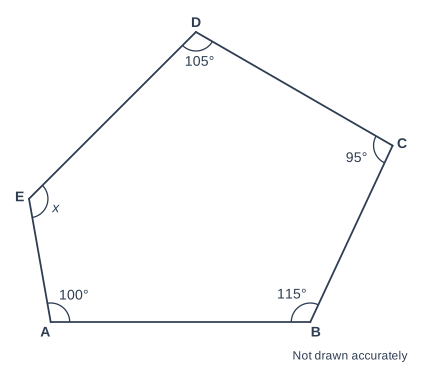
The diagram shows the shape of a garden pond. It is a pentagon.

The angles inside a pentagon add up to \(540^\circ\).

What is the size of angle \(x\), in degrees?

Geometry diagram, marked "Not drawn accurately". Pentagon ABCDE. Angle EAB is marked 100°. Angle ABC is marked 115°. Angle BCD is marked 95°. Angle CDE is marked 105°. Angle DEA is marked x.

Model answer

\(100 + 115 + 95 + 105 = 415\)
\(x = 540 - 415 = 125\)

Answer: 125 °

Explanation

The five angles of the pentagon add up to 540 degrees. Add the four you know, 415 degrees, and take the total from 540 to get 125 degrees. A common mistake is to use 360 degrees, which is the total for a quadrilateral.

Mark scheme
  1. 1 mark

    125 °

    Accept 125 with or without the degree sign. Do not accept 415 (the four angles added) or 55 (415 − 360, using 360°).

Question 3

1 mark

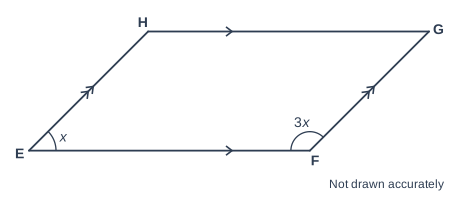
The diagram shows a parallelogram EFGH. Two of its angles are marked \(x\) and \(3x\).

What is the value of \(x\)?

Geometry diagram, marked "Not drawn accurately". Parallelogram EFGH. Angle HEF is marked x. Angle EFG is marked 3x. EF and HG are each marked with an arrowhead (parallel lines). EH and FG are each marked with two arrowheads (parallel lines).

Model answer

The angles of a parallelogram are \(x, 3x, x, 3x\), which add up to \(360^\circ\).
\(8x = 360\), so \(x = 45\).
(Or: angles next to each other add up to \(180^\circ\), so \(4x = 180\).)

Answer: \(45^\circ\)

Explanation

Opposite angles of a parallelogram are equal, so the four angles are x, 3x, x and 3x. They make 8 lots of x, which is 360 degrees, so x = 45. Then the angles are 45 and 135 degrees. A common mistake is to give 135, the size of the angle 3x.

Mark scheme
  1. 1 mark

    \(45^\circ\)

    Only \(45^\circ\). \(30^\circ\): thinks all four angles are equal and each is 3x: 12x = 360. \(60^\circ\): divides 180 by 3 instead of by 4. \(90^\circ\): shares 360° in 4 parts, one for each angle. \(135^\circ\): gives the size of the angle 3x.

Question 4

2 marks

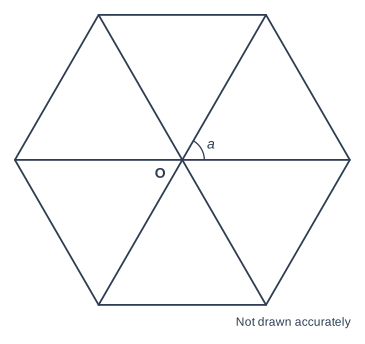
The diagram shows a regular hexagon. Lines from its centre O to each corner split it into 6 identical triangles.

What is the angle \(a\) at the centre of each triangle? What is the size of each interior angle of the hexagon, the whole angle at each corner?

Geometry diagram, marked "Not drawn accurately". A regular hexagon (its vertices are not labelled). A line is drawn from O going to the right. A line is drawn from O going up and to the right. A line is drawn from O going up and to the left. A line is drawn from O going to the left. A line is drawn from O going down and to the left. A line is drawn from O going down and to the right. The angle at O between the line going to the right from O and the line going up and to the right from O is marked a.

Model answer

The 6 angles at the centre make \(360^\circ\): \(a = 360 \div 6 = 60\).
Each triangle is isosceles (two sides go from the centre to a corner), so its other angles are \((180 - 60) \div 2 = 60\): the triangles are equilateral.
Each corner of the hexagon is made of two of these angles: \(60 + 60 = 120^\circ\).

Answer: Angle a (degrees): 60 °
Each interior angle (degrees): 120 °

Explanation

The angles at the centre share 360 degrees equally, so each is 60 degrees. The triangles have two equal sides, so their other two angles are also 60 degrees, and each corner of the hexagon is made from two of them: 120 degrees. A common mistake is to give 60 degrees for the hexagon's angle too.

Mark scheme
  1. 1 mark

    60 °

    Accept 60 with or without the degree sign. Do not accept 30 or 120.

  2. 1 mark

    120 °

    Accept 120 with or without the degree sign. Do not accept 60 or 720.

Ready to try the rest? Tap your answers and see straight away how you did.

Study Helper Hints first, answers after you try

Stuck on this one? Ask for a hint and I’ll point you in the right direction, without giving the answer away. Once you’ve checked your answer, I’ll show you how the marks are awarded.