Practise 25 questions on Scale drawings, maps and scale factors for 11+ Maths. Tap your answer and find out straight away if you are right, with the Study Helper on hand if you get stuck.
25 questions
1–3 marks each
Instant marking
No sign-up needed
20 questions, marked as you go
Sample questions with model answers
Here are 4 of the questions in this topic, each with a model answer, an explanation of why it earns the marks and the mark scheme.
Question 1
1 mark
A drawing of a leaf is 5 cm long. A poster shows the same leaf enlarged to 35 cm long.
What is the scale factor of the enlargement?
Model answer
Scale factor = new length ÷ old length. \(35 \div 5 = 7\)
Answer: 7
Explanation
The scale factor tells you how many times longer the new length is. 35 cm is 7 times 5 cm, so the scale factor is 7. A common mistake is to find the difference, 30 cm, instead.
Mark scheme
1 mark
7
Only 7. 6: counts in fives from 5 cm to 35 cm and counts 6 jumps, instead of 7 lots of 5. 30: finds the difference between the lengths, not how many times bigger. 40: adds the two lengths. 175: multiplies the two lengths.
Question 2
1 mark
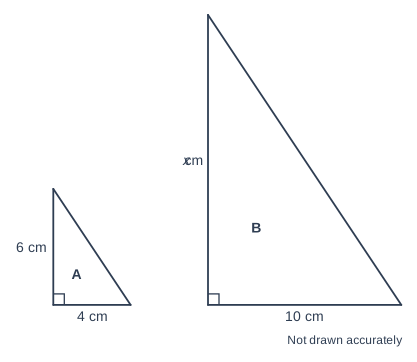
Triangle B is an enlargement of triangle A. Both triangles have a right angle.
Use the two bases to find the scale factor: 10 cm is 2.5 times 4 cm. The height of B is 2.5 times the height of A: \(6 \times 2.5 = 15\) cm. A common mistake is to add 6 cm because the base grew by 6 cm.
Mark scheme
1 mark
15 cm
Only 15 cm. 8.5 cm: finds the scale factor, 2.5, then adds it to 6 cm instead of multiplying. 12 cm: adds 6 cm, the amount the base grew by. 18 cm: rounds the scale factor 2.5 up to 3. 60 cm: uses the base of triangle B, 10 cm, as the scale factor, so multiplies 6 by 10.
Question 3
1 mark
A model aeroplane is \(\dfrac{1}{25}\) of the size of the real aeroplane. The real aeroplane has a wingspan of 30 m.
What is the wingspan of the model, in centimetres?
Model answer
30 m = 3,000 cm. \(3{,}000 \div 25 = 120\) cm.
Answer: 120 cm
Explanation
Change the real wingspan into centimetres first: 30 m is 3,000 cm. The model is one twenty-fifth of the size, so divide by 25. A common mistake is to divide 30 by 25 and forget to change metres into centimetres.
Mark scheme
1 mark
120 cm
Accept 120 or 120 cm. Do not accept 12 (uses 1 m = 10 cm, so 300 ÷ 25) or 750 (30 × 25).
Question 4
1 mark
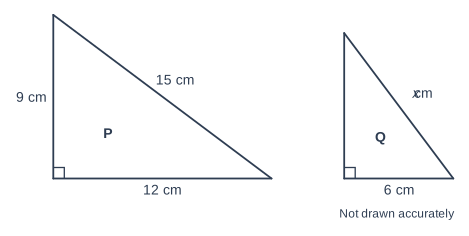
The diagram shows triangle P and triangle Q. Triangle Q is a smaller copy of triangle P that has been flipped over, so the two triangles are the same shape but their sides are in different places. The 6 cm side is the shortest side of triangle Q.
What is the length marked \(x\)?
Model answer
The shortest side of P is 9 cm and the shortest side of Q is 6 cm. Each side of Q is \(\dfrac{6}{9} = \dfrac{2}{3}\) of the matching side of P. The longest side of P is 15 cm, so \(x = 15 \div 3 \times 2 = 10\) cm.
Answer: 10 cm
Explanation
Match the sides by size, not by where they are drawn: the shortest side of Q matches the shortest side of P. The sides of Q are two thirds of the sides of P, so x is two thirds of 15 cm. A common mistake is to match the sides that are at the bottom of each drawing.
Mark scheme
1 mark
10 cm
Only 10 cm. 7.5 cm: matches the 6 cm side of Q with the 12 cm side of P, because both are drawn at the bottom. 8 cm: finds the side of Q that matches the 12 cm side of P, not the longest side. 12 cm: takes 3 cm off the longest side, because the shortest side of Q is 3 cm shorter than the shortest side of P. 22.5 cm: multiplies 15 cm by 1.5 (9 ÷ 6) instead of dividing by 1.5.
Ready to try the rest? Tap your answers and see straight away how you did.
Ctrl + Enter to check
Study HelperHints first, answers after you try
Stuck on this one? Ask for a hint and I’ll point you in the right direction, without giving the answer away. Once you’ve checked your answer, I’ll show you how the marks are awarded.