Angles on a line, around a point and vertically opposite
Practise 30 questions on Angles on a line, around a point and vertically opposite for 11+ Maths. Tap your answer and find out straight away if you are right, with the Study Helper on hand if you get stuck.
30 questions
1–2 marks each
Instant marking
No sign-up needed
20 questions, marked as you go
Sample questions with model answers
Here are 4 of the questions in this topic, each with a model answer, an explanation of why it earns the marks and the mark scheme.
Question 1
1 mark
A reflex angle of \(250^\circ\) and one other angle fit together exactly round a point.
What is the size of the other angle, in degrees?
Model answer
Angles around a point add up to \(360^\circ\). \(360 - 250 = 110\)
Answer: 110 °
Explanation
Angles that go all the way round a point make a whole turn, 360 degrees. One angle is 250 degrees, a reflex angle, so the other is 360 - 250 = 110 degrees. A common mistake is to use 180 degrees, which is for angles on a straight line.
Mark scheme
1 mark
110 °
Accept 110 with or without the degree sign. Do not accept 70 (250 − 180, using 180°).
Question 2
1 mark
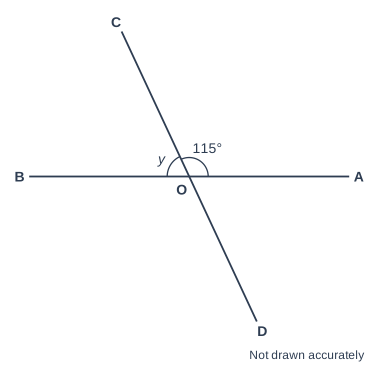
The diagram shows two straight lines that cross.
What is the size of angle \(y\), in degrees?
Model answer
Angle \(y\) and the \(115^\circ\) angle lie together on a straight line. \(y = 180 - 115 = 65\)
Answer: 65 °
Explanation
Angle y sits next to the 115 degree angle along one of the straight lines, so the two angles add up to 180 degrees: y = 65 degrees. The angle opposite the 115 degree angle would also be 115 degrees, but y is not opposite it. A common mistake is to think every angle at a crossing equals the one marked.
Mark scheme
1 mark
65 °
Accept 65 with or without the degree sign. Do not accept 115 (y is not opposite the 115° angle) or 245 (360 − 115).
Question 3
1 mark
Two angles together make a straight line. The smaller angle is two-thirds of the size of the larger angle.
What is the size of the smaller angle?
Model answer
Angles on a straight line add up to \(180^\circ\). If the larger angle is 3 parts, the smaller is 2 parts: 5 parts in all. \(180 \div 5 = 36\) \(2 \times 36 = 72\)
Answer: \(72^\circ\)
Explanation
Two-thirds means that for every 3 parts in the larger angle there are 2 parts in the smaller one, so the straight line is shared in 5 equal parts of 36 degrees. The angles are 72 and 108 degrees, which add up to 180. A common mistake is to find two-thirds of 180 degrees, but 180 is the total of both angles, not the larger angle.
Mark scheme
1 mark
\(72^\circ\)
Only \(72^\circ\). \(36^\circ\): finds one part, 180 ÷ 5, and forgets to multiply by 2. \(90^\circ\): shares 180° equally between the two angles. \(108^\circ\): gives the larger angle. \(120^\circ\): finds two-thirds of 180°.
Question 4
2 marks
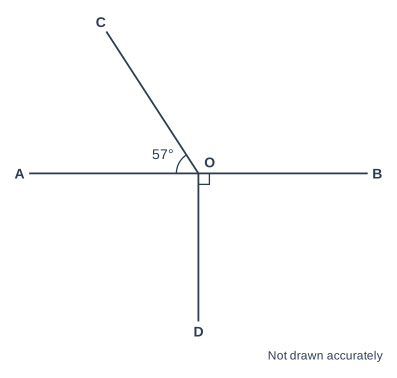
In the diagram, AB is a straight line with O on it. C is above AB and D is below it. Angle AOC is \(57^\circ\), and OD is at right angles to AB.
What are the sizes of angle COB and angle COD?
Model answer
AB is a straight line, so angle COB \(= 180 - 57 = 123^\circ\). OD is at right angles to AB, so angle AOD is a right angle. Angle COD = angle COA + angle AOD \(= 57 + 90 = 147^\circ\).
Angle COB sits next to the 57 degree angle on the straight line, so it is 180 - 57 = 123 degrees. OD is at right angles to the line, so angle AOD is 90 degrees, and angle COD is 57 + 90 = 147 degrees. Check: 123 + 90 + 147 = 360, a whole turn. A common mistake is to give the reflex angle COD, 213 degrees.
Mark scheme
1 mark
123 °
Accept 123 with or without the degree sign. Do not accept 57 (taking COB to equal AOC) or 303 (360 − 57).
1 mark
147 °
Accept 147 with or without the degree sign. Do not accept 213 (the reflex angle COD) or 33 (90 − 57).
Ready to try the rest? Tap your answers and see straight away how you did.
Ctrl + Enter to check
Study HelperHints first, answers after you try
Stuck on this one? Ask for a hint and I’ll point you in the right direction, without giving the answer away. Once you’ve checked your answer, I’ll show you how the marks are awarded.