Practise 25 questions on Angles and turns for 11+ Maths. Tap your answer and find out straight away if you are right, with the Study Helper on hand if you get stuck.
25 questions
1–2 marks each
Instant marking
No sign-up needed
20 questions, marked as you go
Sample questions with model answers
Here are 4 of the questions in this topic, each with a model answer, an explanation of why it earns the marks and the mark scheme.
Question 1
1 mark
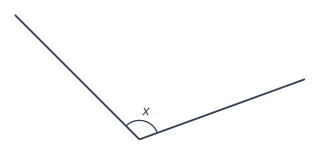
The diagram shows an angle marked \(x\).
What type of angle is \(x\)?
Model answer
Angle \(x\) is bigger than a right angle (\(90^\circ\)) but smaller than a straight line (\(180^\circ\)). So \(x\) is obtuse.
Answer: obtuse
Explanation
Compare the angle with a right angle, like the corner of a page. This angle opens wider than a right angle but not as far as a straight line, so it is obtuse. A common mistake is to call it reflex: a reflex angle is bigger than a straight line.
Mark scheme
1 mark
obtuse
Only obtuse. right angle: thinks the angle is close enough to 90° to be a right angle. reflex: thinks any angle bigger than a right angle is reflex. acute: mixes up acute and obtuse. straight angle: mixes up the names: calls an angle that opens wider than a right angle a straight angle, which is exactly 180°.
Question 2
1 mark
Which of these angles is the largest?
Model answer
Change each angle into degrees. Two-thirds of a whole turn: \(360 \div 3 \times 2 = 240^\circ\). Three-quarters of a straight angle: \(180 \div 4 \times 3 = 135^\circ\). Five-eighths of a whole turn: \(360 \div 8 \times 5 = 225^\circ\). The other two are \(230^\circ\) and a reflex angle of \(190^\circ\). The largest is \(240^\circ\), two-thirds of a whole turn.
Answer: two-thirds of a whole turn
Explanation
To compare angles written in different ways, change them all into degrees: a whole turn is 360 degrees and a straight angle is 180 degrees. Two-thirds of a turn is 240 degrees, which is more than 230 degrees, five-eighths of a turn (225 degrees), the reflex angle of 190 degrees and three-quarters of a straight angle (135 degrees). A common mistake is to treat a straight angle as a whole turn, which makes three-quarters of a straight angle look like 270 degrees.
Mark scheme
1 mark
two-thirds of a whole turn
Only two-thirds of a whole turn. \(230^\circ\): uses 180° for a whole turn, so takes two-thirds of a turn to be 120° and picks 230° as the largest. a reflex angle of \(190^\circ\): picks the one called reflex, thinking a reflex angle is always the largest. five-eighths of a whole turn: compares the fractions without working out the degrees, and thinks five-eighths is bigger than two-thirds because 5 and 8 are bigger than 2 and 3. three-quarters of a straight angle: mixes up a straight angle with a whole turn, so takes it to be 270°.
Question 3
1 mark
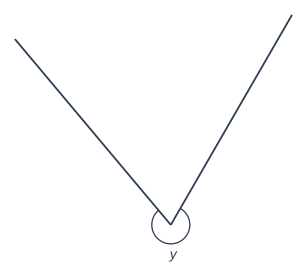
The diagram is drawn accurately.
Which is the best estimate of the size of the reflex angle \(y\)?
Model answer
The smaller angle between the arms is acute, a little less than a right angle: about \(70^\circ\). The reflex angle is the rest of the whole turn: \(360 - 70 = 290\).
Answer: \(290^\circ\)
Explanation
Estimate the smaller angle first, because it is easier to see: it is a bit less than a right angle, about 70 degrees. The reflex angle goes the rest of the way round, so it is about 360 - 70 = 290 degrees. A common mistake is to give the smaller angle instead of the reflex one.
Mark scheme
1 mark
\(290^\circ\)
Only \(290^\circ\). \(70^\circ\): estimates the smaller angle between the arms instead of the reflex angle. \(110^\circ\): takes the smaller angle from 180° instead of 360°. \(190^\circ\): thinks a reflex angle is only just more than a straight angle, so picks the estimate nearest to 180°. \(250^\circ\): adds the smaller angle to 180° instead of taking it from 360°: 180 + 70.
Question 4
1 mark
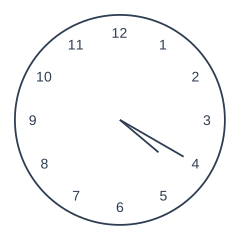
The diagram shows a clock at 20 minutes past 4.
Through how many degrees has the hour hand turned since 12 o'clock?
Model answer
The hour hand turns \(360 \div 12 = 30\) degrees every hour, so by 4 o'clock it has turned \(4 \times 30 = 120\) degrees. It turns half a degree every minute, so in 20 minutes it turns another \(20 \div 2 = 10\) degrees. \(120 + 10 = 130\)
Answer: \(130^\circ\)
Explanation
The hour hand moves 30 degrees each hour, so from 12 to 4 it turns 120 degrees. It does not jump from number to number: in the 20 minutes after 4 o'clock it moves a third of the way on towards the 5, another 10 degrees. So it has turned 130 degrees. A common mistake is to leave the hour hand on the 4 and answer 120 degrees.
Mark scheme
1 mark
\(130^\circ\)
Only \(130^\circ\). \(10^\circ\): gives only the part past the 4: 20 ÷ 2. \(120^\circ\): forgets that the hour hand has moved on past the 4: 4 × 30. \(140^\circ\): moves the hour hand 1° for every minute: 4 × 30 + 20. \(150^\circ\): puts the hour hand on the 5: 5 × 30.
Ready to try the rest? Tap your answers and see straight away how you did.
Ctrl + Enter to check
Study HelperHints first, answers after you try
Stuck on this one? Ask for a hint and I’ll point you in the right direction, without giving the answer away. Once you’ve checked your answer, I’ll show you how the marks are awarded.