
Level:
Correct: 0
Incorrect: 0
Marks: 0/0
Practice
Course:
Topics:
11+ Maths Smart practice A mixed round aimed at your weak spots
Unit 1
Number and place value
Unit 2
Calculation
Unit 3
Factors, multiples and primes
Unit 4
Fractions, decimals and percentages
Unit 5
Ratio and proportion
Unit 6
Algebra
Unit 7
Measures, time and money
Unit 8
Shape and angles
Unit 9
Area, perimeter and volume
Unit 10
Position and direction
Unit 11
Statistics
Unit 12
Probability
Unit 13
Problem solving
Avg
score:
–
Topics
done:
0/71

Listing outcomes and combinations

Practise 25 questions on Listing outcomes and combinations for 11+ Maths. Tap your answer and find out straight away if you are right, with the Study Helper on hand if you get stuck.

  • 25 questions
  • 1–2 marks each
  • Instant marking
  • No sign-up needed
20 questions, marked as you go

Sample questions with model answers

Here are 4 of the questions in this topic, each with a model answer, an explanation of why it earns the marks and the mark scheme.

Question 1

1 mark

The table shows the starters and puddings at a café. A meal is one starter and one pudding.

How many different meals can be chosen?
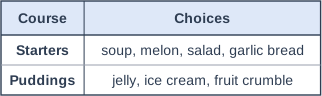
Table with columns "Course", "Choices". Course: Starters; Choices: soup, melon, salad, garlic bread | Course: Puddings; Choices: jelly, ice cream, fruit crumble.

Model answer

There are 4 starters and 3 puddings.
Each starter can go with each pudding: \(4 \times 3 = 12\) meals.

Answer: 12

Explanation

For each of the 4 starters there are 3 puddings to choose from, so there are \(4 \times 3 = 12\) meals. Listing them in order (soup with each pudding, then melon with each pudding, and so on) shows the same. A common mistake is to add 4 and 3.

Mark scheme
  1. 1 mark

    12

    Only 12. 4: gives one meal for each starter. 7: adds the 4 starters and the 3 puddings. 9: leaves out the last starter, garlic bread, when listing: 3 starters with 3 puddings. 24: counts each meal twice, as starter-and-pudding and as pudding-and-starter.
Question 2

1 mark

A café serves 3 soups: tomato, leek and pea. Each soup comes with one of 4 breads: white roll, brown roll, garlic bread or pitta. Tomato soup is never served with garlic bread.

How many different soup-and-bread lunches can be ordered?

Model answer

Without the rule: \(3 \times 4 = 12\) lunches.
Only one lunch is not allowed: tomato soup with garlic bread.
\(12 - 1 = 11\)

Answer: 11

Explanation

Work out all the pairs first, \(3 \times 4 = 12\), then take away the pairs the rule does not allow. Only one pair breaks the rule, so there are 11 lunches. A common mistake is to remove every tomato lunch or every garlic bread lunch.

Mark scheme
  1. 1 mark

    11

    Only 11. 7: adds 3 and 4. 8: takes away all 4 tomato soup lunches instead of just one. 9: takes away all 3 lunches with garlic bread instead of just one. 12: forgets the rule about tomato soup and garlic bread.

Question 3

1 mark

A quiz team has 5 children. The team chooses one child to be captain and a different child to be vice-captain.

In how many different ways can they do this?

Model answer

Any of the 5 children can be captain.
Then any of the other 4 can be vice-captain.
\(5 \times 4 = 20\)

Answer: 20

Explanation

There are 5 choices for captain, and for each one there are 4 choices left for vice-captain, which makes 20. Here order matters: Ana as captain with Ben as vice-captain is different from Ben as captain with Ana as vice-captain. A common mistake is to halve, as for handshakes.

Mark scheme
  1. 1 mark

    20

    Only 20. 4: counts only the choices for vice-captain. 9: adds 5 and 4 instead of multiplying. 10: treats captain and vice-captain as the same, like a pair of handshakes. 25: lets the same child be captain and vice-captain.

Question 4

1 mark

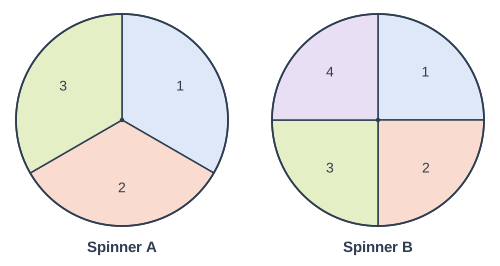
The diagram shows two fair spinners. Spinner A is numbered 1 to 3 and spinner B is numbered 1 to 4. Ollie spins both spinners and multiplies the two numbers.

How many different answers can he get?

Two circular spinners. Spinner A is divided into 3 equal sections, numbered 1, 2 and 3. Spinner B is divided into 4 equal sections, numbered 1, 2, 3 and 4.

Model answer

A = 1: 1, 2, 3, 4
A = 2: 2, 4, 6, 8
A = 3: 3, 6, 9, 12
Different answers: 1, 2, 3, 4, 6, 8, 9, 12. That is 8.

Answer: 8

Explanation

There are \(3 \times 4 = 12\) outcomes, but some products appear more than once: 2, 3, 4 and 6 each appear twice. Listing them in a table and crossing out repeats leaves 8 different answers. A common mistake is to give 12, the number of outcomes.

Mark scheme
  1. 1 mark

    8

    Accept 8 only. Do not accept 12 (all the outcomes, counting repeated answers) or 7 (one answer missed).

Ready to try the rest? Tap your answers and see straight away how you did.

Study Helper Hints first, answers after you try

Stuck on this one? Ask for a hint and I’ll point you in the right direction, without giving the answer away. Once you’ve checked your answer, I’ll show you how the marks are awarded.