
Level:
Correct: 0
Incorrect: 0
Marks: 0/0
Practice
Course:
Topics:
11+ Maths Smart practice A mixed round aimed at your weak spots
Unit 1
Number and place value
Unit 2
Calculation
Unit 3
Factors, multiples and primes
Unit 4
Fractions, decimals and percentages
Unit 5
Ratio and proportion
Unit 6
Algebra
Unit 7
Measures, time and money
Unit 8
Shape and angles
Unit 9
Area, perimeter and volume
Unit 10
Position and direction
Unit 11
Statistics
Unit 12
Probability
Unit 13
Problem solving
Avg
score:
–
Topics
done:
0/71

Comparing and ordering numbers

Practise 25 questions on Comparing and ordering numbers for 11+ Maths. Tap your answer and find out straight away if you are right, with the Study Helper on hand if you get stuck.

  • 25 questions
  • 1–3 marks each
  • Instant marking
  • No sign-up needed
20 questions, marked as you go

Sample questions with model answers

Here are 4 of the questions in this topic, each with a model answer, an explanation of why it earns the marks and the mark scheme.

Question 1

1 mark

The diagram shows part of a number line.

What number does arrow A point to?

A horizontal scale from 400 to 500, divided into 10 equal parts by long marks, each split into 5 small divisions by short marks. Every long mark is numbered (400, 410, 420, 430, 440, 450, 460, 470, 480, 490 and 500). An arrow labelled A points to a mark on the scale.

Model answer

The long marks go up in 10s. Each gap of 10 is split into 5 small steps, so each small step is \(10 \div 5 = 2\).
Arrow A is 3 small steps after 430: \(430 + 3 \times 2 = 436\).

Answer: 436

Explanation

Work out what each small step is worth before you count: here 10 is split into 5 steps, so each step is 2. Then count the steps from the nearest numbered mark. A common mistake is to count each small step as 1.

Mark scheme
  1. 1 mark

    436

    Only 436. 433: counts each small step as 1 instead of 2. 434: counts one step too few. 435: takes the arrow to be halfway between 430 and 440. 438: counts the marks instead of the gaps, so counts one step too many.
Question 2

1 mark

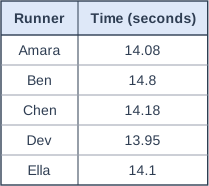
Five runners ran a race, and the table shows their times. The shortest time wins.

Who came second?

Table with columns "Runner", "Time (seconds)". Runner: Amara; Time (seconds): 14.08 | Runner: Ben; Time (seconds): 14.8 | Runner: Chen; Time (seconds): 14.18 | Runner: Dev; Time (seconds): 13.95 | Runner: Ella; Time (seconds): 14.1.

Model answer

Write each time with two decimal places: 14.08, 14.80, 14.18, 13.95, 14.10.
In order from shortest: 13.95 (Dev), 14.08 (Amara), 14.10 (Ella), 14.18 (Chen), 14.80 (Ben).
Amara came second.

Answer: Amara

Explanation

The shortest time wins, so put the times in order from smallest. Writing them all with two decimal places shows that 14.08 is less than 14.10. A common mistake is to think 14.1 is less than 14.08 because 1 is less than 8.

Mark scheme
  1. 1 mark

    Amara

    Only this answer: Amara. Chen: puts the times in order from largest to smallest. Ella: compares the digits after the decimal point as whole numbers (1, 8, 18), so thinks 14.1 is the next smallest after 13.95. Dev: gives the winner, who has the shortest time, not second place. Ben: gives the runner in the second row of the table instead of putting the times in order.

Question 3

1 mark

A digit is missing from the box.

\(56{,}\square 42 > 56{,}719\)

What is the smallest digit that can go in the box?

Model answer

The ten thousands and thousands are the same (56 thousand), so compare the hundreds.
If the digit is 6: 56,642 < 56,719. Too small.
If the digit is 7: 56,742 > 56,719, because the hundreds are equal and 4 tens is more than 1 ten.
So the smallest digit is 7.

Answer: 7

Explanation

Compare from the left. The thousands match, so the hundreds digit decides, unless the hundreds are equal, when the tens decide. With a 7 the hundreds match and 42 beats 19, so 7 works. A common mistake is to think the digit must be bigger than 7.

Mark scheme
  1. 1 mark

    7

    Only 7. 0: compares only the last two digits: 42 is more than 19, so thinks any digit works and gives the smallest digit, 0. 3: counts how many digits work (7, 8 and 9) instead of giving the smallest. 8: thinks the missing digit must be bigger than 7, forgetting that 42 is more than 19. 9: gives the largest digit that works, not the smallest.

Question 4

2 marks

Leah writes these numbers in descending order (largest first).

0.9   0.09   0.909   0.99   0.099

Which number does she write first, and which does she write last?

Model answer

With three decimal places: 0.900, 0.090, 0.909, 0.990, 0.099.
Descending: 0.990, 0.909, 0.900, 0.099, 0.090.
First: 0.99. Last: 0.09.

Answer: First number: 0.99
Last number: 0.09

Explanation

Descending means largest first. Write every number with three decimal places, then compare them as thousandths: 990, 909, 900, 099, 090. A common mistake is to think 0.909 is larger than 0.99 because it has more digits.

Mark scheme
  1. 1 mark

    0.99

    Only 0.99.

  2. 1 mark

    0.09

    Only 0.09.

Ready to try the rest? Tap your answers and see straight away how you did.

Study Helper Hints first, answers after you try

Stuck on this one? Ask for a hint and I’ll point you in the right direction, without giving the answer away. Once you’ve checked your answer, I’ll show you how the marks are awarded.