Practise 30 questions on Pie charts for 11+ Maths. Tap your answer and find out straight away if you are right, with the Study Helper on hand if you get stuck.
30 questions
1–2 marks each
Instant marking
No sign-up needed
20 questions, marked as you go
Sample questions with model answers
Here are 4 of the questions in this topic, each with a model answer, an explanation of why it earns the marks and the mark scheme.
Question 1
1 mark
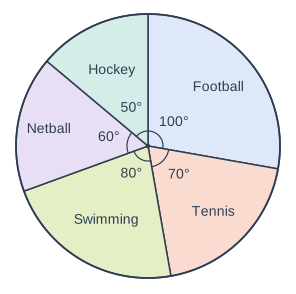
The pie chart shows the sports chosen by the children at a holiday club.
Which two sports together were chosen by exactly half of the children?
Model answer
Half of the chart is 180°. Football and swimming: \(100 + 80 = 180^\circ\)
Answer: Football and swimming
Explanation
Half of a pie chart is 180°, half of 360°. Add the angles of pairs of sectors to find the pair that makes exactly 180°. A common mistake is to judge by eye, when two sectors only look like half.
Mark scheme
1 mark
Football and swimming
Only this answer: Football and swimming. Football and tennis: judges by eye; these make 170°, not 180°. Swimming and tennis: judges by eye; these make 150°, not 180°. Football and netball: judges by eye; these make 160°, not 180°. Football and hockey: judges by eye: these two sectors sit next to each other and look like half, but they make 150°, not 180°.
Question 2
1 mark
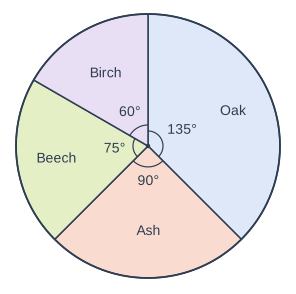
The pie chart shows the types of tree in a small wood.
What fraction of the trees are oak trees? Give your answer as a fraction in its simplest form.
Model answer
Oak: 135° out of 360°. \(\dfrac{135}{360} = \dfrac{27}{72} = \dfrac{3}{8}\) (divide by 5, then by 9)
Answer: \(\dfrac{3}{8}\)
Explanation
Write the angle over 360 and simplify. Another way: 45° is one eighth of 360°, and 135° is three lots of 45°, so it is three eighths. A common mistake is to write the angle over 100.
Mark scheme
1 mark
\(\dfrac{3}{8}\)
Do not accept 135/100 (the angle written over 100). An unsimplified fraction such as 135/360 or 27/72 is not in its simplest form.
Question 3
1 mark
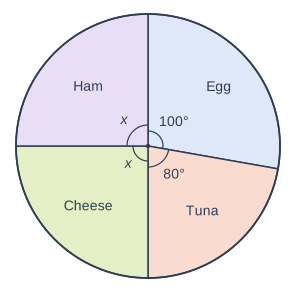
The pie chart shows the sandwiches sold at a picnic. The sectors for cheese and ham are the same size.
What is the angle x?
Model answer
Egg and tuna: \(100 + 80 = 180^\circ\) Left for cheese and ham: \(360 - 180 = 180^\circ\) They are equal: \(x = 180 \div 2 = 90^\circ\)
Answer: \(90^\circ\)
Explanation
Take the angles you know from 360° to find what is left for the two equal sectors, then halve it. A common mistake is to forget to share the 180° between the two sectors.
Mark scheme
1 mark
\(90^\circ\)
Only \(90^\circ\). \(45^\circ\): shares the 180° left between all four sectors instead of the two equal ones. \(130^\circ\): forgets to take away the tuna angle: \((360 - 100) \div 2\). \(140^\circ\): forgets to take away the egg angle: \((360 - 80) \div 2\). \(180^\circ\): finds the angle left for cheese and ham together and forgets to halve it.
Question 4
2 marks
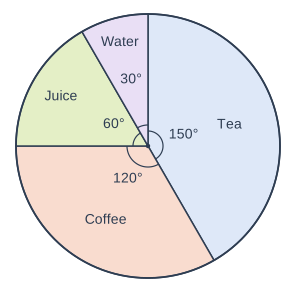
60 people at a café said which drink they ordered. The pie chart shows the results.
How many people ordered tea? How many people ordered juice or water?
Model answer
Each person: \(360 \div 60 = 6^\circ\) Tea: \(150 \div 6 = 25\) Juice and water: \(60 + 30 = 90^\circ\), and \(90 \div 6 = 15\)
Answer: Tea: 25 Juice or water: 15
Explanation
Find the angle for one person (6°), then divide each angle by it. For juice or water, add the two angles first, or add the two numbers of people. A common mistake is to use 10° for each person.
Mark scheme
1 mark
25
Do not accept 150 (the angle) or 15 (10° for each person).
1 mark
15
Do not accept 90 (the angle) or 10 (juice only).
Ready to try the rest? Tap your answers and see straight away how you did.
Ctrl + Enter to check
Study HelperHints first, answers after you try
Stuck on this one? Ask for a hint and I’ll point you in the right direction, without giving the answer away. Once you’ve checked your answer, I’ll show you how the marks are awarded.